The response to our Science Without Borders® Challenge has been overwhelming! We’ve been blown away by the sheer number of submissions that we received from aspiring young scientists and artists all over the world. Last week, we proudly unveiled the finalists in the 11-14 age group, and now, we’re ecstatic to announce the finalists in the 15-19 year-old category.
These young artists hail from all corners of the globe, including China, Indonesia, Korea, the Philippines, Poland, Singapore, Spain, the United Kingdom, and the United States. You will be amazed at their incredible artwork and how well they captured the essence of the theme, “The Sixth Extinction.” Students depicted a diverse range of endangered marine animals in their artwork including whales, fish, polar bears, sharks, sea otters, horseshoe crabs, seals, and crocodiles. We were amazed by these students’ boundless creativity, execution of the theme, and artistic abilities.
Without further ado, please meet our talented 15-19 year old finalists! These exceptional artists have not only showcased their incredible talents but also their unwavering passion for marine conservation.
"Anthropocene" by Keyun Xiao, Age 16, United States of America
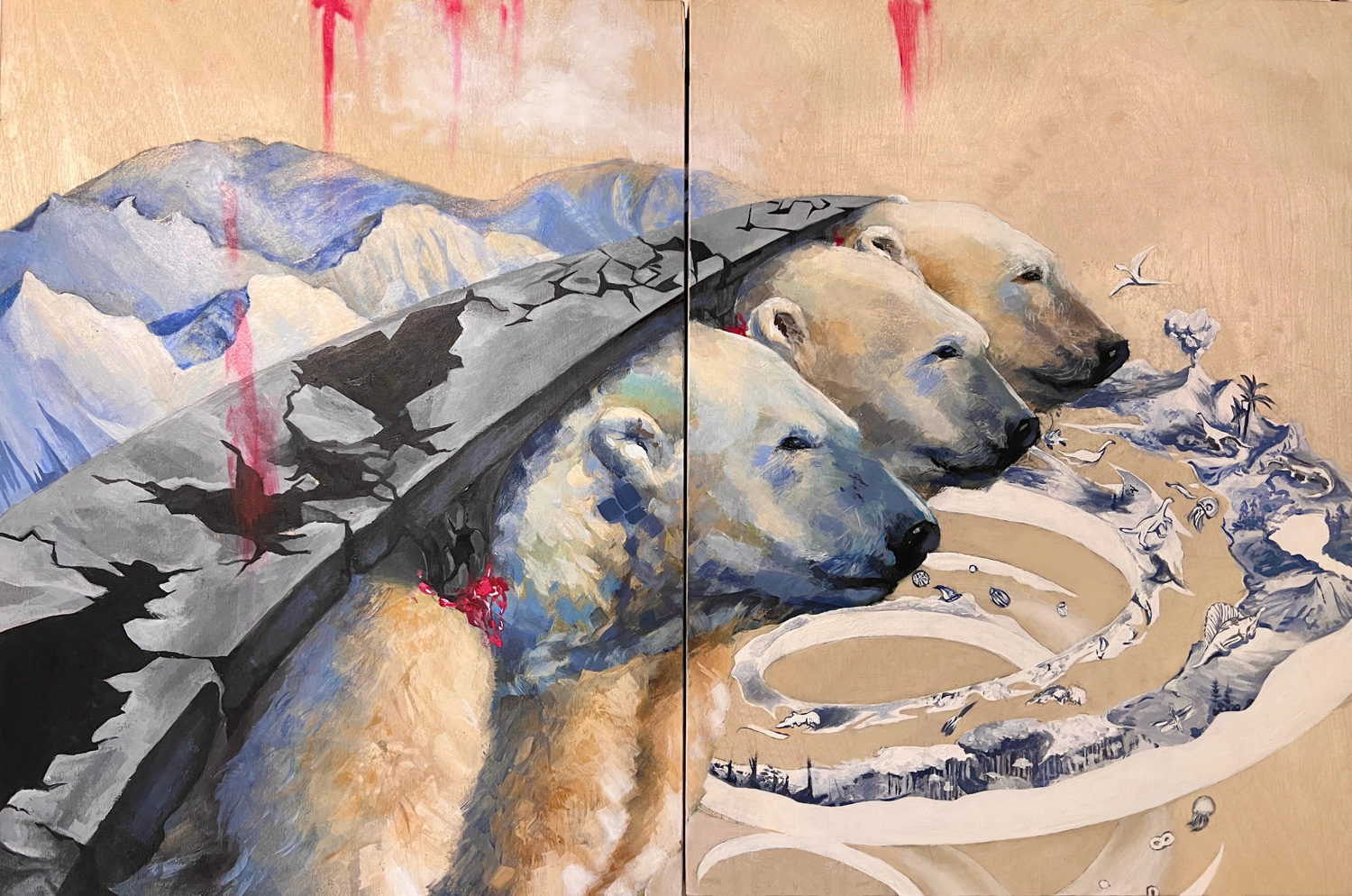
ARTIST’S STATEMENT: Jurassic, Carboniferous, and now the Anthropocene, the age of human destruction. The dualism of prioritizing ownership, the material accumulation, and exploitation in pursuit of unhindered development progress. We float above in the name of the reciprocal relationship between human and non-human beings. However, that is a dagger to our ecosystem, especially to endangered creatures such as Ursus maritimus. That dagger is climate warming, a distinct seed for the 6th mass extinction. Smoke from factories and modern roads is weaponized through petro-capitalist extraction, and there is no “outside” that organisms can escape to—they slither into their lungs and penetrates their cell membranes. All the organisms left behind spiral down in the history of evolution in monochrome, and Ursus maritimus should not be the next in the spiral. They are hurting, and every form and movement is another opportunity to push in the direction of justice, transforming the Anthropocene into a sanctuary.