
search-icon
6 Months in the South Pacific

One of our most ambitious research missions of the Global Reef Expedition to date will take us to the South Pacific, where we will spend more than six months exploring coral reefs throughout French Polynesia.  We arrived late Thursday night to Papeete (the capital of French Polynesia), on the island of Tahiti, and joined the crew on board the M/Y Golden Shadow.  After a press conference and live interviews, introductory speeches and ship tours for government officials and other partners, and an outstanding function on board the M/Y Golden Odyssey, we were geared up for our aerial reconnaissance of the islands we will visit and the arrival of the rest of the team.

Over the next 30 days, our focus will be the Society Islands, where we will explore 8 islands that vary in morphology from rugged, active volcanoes to low-lying, palm-fringed atolls. Our dedicated team of international and local scientists from French Polynesia, France, New Caledonia, Australia, Portugal, the Philippines, and the United States will continue to work together on four additional missions to Tuamotu, Gambier and the Austral Islands, to better understand the status of South Pacific coral reefs and their resilience to a host of impacts, both natural and man-made.  These assessments provide a unique opportunity to compare reef systems over a large geographical (2.5 million sq km of ocean) and latitudinal extent (more than 15°).  These archipelagos experience vastly differing environmental conditions and varying scales of human impact, and include remote locations that have never been surveyed, as well as more famous and better surveyed destinations for comparison.

Vibrant coral reefs are found throughout French Polynesia, providing one of the main sources of income in the South Pacific.
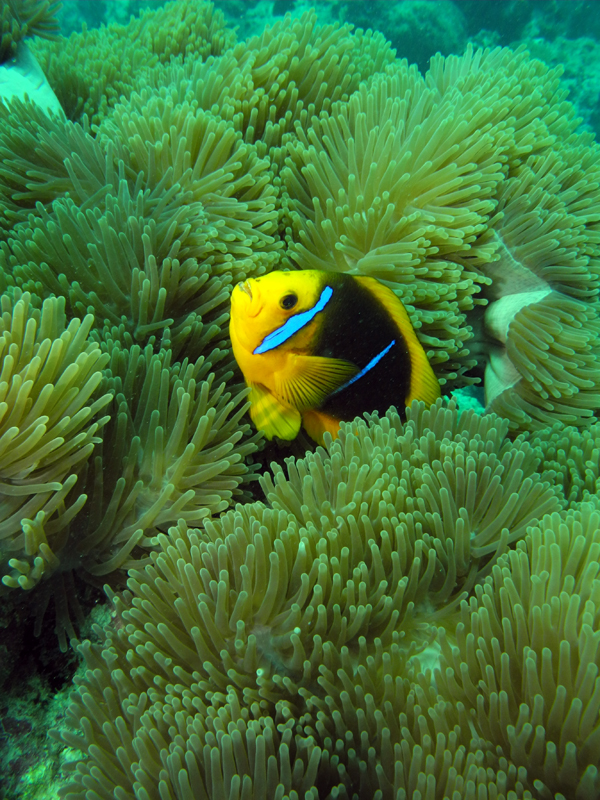
Vibrant coral reefs are found throughout French Polynesia, providing one of the main sources of income in the South Pacific. Here, an Orangefinned anemonefish (Amphiprion chrysopterus) living amongst a sea anemone.
Orangefinned anemonefish (Amphiprion chrysopterus) living amongst a sea anemone


These reefs of the South Pacific sustain tourism, support black pearl industries that employ over 5000 people and are worth more than $100 million annually, and provide livelihoods through reef fisheries.
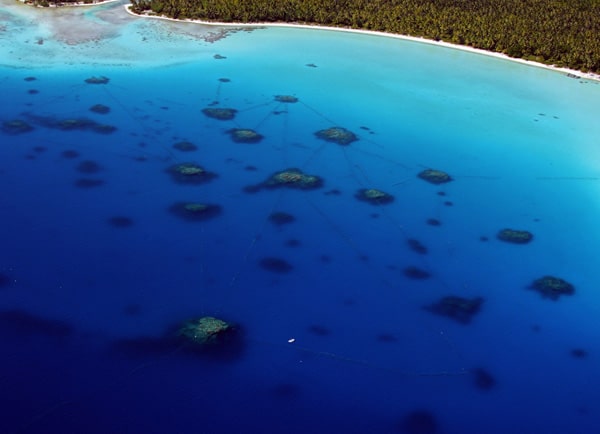
An aerial shot of a pearl farm in the lagoon at Scilly.  The ropes that have attached oysters extend between large coral bommies.
An aerial shot of a pearl farm in the lagoon at Scilly. The ropes that have attached oysters extend between large coral bommies.


Yet, over the last two decades a number of sites have experienced major degradation from cyclones, crown-of-thorns sea star infestations, and coral reef bleaching events, and in some locations there is a high prevalence of ciguatera fish poisoning.  Collectively, our research will help identify the healthiest, and most valuable coral reefs in the region, determine how well damaged reefs have recovered from past disturbances, and predict future changes to these systems.  Together with our high resolution benthic habitat maps, we will provide tools and information that can assist in the conservation of French Polynesia’s coral reefs.  Please join us in our South Pacific adventures!(Photos/Images by: Dr. Andy Bruckner)

To follow along and see more photos, please visit us on Facebook! You can also follow the expedition on our Global Reef Expedition page, where there is more information about our research and team members.
Related Posts

Introducing Our New Website: A Fresh Look for the Foundation’s Future

As we celebrate the Khaled bin Sultan Living Oceans Foundation’s 25th anniversary, we are proud to unveil our newly redesigned website—a modern home for our science, conservation work, and educational programs. This launch marks an important moment for the Foundation as we honor our long history and look toward the future of ocean conservation.

For more than two decades, the Foundation has worked tirelessly to improve the health of our living oceans. We have advanced ocean science, led one of the largest coral reef research missions in history, restored mangrove forests with local communities, created award-winning education programs, and shared the wonders of the ocean with people around the world. Our new website reflects the organization we are today—focused on conserving coral reefs, restoring mangrove forests, and improving ocean literacy—while still highlighting the legacy of work that brought us here.

The redesigned site…

Read More

Connecting People, Art, and Oceans: Championing Conservation at the 2025 IUCN Congress

The IUCN World Conservation Congress brings together thousands of leaders and decision-makers from governments, non-profit organizations, civil society, Indigenous groups, and the private sector to shape global conservation policy and action. This influential gathering serves as a platform to share knowledge, build partnerships, and advance initiatives that protect our planet’s biodiversity.

As a member of the International Union for Conservation of Nature (IUCN), the Khaled bin Sultan Living Oceans Foundation was honored to take part in the Congress, joining a global community of leaders, organizations, and changemakers committed to protecting nature and advancing sustainable futures.

Read More
Privacy Overview

This website uses cookies so that we can provide you with the best user experience possible. Cookie information is stored in your browser and performs functions such as recognising you when you return to our website and helping our team to understand which sections of the website you find most interesting and useful.  You can view our complete Privacy Policy here.

Strictly Necessary Cookies

Most of our cookies are used to improve website security and reduce spam. These cookies should be enabled at all times. They also enable us to save your preferences for cookie settings.

3rd Party Cookies

This website uses Google Analytics to collect anonymous information such as the number of visitors to the site, and the most popular pages. Keeping this cookie enabled helps us to improve our website.