
Most coral reefs thrive in shallow depth, where light can easily penetrate the water. Corals depend on the energy of sunlight, through the photosynthetic microscopic algae that reside within their tissue, to grow and survive.
For the first time in the Global Reef Expedition, we’ve been trying to assess the efficiency of these algae in converting light into energy. Parallel to the research on the diversity of different types of symbiotic algae associated with Pocillopora corals in French Polynesia, the science team is also focusing on the photosynthetic efficiency and “health” condition of these corals. Pocillopora corals are among the most common corals in French Polynesia and are responsible for a large portion of local coral cover on fore reef sites we have examined. Additionally, these corals are widely distributed throughout the Pacific, where future missions of the Global Reef Expedition will be heading in the near future. The broad ecological and geographic distribution of Pocillopora corals make them perfect for comparisons over these distant locations and in changing environments.
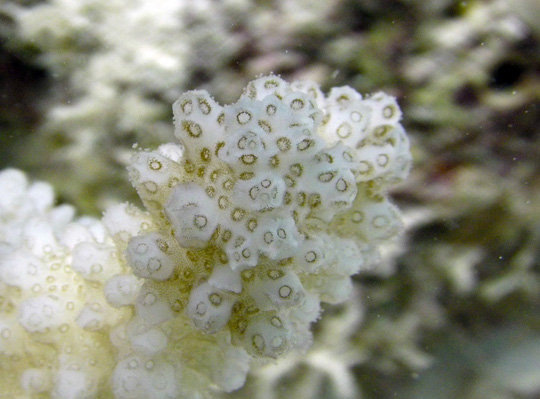
The photosynthetic efficiency of symbiotic algae can be used as a proxy of the condition of a coral. Low efficiencies can lead to the disruption of the bond between the coral host and algae inhabitant, leading to coral bleaching; this is also a sign of poor health of the coral. In unhealthy corals, whether caused by infectious diseases, predation or stress induced bleaching, the symbiont’s ability to photosynthesize declines, further compromising the coral.
In order to determine the photosynthetic efficiency of the coral’s symbionts, the science team is using special equipment that will allow them to estimate the overall photosynthetic efficiency, the Dive-PAM. This equipment measures fluorescence emitted by the pigmentation of the symbiotic algae.
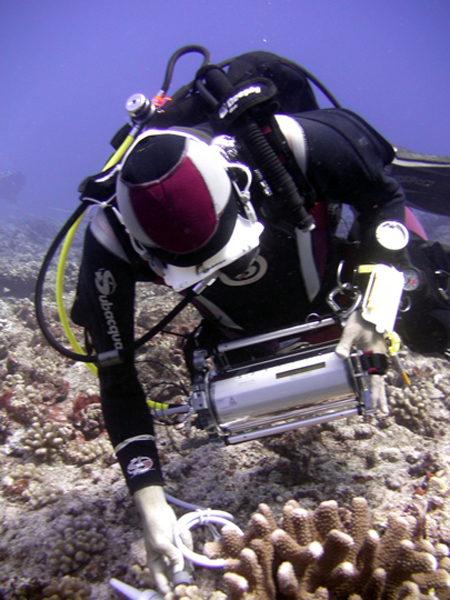
Sunlight reaching the algae is either used during photosynthesis or is emitted back in a wavelength unperceivable by human vision: fluorescent light. The PAM fluorometer, however, is able to “see” and quantify this energy emitted back by the algae within the coral. The Dive-PAM simply calculates the amount of energy used in photosynthesis by pulsing the coral with a known amount of energy, and then measuring the amount that is reflected back off the coral. The difference is a measure of photosynthetic efficiency. Click here to watch Joao’s video on testing the Dive-PAM prior to the mission in French Polynesia.
One of the biggest challenges of this work is the interference from daylight. To get an accurate reading requires night dives, which presents a whole new set of challenges. To achieve this, the team tags colonies during daylight, takes small tissue samples to determine the type and concentration of the symbiont, and then returns after sunset to measure the corals with the Dive-PAM. When the algae are acclimated to the dark and there is no interference of changing conditions of sunlight, multiple fluorescence readings are collected for each colony. Click here to check out a video of Joao’s night dive collecting coral samples.

Overall photosynthetic efficiency of several Pocillopora species is being measured within fore and back reef environments throughout each of the atolls we are visiting to determine how this varies among species, depths and environmental conditions. These data will be paired with data on the symbiont type, providing valuable information on the ability for these corals to survive in different environments and under changing climates.
(Photos by: 1,3 Dr. Andy Bruckner, 2 Candice Jwaszko, Videoes by: Joao Monteiro)
To follow along and see more photos, please visit us on Facebook! You can also follow the expedition on our Global Reef Expedition page, where there is more information about our research and team members.