
When I arrived on the Golden Shadow on October 1st as part of the Coral Reef Educator on the Water program, I knew I would be participating in a very unique opportunity – to be able to witness firsthand the coral reef research being done by the Khaled bin Sultan Living Oceans Foundation. As an educator coming from Alberta, Canada, I was excited and curious about what sort of issues would be specific to French Polynesia, and their similarity to coral reefs worldwide.
There was so much going on that first day, I simply tried to keep up and watch as much as I could. There were coral reef researchers setting up equipment I had never seen, discussions of coral diseases and water acidity, and assessments of dive sites for their survey potential. I soon found myself underwater with the research team. It was unlike any diving I’ve done to date. Unlike recreational scuba diving, these marine researchers are here with specific objectives, and each dive is meant to count.
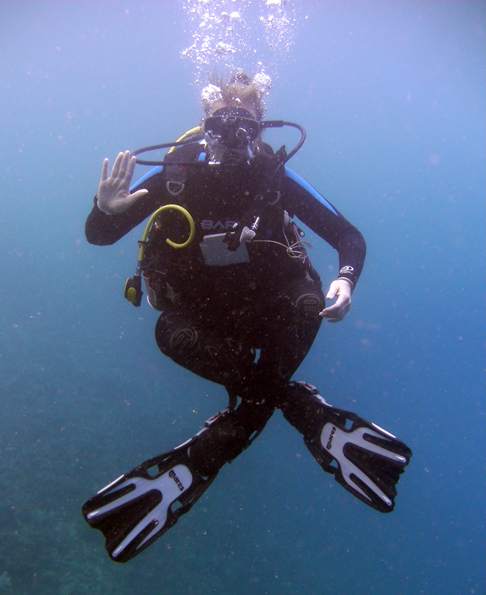
Today is my sixth day with the expedition, and already I feel I have learned a tremendous amount. I now realize there are issues pertaining to coral reefs that I never dreamed existed. I have met such passionate and intelligent coral reef researchers, who are literally working tirelessly to piece together the complex fabric of reef ecosystems to better assess their fragility and health. Chief scientist, Dr. Andrew Bruckner, has generously allowed me to dive with each different research team, so that I can see how each operates and learn about their work. Their research is fascinating and more complex than I could ever have imagined.
So far, I have accompanied coral reef researchers who are working on fish diversity surveys, photosynthetic productivity of the symbiotic algae living within the coral, as well as looking at pathogens and diseases affecting corals. Getting a small glimpse into their research is only scratching the surface. The one thing that continues to resonate in my mind is how incredibly hard these people are working to gather as much information as possible. Once the dives are done, and equipment unloaded, the ship becomes a busy hive of workers, each one processing samples, entering data, discussing what the day presented, and planning the next move. As the nitrogen and labor intensive diving wears on everyone’s bodies, they work into the night, each one stitching their corner of the fabric that will hopefully be woven together to provide a more comprehensive picture of coral reef health, threats, and overall status of the Society Islands.
Aboard the ship, the crew steadily prepares meals, navigates the vessel, and maintains the ship. How this vessel operates is astounding and impressive to say the least. Perhaps the person who resonates within my mind the most is Dr. Andy Bruckner. He coordinates and executes a plethora of activity and planning, and yet he does it with a smile and a very clear vision.
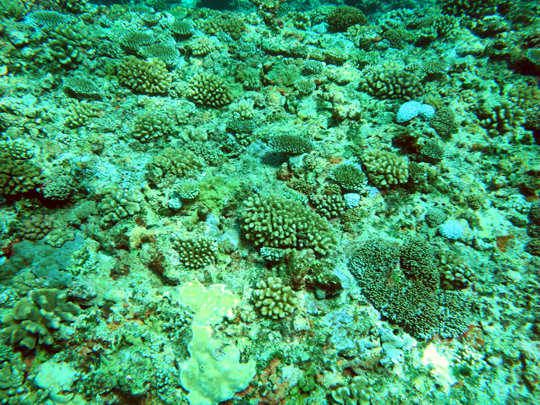
Today we dove off the south end of the Island of Raiatea to a depth of 50 feet for almost an hour. I accompanied Associate Professor Matti Kiupel as he searched for coral disease. The underwater scene provided mixed emotions. I saw some lovely fish and coral formations, but I also saw diseased and dead coral.
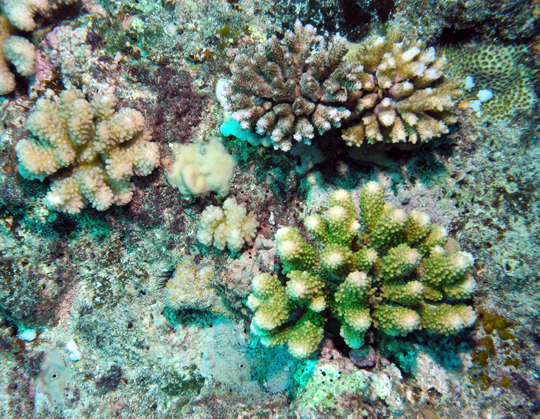
As I looked around at the busy coral reef researchers working against time, I wonder, would our next generations be able to see the beauty of this fragile ecosystem? I’m not sure of the answer. But back on the boat, with palm trees and beaches setting up a backdrop of paradise, observations and thoughts about the day’s dives were exchanged. I looked around at all the marine researchers and felt gratitude for the work they are doing, and perhaps more importantly, I felt hope.
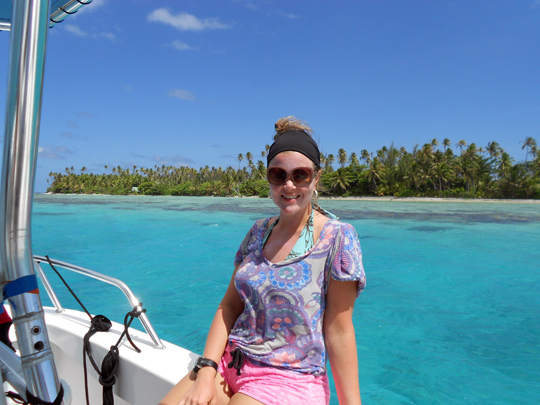
*The CREW (Coral Reef Educator on the Water) program is designed to give educators firsthand experience of life on board a working scientific vessel, a greater understanding of the importance of coral reefs, and inspiration to convey what they have learned to their students and members of their community. To learn more, go to www.livingoceansfoundation.org/CREW.
(Photos by: 1,4 Candice Jwaszko, 2-3 Dr. Andy Bruckner)
To follow along and see more photos, please visit us on Facebook! You can also follow the expedition on our Global Reef Expedition page, where there is more information about our research and team members.