
search-icon
Thriving Alien and Declining Local Invertebrates

The French Polynesian scientists participating on the Society Islands mission took the opportunity to quantify the abundance of a number of French Polynesia invertebrates… species that have, or may have, a commercial and food subsistence role in the near future. In particular, they investigated the abundance of a number of sea cucumbers species, giant clams (only Tridacna maxima is found everywhere in French Polynesia) and also the imported green snails, Turbo marmoratus and Trochus niloticus. Trochus snails were brought to Tahiti from Vanuatu nearly 50 years ago, and then transplanted to selected islands throughout French Polynesia.
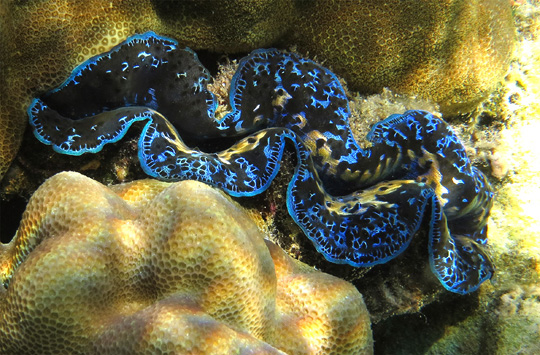
French Polynesia Invertebrates: The giant clam is prized for its flesh all over the Pacific Islands, but also for the aquarium market.

Local Populations of French Polynesia Invertebrates

Because populations of these two alien snail species have declined, fishing them has been banned.  An updated population assessment is necessary to decide if selected fishing grounds should be reopened. Conversely, the local giant clams are considered a delicacy for Polynesians, raw or cooked. It is consumed locally in every inhabited island, and therefore the fishing pressure can be high on these colorful bivalves. Finally, sea cucumbers are not locally consumed, but their high value on Asian markets has recently promoted their exploitation in the Society Islands, and in the Tuamotu Archipelago. The level of declared exports of dry and frozen sea cucumbers increased from 3 tons to 125 tons between 2008 and 2011. There are currently no regulations to control the level of catches, but the concerns over these French Polynesia invertebrates are growing in several islands.
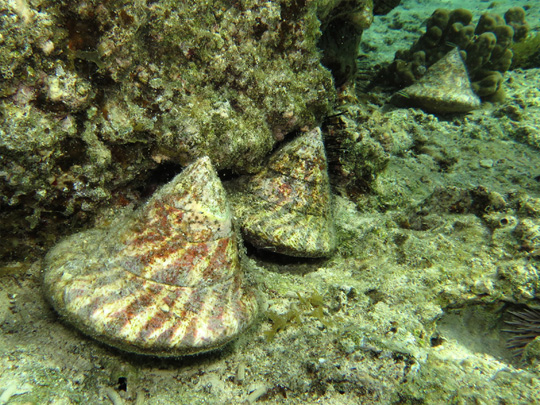
The trochus snail is found in abundance on a variety of high rugosity* habitats.


A variety of habitats and reef zones were sampled for French Polynesia invertebrates during the expedition: deep oceanic sand plain, forereef slopes, spur and grooves, crests, passes, lagoon floors and slopes, patch reefs, sheltered and exposed fringing reefs. The preliminary results show that the imported, protected species, are thriving in a number of habitats of the high islands where they have successfully become established. Giant clams juveniles are also abundant, but the lack of large individuals in many places show that they are harvested as soon as they reach the legal size for catch (currently 12 cm in French Polynesia). The status of the sea cucumber population is the most worrisome. While few deep (>25 m) places showed a level of density typical of unfished areas, most sites were depleted.  Sea cucumbers are important components of the ecosystem. They recycle the organic matter in the sediments, graze the substrates, and contribute to the health and functioning of the coral ecosystem. Furthermore, considering that several prized species reach their sexual maturity very late (up to 5 years-old), a depleted stock takes very long to recover.
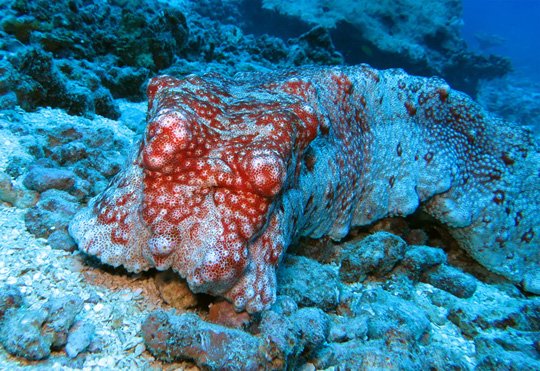
A large, but increasingly rare, sea cucumber found in deep sand plains.


The local fishery services (Direction des Ressources Marines) contributed to the Society Islands expedition with a dedicated scientific diver. (Read Joseph Campanozzi’s bio.) They will use the findings to regulate the catch of local French Polynesia invertebrates (especially sea cucumbers), and also to decide whether the fishery of the imported trochus and turbo snails should be re-opened. This sampling effort will continue in the Tuamotu and Gambier legs of the French Polynesia mission.

* rugosity-an indicator of the amount of available habitat available for colonization

(Photos by: 1-3 Serge Andréfouët)

To follow along and see more photos, please visit us on Facebook! You can also follow the expedition on our Global Reef Expedition page, where there is more information about our research and team members.
Related Posts

From Dialogue to Action: Ocean Foundations Gather in Stockholm

What can philanthropy accomplish when foundations working across ocean science, conservation, and sustainable development come together around a shared purpose?

That question was at the heart of the 6th UN Ocean Decade Foundations Dialogue, held September 7–9 in Stockholm, Sweden. The Khaled bin Sultan Living Oceans Foundation joined philanthropic organizations from around the world for three days of discussion, collaboration, and planning focused on accelerating progress during the second half of the UN Decade of Ocean Science for Sustainable Development.

Facilitated by UNESCO’s Intergovernmental Oceanographic Commission (IOC), the UN Ocean Decade Foundations Dialogue is a growing network of more than 30 philanthropic organizations committed to advancing ocean science, collaboration, and action. Since its creation within the framework of the Ocean Decade, the Dialogue has provided foundations with a space to exchange ideas, develop partnerships, and explore how philanthropy can help advance a healthy and resilient ocean.

Hosted by the Voice of the Ocean Foundation (VOTO), this year’s gathering began with From Depth to Action, an Opening Forum that brought nearly 100 leaders from the Swedish and international ocean community together at…

Read More

Meet IFAN: Helping Bring Navigate with Care to the Next Generation

If you’ve ever seen a lighthouse flashing from the shore or a brightly colored buoy bobbing in the water, you’ve seen Aids to Navigation at work.

Aids to Navigation, often called AtoNs, help mariners navigate safely. They can mark channels, warn of hazards, help vessels determine their position, and provide other information people need to make safe decisions on the water. Around the world, these systems help guide everything from small recreational boats to large commercial or container ships. 

But safe navigation isn’t only about protecting vessels and the people aboard them. The choices mariners make can also affect the animals and ecosystems beneath and around them.

That connection between maritime safety and ocean conservation is at the heart of this year’s Science Without Borders® Challenge—and of our partnership with this year’s theme sponsor, the International Foundation for Aids to Navigation (IFAN).

Read More

Privacy Overview

This website uses cookies so that we can provide you with the best user experience possible. Cookie information is stored in your browser and performs functions such as recognising you when you return to our website and helping our team to understand which sections of the website you find most interesting and useful.  You can view our complete Privacy Policy here.

Strictly Necessary Cookies

Most of our cookies are used to improve website security and reduce spam. These cookies should be enabled at all times. They also enable us to save your preferences for cookie settings.

3rd Party Cookies

This website uses Google Analytics to collect anonymous information such as the number of visitors to the site, and the most popular pages. Keeping this cookie enabled helps us to improve our website.