Focus for today:
Survey of coral at depth; distribution of coral species and growth forms with depth.
Target key stage:
Key Stage 4 – National Science Curriculum, Dual Award, Sc2, 5a: the distribution and relative abundance of organisms in habitats can be explained using ideas of interdependence, adaptation, competition and predation.
Key information:
The marine environment is notoriously difficult and potentially dangerous to work in. Factors such as temperature, rough seas, visibility and currents all limit the way we can work, but by far the greatest restriction is the depth we can work at. During this trip we have to limit our dives to a maximum of 30m depth to reduce the risk of decompression sickness, but we are very lucky to have a remotely operated vehicle (ROV) that can extend our working depth to at least 100m depth. The ROV is connected to a control console at the surface by an umbilical cable and moves by means of four thrusters. At the front it has two cameras that can be rotated by the operator, and three lights that are essential at depth when light levels get low. The ROV is not able to gather as much information as a diver, but it can stay down as long as we want and operates at depths that divers cannot reach without specialist equipment and considerable risk.
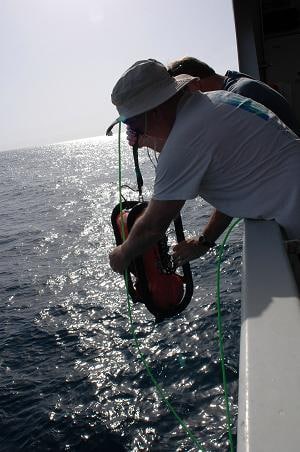
ROV Being Deployed to Survey Coral at Depth
During this expedition we are going to use the ROV to survey coral at depth. Using vertical transects we shall establish how much coral cover there is below 50m depth, what species are present, and at which depth they stop growing. We should also be able to record changes in the growth form of certain coral species in response to lower light levels at depth. This is necessary for coral as many species rely on algae in their tissues to obtain energy from the sun. These microscopic algae are called zooxanthellae. Just as many plants do, corals have to change their shape to gather more or less sunlight depending on how much light is available. In addition to variations in coral at depth, the fish population also changes at depth and there are species divers never see. We shall also use the ROV to document the fish species present.
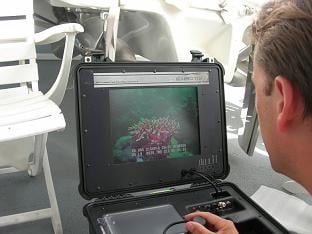
ROV Control Centre (note coral on screen)
Question for students/food for thought:
Why do you think light levels drop as you move into greater depths, and are there any other physical changes that may affect deep water communities of coral at depth?
How do you think a coral may change its growth form to adapt to lower light levels?
Can you think of ways in which plants encounter similar light availability problems in a forest, and how do they cope with them?
Additional information:
So far we have run two test dives on the ROV to make sure everything is working well. One problem we have is that the boat has to be at anchor to operate the ROV, and it can be very difficult to find suitable places to anchor in relatively shallow water and have the boat resting over deep water. Another problem is safely deploying the ROV without getting the umbilical cable tangled on coral outcrops. On our second practice this did happen and we spent about 30 minutes driving the ROV to release the trapped umbilical. Hopefully as our practice increases this will happen less.