Let me tell you about yesterday’s wonderful (seriously) sea snake encounter while it’s still fresh in my mind.
First of all, up here in the northern Great Barrier Reef we’re getting close to saltwater crocodile territory. They can grow to 25+ feet and have nasty dispositions, and unlike sharks who will come around and say Hi and then skedaddle, crocs are likely to come after you as soon as they realize you’re there. They’ve been known to frequent reefs very far from shore, even out to the shelf edge. The water has been murky the past several days while we’ve been on the mid-shelf reefs, and so we’ve been justifiably edgy diving in the low visibility. We do have all sorts of safety protocols in place – the small boat crews keep a lookout and have underwater alarms they’ll sound if anything untoward should occur. (No, there was no croc, I’m just setting the stage.)
Doing coral surveys I often have my face in the reef and I sometimes don’t see cool fish and turtles swimming by. The fish surveyors have to tell me afterwards about what was all around us. So, there’s been a little bit of a creepy, hair- sticking-up-on-the-back-of-my-neck, who’s-behind-me feeling on each dive. Nothing bad, I just keep looking over my shoulder every few minutes.
Anyway, there I was face into the corals, literally only one foot away, squinting to see the tiny polyps and scribbling like a dutiful scientist, when without any warning a huge olive sea snake sticks her face right into mine. She (she felt like a she) was maybe 6 inches from my mask. Obviously it scared me to death and I screamed like a little girl, backing away as fast as I could. I really freaked out during those few seconds, heart pounding and breathing through about half of my scuba tank.
This was not because it was a deadly sea snake with lethal neurotoxin in its venom (truly). I probably would have been just as scared if it had been a sea turtle. It was just instantly right there and I jumped out of my skin.
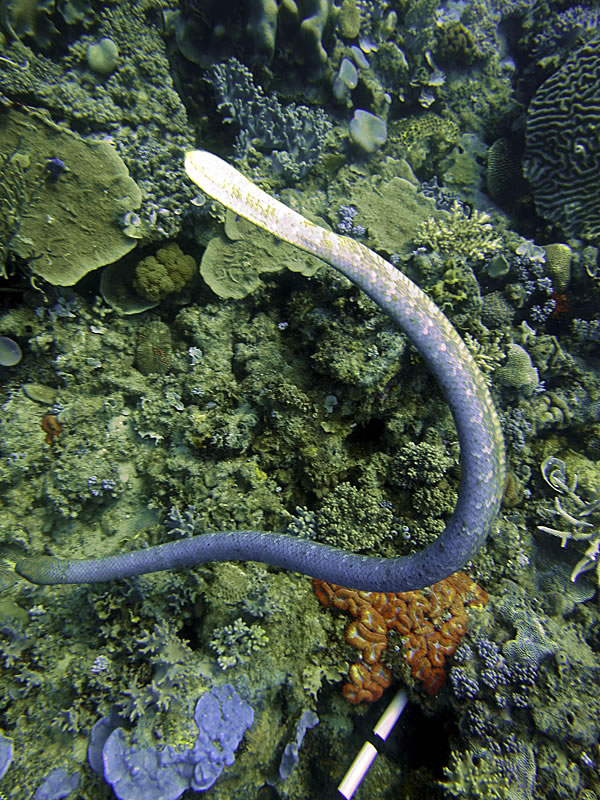
Olive sea snake interrupting my work to hunt in the crevices of the reef.
The thing was, after I backed away a bit and calmed down (felt like hours – it was probably 5 seconds), she just seemed to look at me and ask if it was OK if she shared the reef for a moment. “Are you going to hunt there?” “Would you mind if I took a turn?” “Thank you very much!” She was polite and friendly and I swear she had a disarming smile. She was about 4-5 feet long and as big around as my forearm. Her head was the size of a big pear and her scales were like my thumbnails. I’ve seen banded sea snakes, even this close (almost), but never so big as to see the striations on the scales.
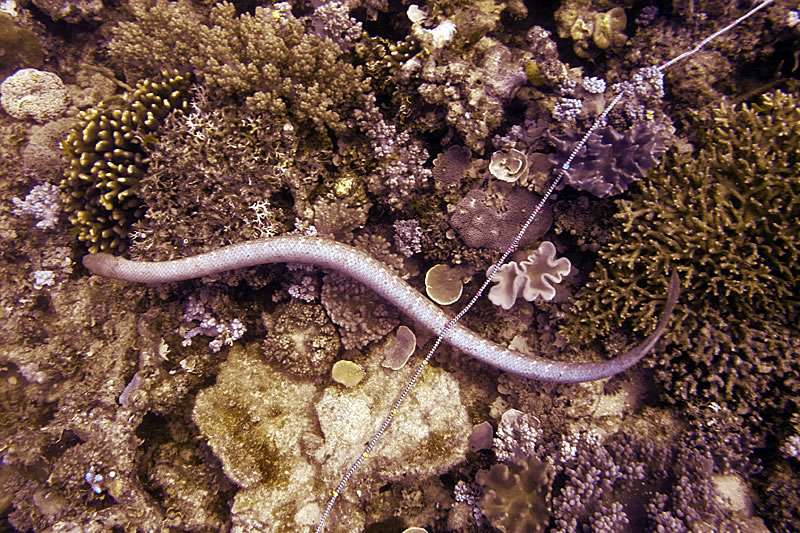
The snake seems unperturbed by ropes and meter sticks and other scientific gear.
She just came through slowly and methodically, sticking her face into nooks, hunting. She couldn’t have cared less that I was there and had ropes and sticks and all sorts of weird paraphernalia about me. She came right through the transect I was measuring and then swam over to where Kristin, my dive buddy, was working. I hurried over to give Kristin a heads up so that she wouldn’t be startled like I was, and then I went back to my transect.
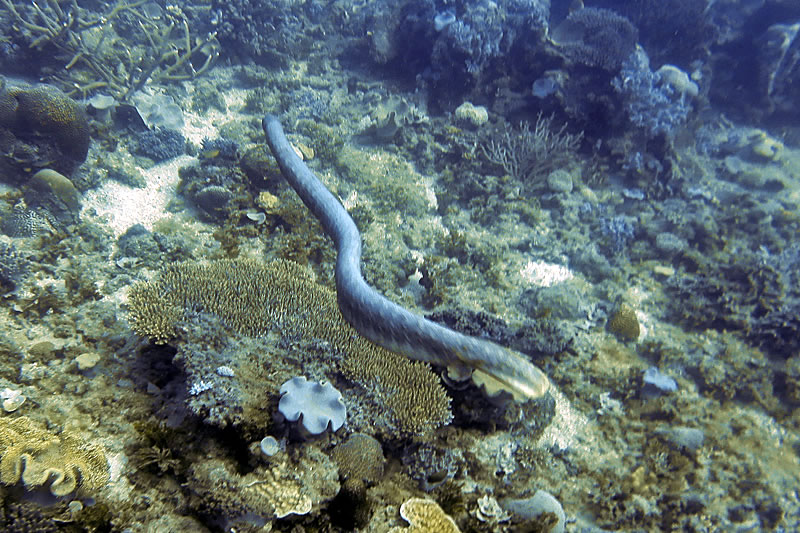
Olive sea snake swimming over to find fresh reef to hunt (and other scientists to visit).
The funniest part was that while I was finishing my transect, the snake came back and seemed to be mimicking me! I actually had no idea it came back, and had assumed it had moved on. But Kristin was watching and took some fun photos. Overall, it was an amazing and moving experience. Sea snakes are beautiful animals (just check out that crazy tail), and this one seemed gentle and kind. So remember, be nice to sea snakes – they are your friends.
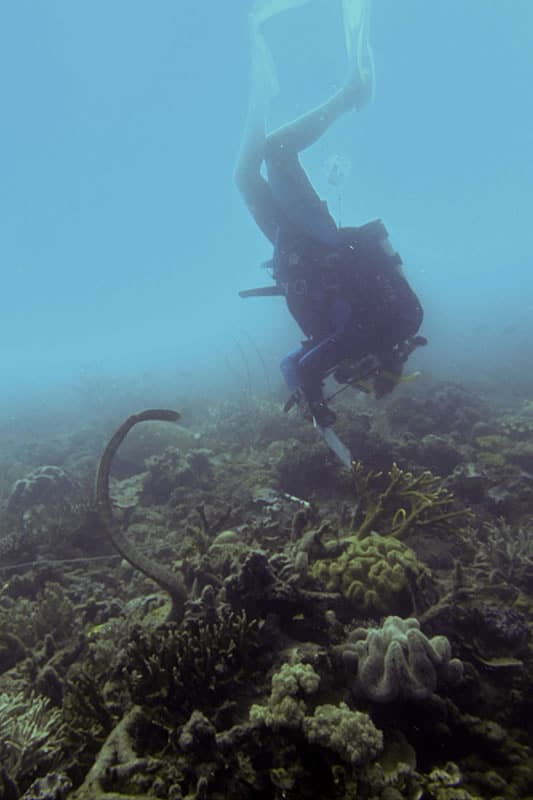
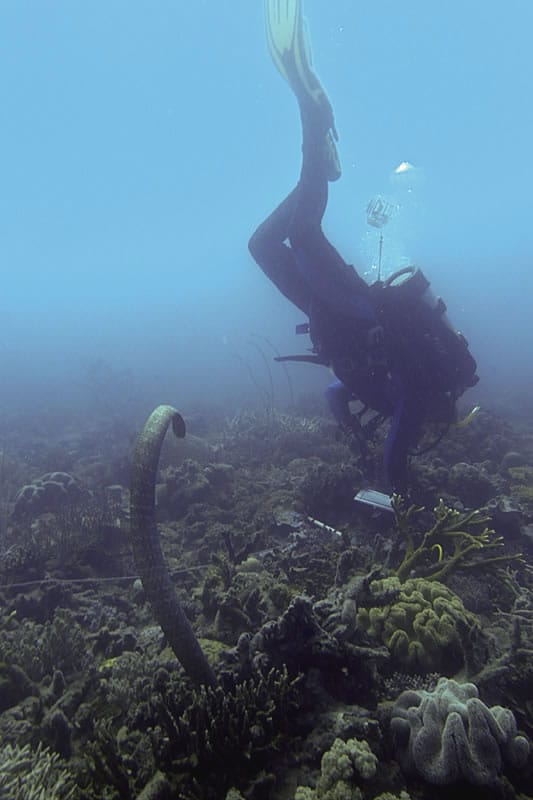
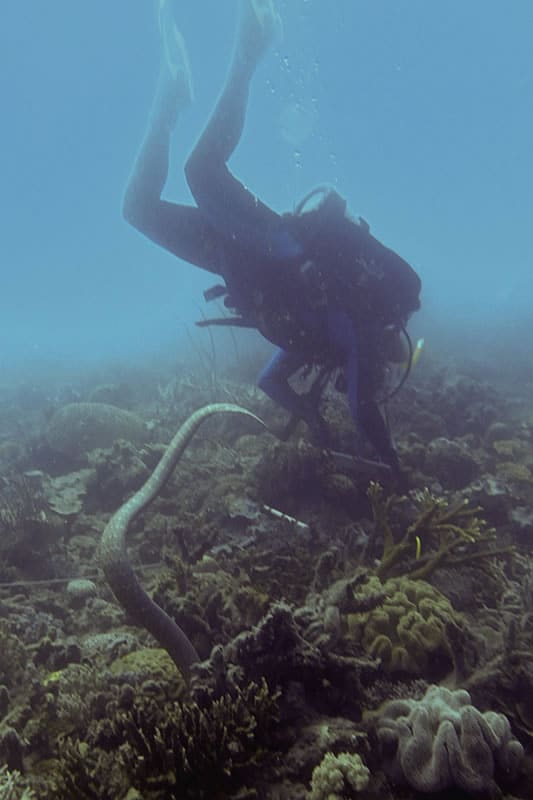
“Arch your back… now stretch… now bend your knees…”
(Click-thru on images for greater detail.)
Photos: 1,3 – Konrad Hughen; 2,4-6 – Kristin Stolberg