Sharks are a natural component of coral reef ecosystems, where they occupy the role of top-order predators. Reef sharks are important to the overall health of the coral reef assemblage, and their presence is generally an indication of a coral reef in good shape. Three different species dominate the shark assemblage on the Australian Great Barrier Reef. These are the grey reef shark, the whitetip reef shark and the blacktip reef shark. Grey reef sharks and whitetip reef sharks are primarily found on the exposed dropoffs and reef crests, while the blacktip reef sharks prefer the reef flats and lagoonal areas.
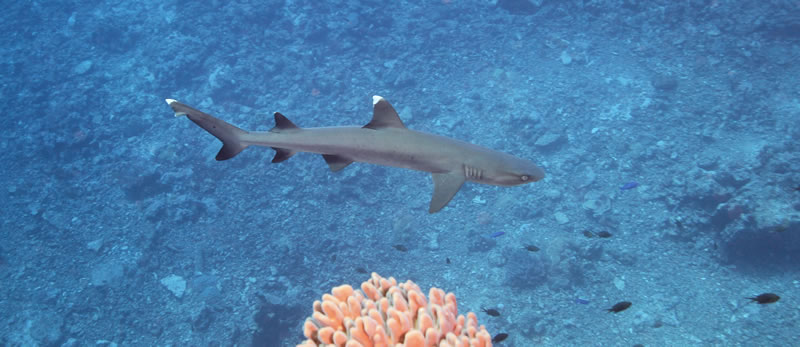
Whitetip reef shark cruising next to a reef dropoff. Whitetip reef sharks are the most benthic of the three reef sharks, and can be easily identified by their distinctive white fin markings.
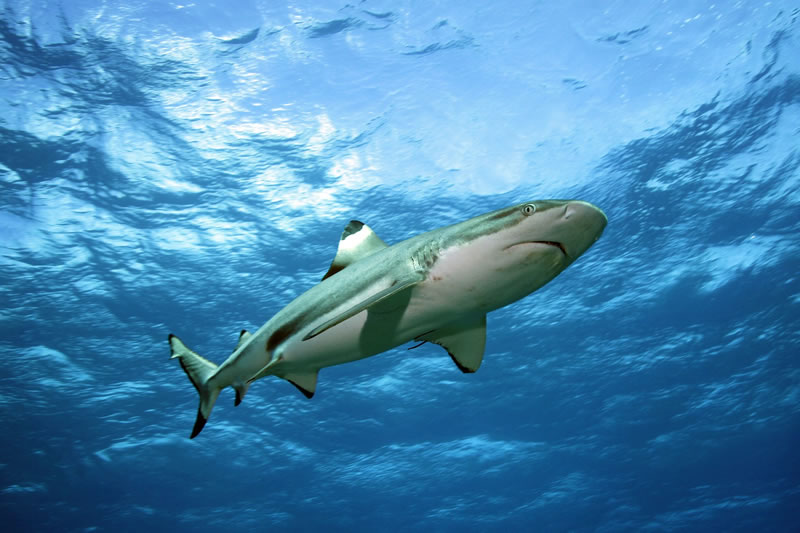
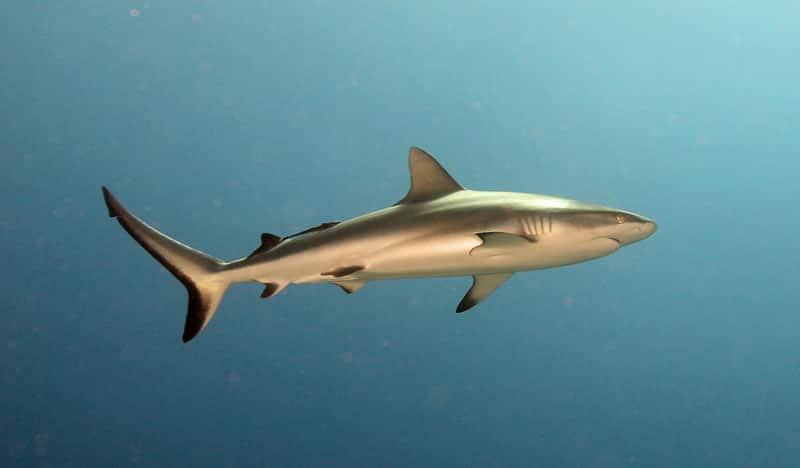
Left: Blacktip reef shark patrolling high in the water column. These sharks are commonly found at the top of the reef flat and are identified by the prominent black markings on each fin. / Right: Grey reef shark up close. These are the most abundant shark on the Great Barrier Reef, and are easily identified with their large black “V” on the back of the tail.
(Click-thru on images for greater detail.)
Previous research conducted on the Great Barrier Reef demonstrated that East Australian grey reef sharks and whitetip reef sharks mature late in life, and only produce a limited number of pups throughout their lifetime. Like any top predator, they are also much lower in abundance than their prey species. These factors make reef sharks highly vulnerable to exploitative activities such as fishing. Estimates of reef shark abundance conducted 10 years ago found significant declines in reef shark abundance in areas open to fishing, and in entry-but-no-take zones on the Great Barrier Reef. This research resulted in changes to fishing legislation in 2004, giving reef sharks a greater level of protection. As part of this trip the shark team is reassessing the abundance of reef sharks in the different management zones, to determine the effects which these changes are having.
Small silvertip shark buzzes in to investigate our divers. This species is much more streamlined than the whitetip reef shark, and has silver-white on all fins.
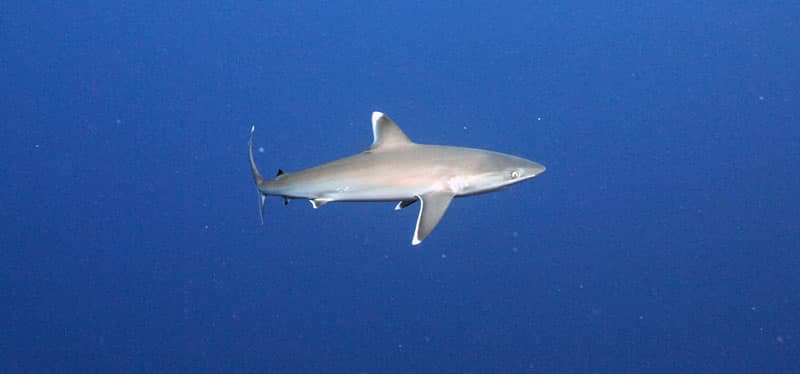
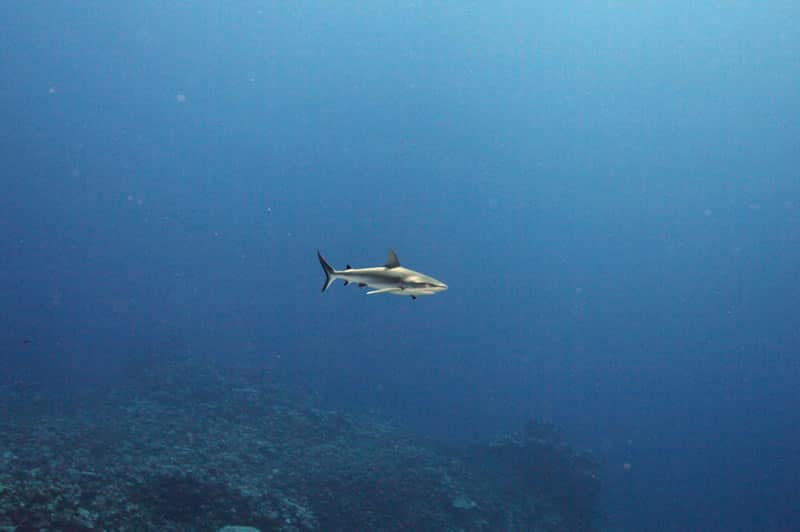
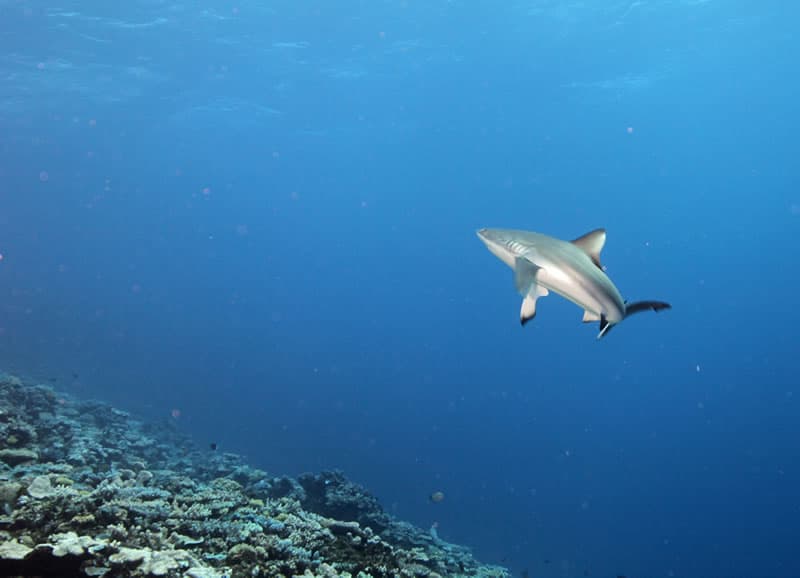
Left: Solitary grey reef shark swimming over deep bommies on the outer Great Barrier Reef. / Right: Grey reef shark mid-turn as a distant fish catches its attention.
(Click-thru on images for greater detail.)
To date the results from the Global Reef Expedition GBR trip have been very encouraging. We have surveyed over 45 km of reef front, during which we have counted over 230 sharks from six species. These include the three reef shark species mentioned above, along with tawny nurse sharks, silvertip sharks and scalloped hammerhead sharks. Tawny nurse sharks are usually found in the midshelf region, often resting under coral overhangs, while hammerheads and silvertip sharks are more pelagic, and are found on the fronts of the outer reefs. All species of shark have been quite inquisitive about our divers, and have often buzzed in close to check us out.
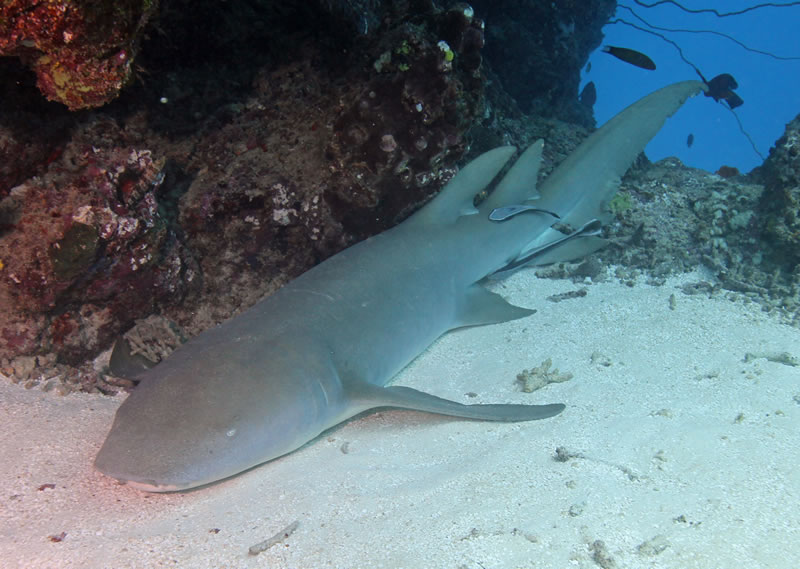
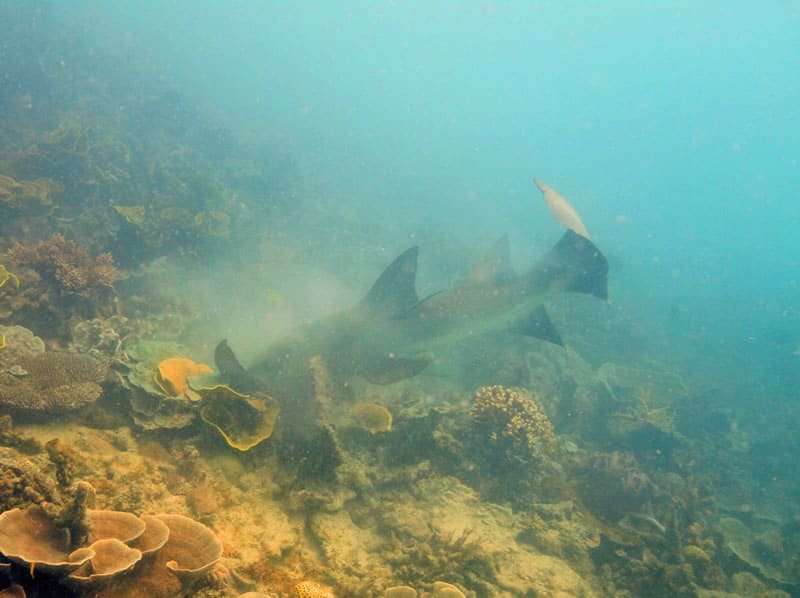
Left: Tawny nurse shark at rest under a coral overhang. This is the usual state which we observe this species during our abundance surveys. / Right: Tawny nurse shark attacking prey hiding in the substrate. We watched this shark for a number of minutes thrashing its head back and forth in a hole as clouds of debris are thrown up.
(Click-thru on images for greater detail.)
Excitingly, our abundance surveys indicate that the modified fishing regulations are having a positive effect on shark numbers. For example, grey reef shark numbers are much higher than 10 years ago, and encouragingly the biggest increases have been found in management zones previously found to be markedly depleted of sharks. Many of the animals we’ve seen are small-medium sized, indicating increased survival of younger age classes. We will be able to determine the exact size of each animal to ensure we’re not recounting individuals, and to allow us to calculate the size structure of the population as we’re using a stereo video system to obtain a visual record of each shark. Although we’re still surveying, these results have the team very pumped, and keen to examine more reefs in this last week!

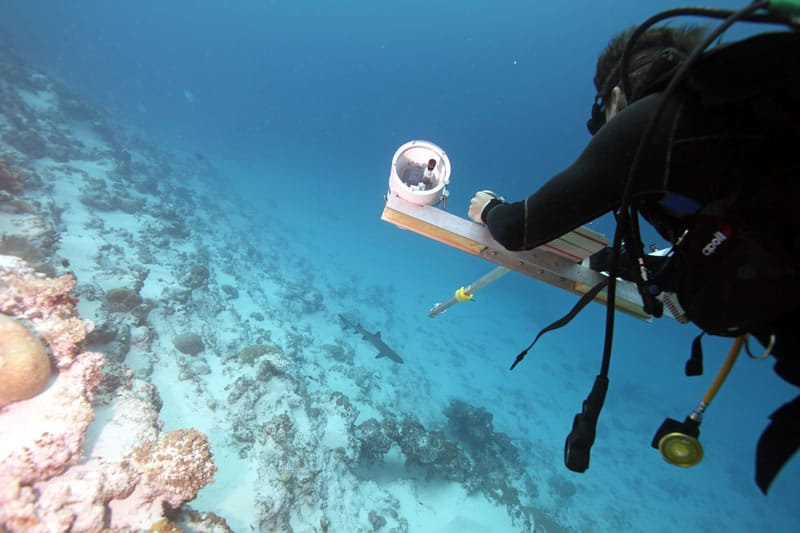
Left: Diver using the stereo video system to record sharks. / Right: Diver using the stereo video system to capture footage of a whitetip reef shark. Images from the two cameras are slightly offset, which allows synced frames to be analyzed using a computer system to measure distance away from the shark, and the size of the shark.
(Click-thru on images for greater detail.)
Photos by William Robbins, Wildlife Marine