search-icon
Tawny Nurse Sharks

Expedition Log: BIOT – Day 8

Within the first few days of surveying in Chagos, our fish and benthic surveyors have had multiple encounters with large and often pregnant tawny nurse sharks (Nebrius ferrugineus).
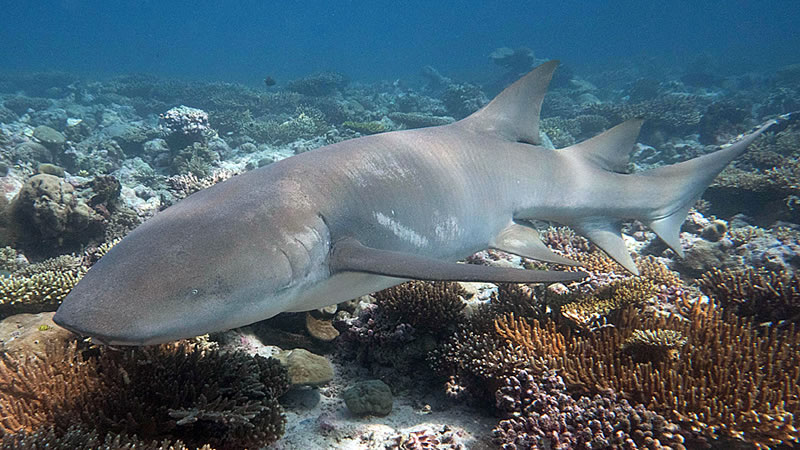
Tawny nurse sharks, Chagos
Tawny nurse shark swims over the reef.

With their cylindrical body and broad, flattened head, the tawny nurse shark is quite similar in appearance to the nurse shark (Ginglymostoma cirratum) but can be distinguished by its pointed-tipped dorsal fins and narrow, sickle-shaped pectoral fins.

Given that tawny nurse shark pups are born at an average length of between 40 to 60cm, it was clear that these large females were pregnant by their distinctively bulging stomach. The tawny nurse shark is the only member of the carpet shark family which exhibits intrauterine cannibalism; once the pups have used up their yolk supply, they will feed on other eggs within the uterus.
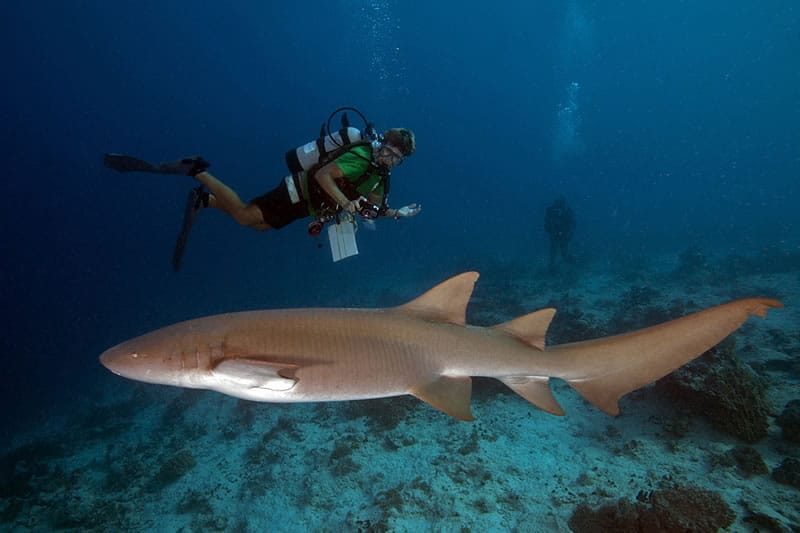
large pregnant female tawny nurse shark comes over to inspect us
Attracted by our presence on the reef, a large pregnant female comes over to inspect us.

On one occasion, a large individual swam directly over our fish transect line, giving us a good estimate of the length which was close to 3m (the maximum recorded length of the tawny nurse shark is 3.2 m). Several of these large females have been observed swimming with the company of a single juvenile (~1 m) which may be a year old pup of hers.
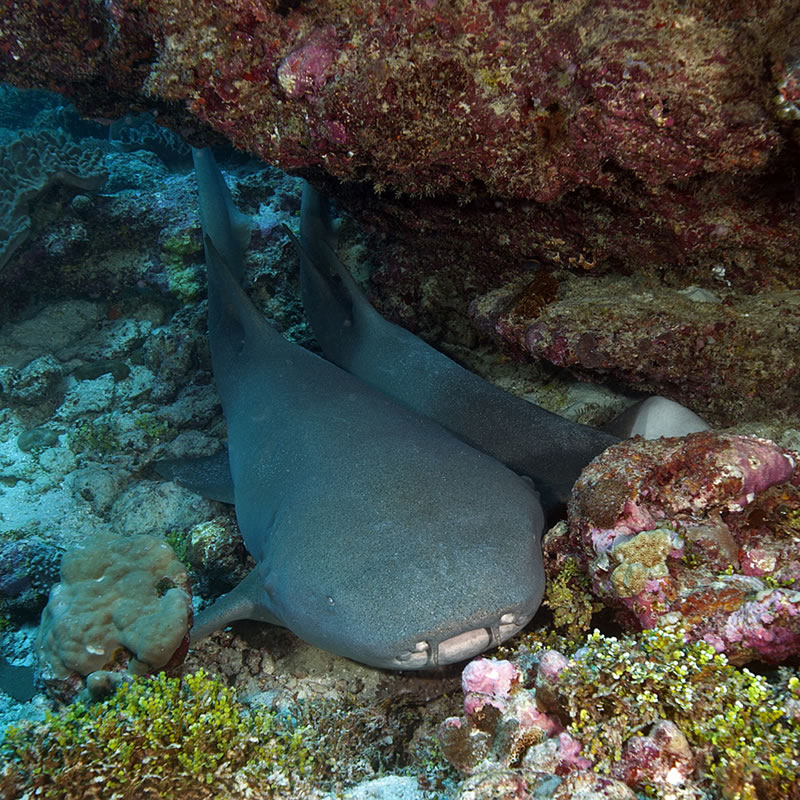
Larger female tawny nurse shark resting under a ledge with a single smaller juvenile
Larger female resting under a ledge with a single smaller juvenile.

Nocturnal by nature, the tawny nurse shark is most commonly seen during the day resting in caves or under ledges. By night, these predators use their large pharynx as a powerful suction pump to rapidly suck in reef organisms from inside holes and crevices. Food of this shark includes corals, crabs, lobsters and other crustaceans, sea urchins, and reef fish including surgeonfish (Acanthuridae), queenfish (Carangidae) and rabbitfish (Siganidas). These sharks may be one of the few animals that specializes in preying upon octopus, which may explain the timid nature of the abundant octopus we have observed hiding in reef crevices.
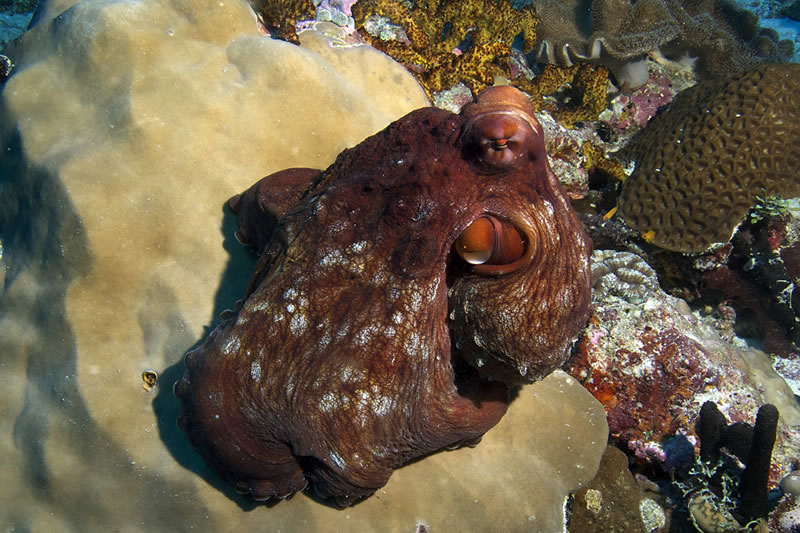
A Day Octopus (Octopus cyanea) emerges from den
A Day Octopus (Octopus cyanea) emerges from its den where it has been hiding.


Photos: 1 Stefan Andrews, 2-3 Ken Marks, 4 Alex Dempsey
Related Posts

Introducing Our New Website: A Fresh Look for the Foundation’s Future

As we celebrate the Khaled bin Sultan Living Oceans Foundation’s 25th anniversary, we are proud to unveil our newly redesigned website—a modern home for our science, conservation work, and educational programs. This launch marks an important moment for the Foundation as we honor our long history and look toward the future of ocean conservation.

For more than two decades, the Foundation has worked tirelessly to improve the health of our living oceans. We have advanced ocean science, led one of the largest coral reef research missions in history, restored mangrove forests with local communities, created award-winning education programs, and shared the wonders of the ocean with people around the world. Our new website reflects the organization we are today—focused on conserving coral reefs, restoring mangrove forests, and improving ocean literacy—while still highlighting the legacy of work that brought us here.

The redesigned site…

Read More

Connecting People, Art, and Oceans: Championing Conservation at the 2025 IUCN Congress

The IUCN World Conservation Congress brings together thousands of leaders and decision-makers from governments, non-profit organizations, civil society, Indigenous groups, and the private sector to shape global conservation policy and action. This influential gathering serves as a platform to share knowledge, build partnerships, and advance initiatives that protect our planet’s biodiversity.

As a member of the International Union for Conservation of Nature (IUCN), the Khaled bin Sultan Living Oceans Foundation was honored to take part in the Congress, joining a global community of leaders, organizations, and changemakers committed to protecting nature and advancing sustainable futures.

Read More
Privacy Overview

This website uses cookies so that we can provide you with the best user experience possible. Cookie information is stored in your browser and performs functions such as recognising you when you return to our website and helping our team to understand which sections of the website you find most interesting and useful.  You can view our complete Privacy Policy here.

Strictly Necessary Cookies

Most of our cookies are used to improve website security and reduce spam. These cookies should be enabled at all times. They also enable us to save your preferences for cookie settings.

3rd Party Cookies

This website uses Google Analytics to collect anonymous information such as the number of visitors to the site, and the most popular pages. Keeping this cookie enabled helps us to improve our website.