Expedition Log: BIOT – Day 9
Blacksaddled Groupers (Plectropomus laevis) are aggregating in Chagos. Groupers are usually solitary fish, except when it comes to spawning, when small groups or larger aggregations form to release large quantities of eggs and sperm into the surrounding water.
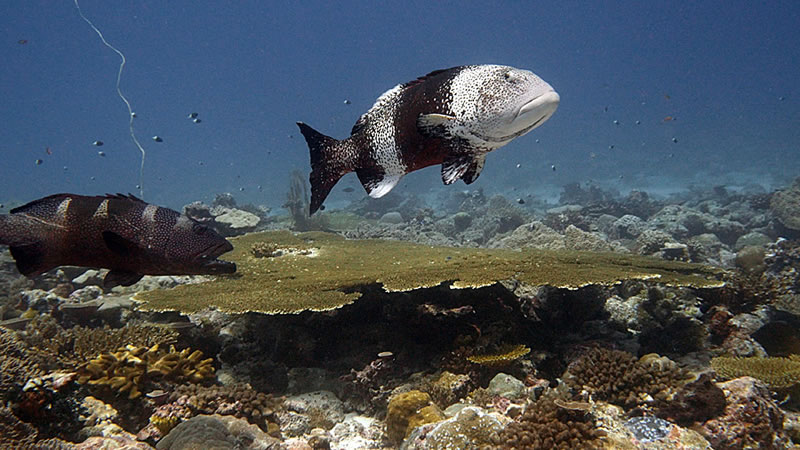
Blacksaddled Groupers aggregating on a submerged bank (15m depth) near the Three Brothers Island Group in Chagos.
Today we came across a large (100cm) male grouper with a group of eight or more smaller (40-80 cm) female groupers aggregating on a submerged reef flat north of the Three Brothers Islands Group in Chagos. The male blacksaddled grouper was displaying a distinctive mating coloration, a light colored head, and a dark midbody followed by a lighter speckled body bar. We observed the large male grouper displaying courtship behavior, shaking its head and body for short bursts and repeating this procedure to the harem of females; no release of milt or eggs was observed.
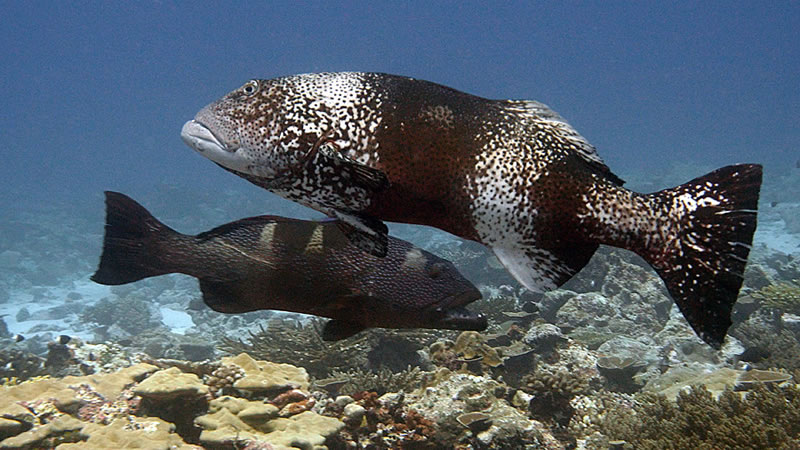
A male blacksaddled grouper (above) with a female (below).
All Blacksaddled Groupers begin life as a female, and then as the animal ages, based on internal or external triggers, it shifts sex to become a male, a system known as protogynous hermaphroditism. Dominance hierarchies are common in protogynous hermaphrodites where often the largest fish in a social group is a dominant and highly aggressive male.
It is still unknown when exactly, and what, triggers a sex change from female to functional males in P. laevis. Studies on the causes of sex change are limited to a number of small, territorial reef fishes -mainly wrasse (family Labridae) and damselfish (Pomacentridae) where removal of males from the population leads to sex change in the dominant (largest) female.
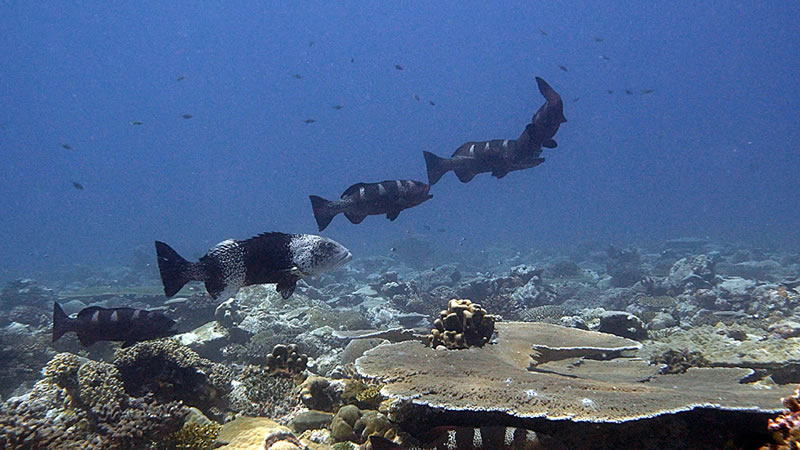
A male blacksaddled grouper hangs out with 4 female groupers on the reef.
We first saw these grouper aggregations around the new moon, which is consistent with observations of a similar species on the Great Barrier Reef. In that study, scientists found Coral Trout (Plectropomus leopardus) returned to spawn at the same place on the reef each year for 3 consecutive new moons and they chose to spawn at times when the tide and current were minimal (possibly to increase the chance of successful fertilization).
The blacksaddled grouper is exploited over much of its range through line fisheries and is an important part of the live reef food fish trade. Aggregating behavior in combination with their slow growth and late reproductive maturation has made groupers particularly vulnerable to overfishing in many parts of the world but also a prime candidate for management strategies that include seasonal and spatial fishery closures to protect groupers during their spawning aggregations.
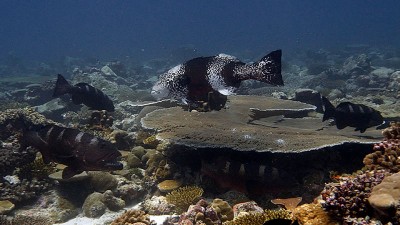
Grouper Aggregation around the coral reefs of Chagos.
Due to the isolation of the reefs visited during this mission, we had the unique opportunity to survey fish populations that may reflect natural abundances in the absence of fishing. As expected, we saw many Blacksaddled Grouper close the maximum size this grouper attains (100cm).
Reef fishery managers are concerned that fishing might affect the reproductive capacity of protogynous fish stocks more severely than separate sex (gonochoristic) stocks. In protogynous stocks, increased fishing mortality might reduce the relative abundance of males by reducing the abundance of the large males, and diminish the probability that eggs will be successfully fertilized.
In a long-term study published recently in Current Biology, Coral Trout (P. leopardus) in protected ‘green zones’ of the Great Barrier Reef Marine Park were found to be not only bigger and more abundant than those in fished ‘blue zones’. The results of this study are consistent with our observations from large groupers recoded in protected areas during our 2014 Global Reef Expedition (GRE) mission to the Great Barrier Reef (GBR) and also so far from the untouched reefs of Chagos.
Photos by Stefan Andrews.