Our team continued reef assessments along middle shelf locations to better characterize the spatial extent of the disturbance. We first examined two locations along the unnamed submerged reef platform described yesterday, first at the northwestern tip, about 6.4 km west of yesterday’s dive, followed by a site about 6.8 km south, at the extreme southern end of the platform. Our afternoon dive was on another submerged reef (Shi’b Murabba), located 7 km east of this platform and separated by a deep (500+ meter) channel.
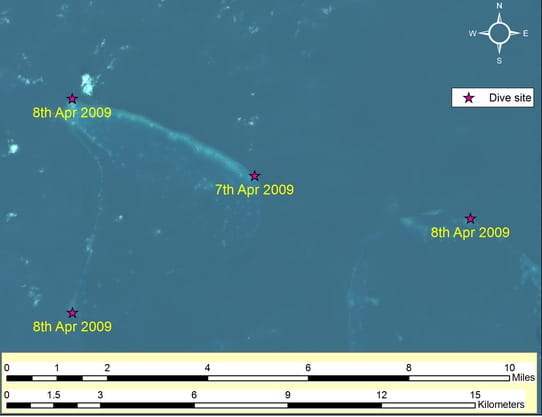
Farasan Bank Dives: 08 April 2009
The three locations had a similar structure – the shallow reef flat dropped abruptly to 8-10 meters, followed by a more gradual slope to 15-20 m and a second drop-off into deep water. The reef framework in deeper water consisted of small columnar Porites heads up to about 1 m in relief with fine sediments in depressions. In all three locations, evidence of a major recent (2-4 years) reef disturbance was apparent. Stony coral cover in deeper water was generally low (<5%) and there were few surviving large corals, with exception of scattered colonies of Diploastrea and Millepora. Many of the dead corals were carpeted with Xenia and other soft corals, but a lot of uncolonized reef substrate was apparent. There were also some important differences between the sites.
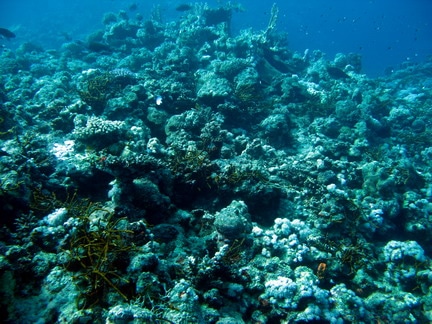
A typical deep reef.
At the first location, there was a moderate cover of corals in shallow water at the edge of the drop off, mostly small (10-25 cm) colonies of Pocillopora. However, there was one pinnacle that came within 4 m of the surface with 60-70% living coral cover with healthy acroporids, Pocillopora, Porites and Millepora on the top, and large plating and massive corals (mostly Echinopora, Hydnophora, Echinophyllia, Lobophyllia and Turbinaria) on vertical surfaces.
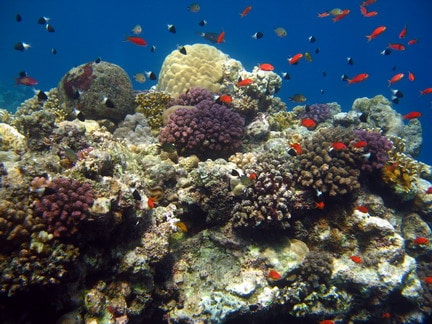
Reef crest at site 1.
The shallow reef slope (2-10m depth) at the second location was dominated by massive heads of Porites, some that were 5-6 m in diameter, with many other medium and large sized colonies of plating, massive and branching corals (Leptoria, Platygyra, Hydnophora, Goniastrea, Echinopora, Diploastrea, Stylophora, Seriatopora, etc.) and small (10-30 cm) colonies of Acropora and Pocillopora. At the edge of the drop off dense thickets of acroporids and other branching corals, many vibrantly colored purple, red, blue and green. On the gently sloping fore reef (10-15 m depth), coral cover was lower, but there was an abundance of small branching and massive corals along with isolated larger colonies of Goniopora, table and branching acroporids and other taxa, although most of the underlying Porites framework was dead.
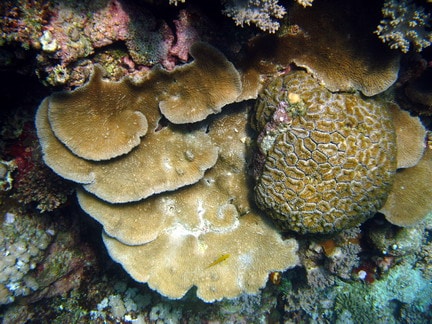
Plating Hydnophora and Lobophyllia.
At the third site, the gently sloping fore reef (8-15m depth) also had low cover, but there were many young colonies (especially branching corals) and we found several larger table acroporids and dense patches of branching fire coral (Millepora).
Interestingly, all three sites also exhibited incredible rates of settlement, with 100-200 recruits and juvenile (<3 cm) corals per square meter. Interestingly, the smallest corals (visible only with the NightSea flashlight) were much more abundant at the first two sites, while the third site had many more juveniles.
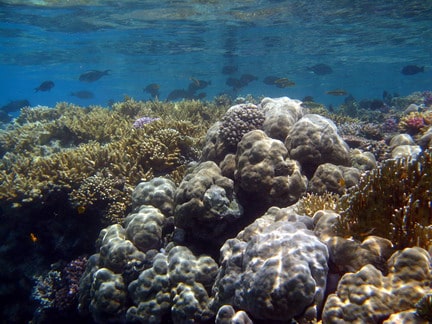
Shallow Reef with Porites and Acropora.
Our surveys suggest that these reefs are unusually resilient, and they are likely to spring back within the next 4-5 years.
Besides the unusually high levels of recruitment, reef substrates have very little macroalgae. Herbivorous urchins (Diadema) were fairly common. These sites also had large schools of herbivorous surgeonfish, and many of the largest parrotfish we have seen thus far. Environmental conditions are also ideal. Besides an absence of major human stressors that are apparent at many nearshore sites, there are many channels and inlets perforating the reefs, strong currents and tidal flushing, all of which may help moderate temperature extremes.
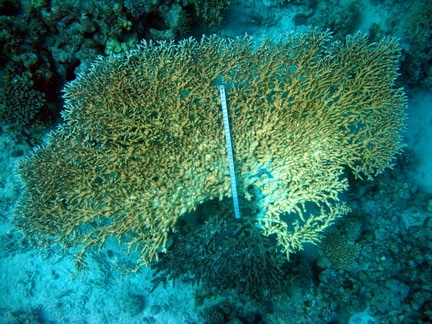
Several meter table Acropora at 45 feet.
At this point it is still difficult to conclude whether the mortality event was due to a severe bleaching event or an outbreak of crown of thorns sea stars, there are several intriguing and somewhat confounding pieces of evidence. Tomorrow, I’ll talk in detail about some of these features.