search-icon
Feathery Fossils

Expedition Log: Maldives – Day 15

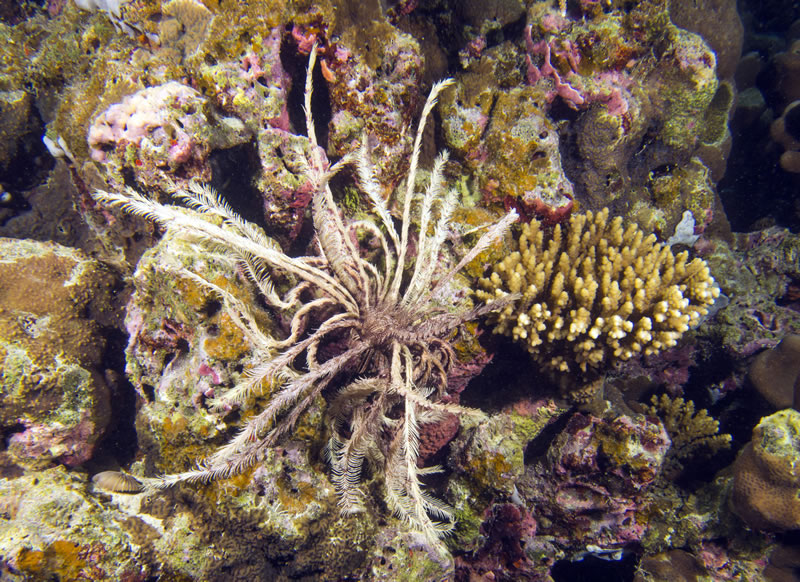
Often misidentified as a brittle star, yet plant-like in appearance, with long, flexible and highly contorted feathery arms, crinoids are the most ancient class of spiny skinned animals in the Phylum Echinodermata. Dating back to the Paleozoic period, long before sea urchins, sand dollars, sea cucumbers and even the crown of thorns starfish, these echinoderms are the only representatives that have a mouth oriented away from the bottom and are attached to the bottom, at least as a juvenile.
Crinoids
A crinoid.

As a young animal, their bodies have an attached stalk, a central crown, and 5-200 jointed arms that radiate off the periphery of the crown. The stalk persists in the sea lilies, but in the other group of crinoids, the feather stars, it breaks off, and the animals become stalk-less and lead a mobile life-style.

On many of our dives especially in areas of high currents and during the night we often see dozens of sea lilies perched on the tops of sponges, sea fans and corals. Along their colorful arms are rows of feather-like pinnules, each with a narrow channel (the ambulacral groove) lined by tube feet. The arms are intertwined, forming a basket that is extended into the water column to capture plankton. As the plankton is carried past the basket, it becomes trapped in mucus; the tube feet transfer the food to the amulacral groove, and hair-like cilia that line the groove carry the plankton to the mouth through this elaborate conveyer system.

While some reefs may contain hundreds of crinoids, it’s much less common to see one crawling along the bottom. During a recent dive I found a small crinoid slowly crawling along the reef substrate. It used its arms in a coordinated fashion to slowly lift its body and move forward, inch by inch.

crinoid video


Photos by Andrew Bruckner

Related Posts

From Mangrove Mud to Meaningful Work: Desta’s J.A.M.I.N. Journey

Some students I remember for their grades, their quick answers, or a moment that made the whole class laugh. Others I remember for the way they stepped into the mangroves.

Desta was the kind of student who thrived outdoors. While some students hesitated at the edge of the mud, he walked right in. And when he inevitably got stuck — because everyone does — he didn’t get frustrated. He laughed. Covered in mud, holding mangrove propagules in his hands, he embraced the experience fully.

Even then, it was clear that he was connecting with the environment in a way that went beyond the lesson plan…

Read More

From Students to Stewards: A Full-Circle Moment for J.A.M.I.N.

There are certain faces you never forget.

Over the years, hundreds of students have stepped into mangrove forests with us through the Jamaica Awareness of Mangroves in Nature (J.A.M.I.N.) program. I may not always remember every name, but I remember the expressions — the hesitation before stepping into thick mud, the laughter when someone loses a shoe, the look of surprise when they catch that unmistakable sulfur smell rising from the mangrove soil…

Read More
Privacy Overview

This website uses cookies so that we can provide you with the best user experience possible. Cookie information is stored in your browser and performs functions such as recognising you when you return to our website and helping our team to understand which sections of the website you find most interesting and useful.  You can view our complete Privacy Policy here.

Strictly Necessary Cookies

Most of our cookies are used to improve website security and reduce spam. These cookies should be enabled at all times. They also enable us to save your preferences for cookie settings.

3rd Party Cookies

This website uses Google Analytics to collect anonymous information such as the number of visitors to the site, and the most popular pages. Keeping this cookie enabled helps us to improve our website.