A new program for high-school students helps scientists study mangrove disease
Scientists are looking to students across the Caribbean for their help studying the health of mangrove forests. This week, Dr. Ryann Rossi, a post-doctoral scholar at the Louisiana Universities Marine Consortium (LUMCON), launched the Mangrove Detectives Project with help from the Khaled bin Sultan Living Oceans Foundation and Friends of the Environment. Mangrove Detectives is a new citizen-science project that teaches students valuable laboratory and field skills while they document mangrove disease and insect communities in their local mangrove forest. The project provides teachers, non-profit organizations, and environmental educators with free lesson plans, field kits, and laboratory materials to help their students study threats to their local mangrove forest and become part of an international community of Mangrove Detectives.
Mangrove forests are critical ecosystems, buffering the coast from large storms, providing nursery habitat for fish, and filtering runoff to keep coastal waters clean. They also sequester vast amounts of carbon and help protect the coast from erosion. But mangrove forests are one of the most threatened tropical ecosystems on Earth. In the past 50 years, over 50% of the world’s mangrove forests have been lost. Much of this loss has been from clearing mangrove forests for coastal development, wood, coal, or fish farms, but recently, mangrove die-offs have played an increasing role. Die-offs of large sections of mangrove forests can occur when there is a change in the environment (such as decreased water flow or increased salinity), or when less studied stressors such as disease and herbivory are present. Mangrove Detectives aims to document these threats to mangroves and see how they are distributed across mangrove forests in the Caribbean.
“I am really excited to launch this program to better document these stressors and to include students in
hands on , research-based activities,” says Dr. Rossi. “My hope is that this program introduces students to new skills and sparks their interest in pursuing a STEM career.”
Dr. Rossi created the Mangrove Detectives project to help collect data for her research into the factors that contribute to die-offs in mangrove forests—including disease and herbivory. She launched the program with the help of Amy Heemsoth, Director of Education at the Living Oceans Foundation, who wrote lesson plans for teachers and field and laboratory exercises for students. For the past three years, high-school students participating in the Living Ocean Foundation’s Mangrove Education and Restoration programs in Jamaica and The Bahamas have helped Dr. Rossi document signs of mangrove disease. Now, with the launch of the Mangrove Detectives project, the research program is expanding to study insect communities and reach students across the Gulf of Mexico and the Caribbean
Rookery Bay National Estuarine Research Reserve and Fairchild Tropical Botanical Gardens in Florida will be the first to bring the Mangrove Detectives project to students participating in their education programs. But the search is on to find more Mangrove Detectives. Teachers and organizations that are interested in participating in this unique citizen-science project can learn more and sign up to receive free lesson plans and materials at mangrovedetectives.org.
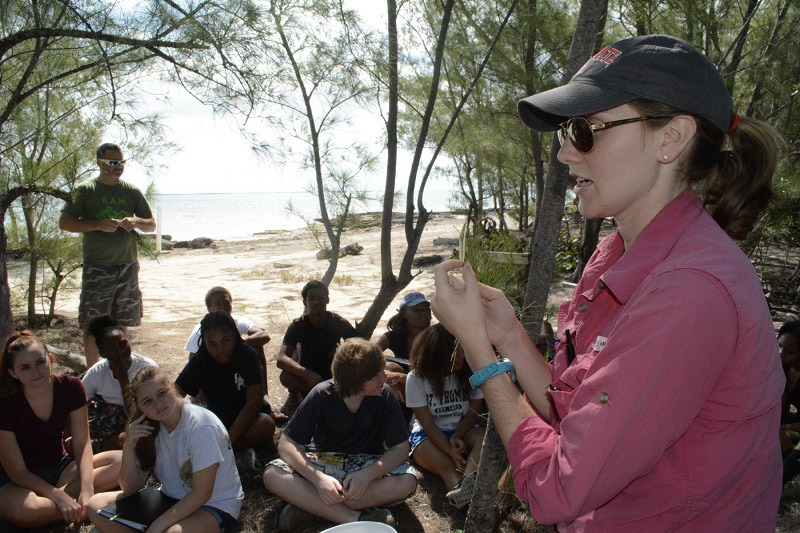
Image Caption: Dr. Ryann Rossi teaches students in The Bahamas how to look for signs of mangrove disease.