This month, we released our Fiji final report, titled Global Reef Expedition Final Report: Lau Province, Fiji. It reveals that despite vibrant coral communities, Fiji’s reefs show signs of trouble.
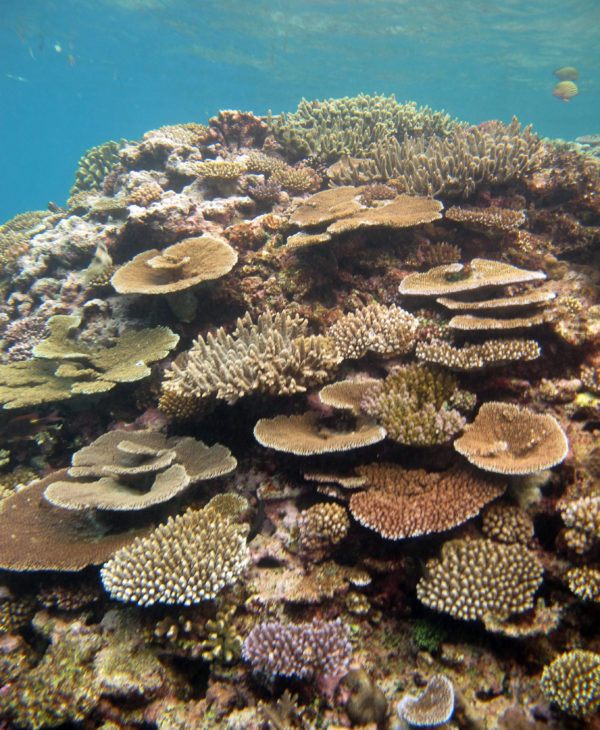
The report is the result of extensive scientific surveys we conducted, along with local partners including the Ministry of Fisheries, the Pacific Blue Foundation, the Lau Provincial Council, and members of the Fiji Locally Managed Marine Area (FLMMA) Network, in 2013.
Global Reef Expedition
The research was part of our Global Reef Expedition, a 5-year research mission to assess the health and resiliency of coral reefs around the world. In Fiji, the joint science team spent three weeks diving, three-times a day, taking notes and measurements of the reef. They took note of which species of fish they saw, how many of them there were, and what size they were. They recorded what the seafloor was made of, noting sand, rocks, or coral. They made notes on the species of corals they saw, how healthy they were, and how many there were. They recorded other living creatures like octopus, sea cucumbers, and clams. In short, the research team conducted the first detailed scientific assessments of Lau’s coral reefs.
The research also included making detailed maps of the shallow water marine habitats in the region. In addition, the Expedition visited many schools and villages to share information about the health of the reefs and to encourage villages to create environmental committees to help manage their marine resources.
Surprising Results
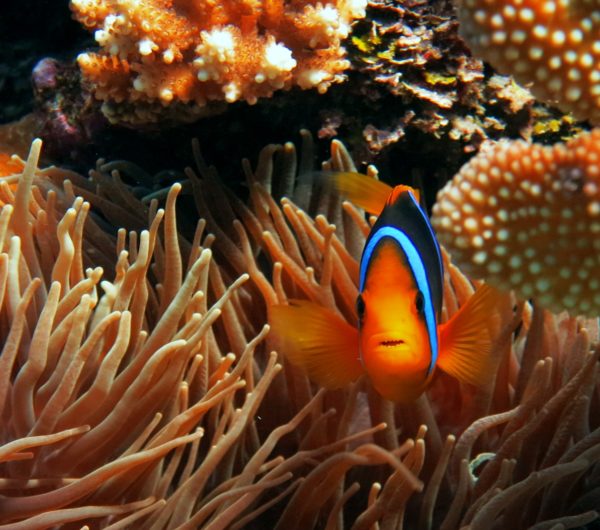
The results in the Fiji final report contain both good and bad news. On the positive side, the researchers found coral reefs in Lau Province had thriving coral communities. However, a worrying result was that the fish on the reef were small, and very few large fish remained.
One of the most surprising findings of the expedition was the presence of large mats of cyanobacteria in and around the reef. A coral reef is naturally home to cyanobacteria, but under healthy conditions the cyanobacteria does not form large choking mats, but instead, is filtered out of the water and eaten by creatures like sea cucumbers. The presence of large cyanobacterial mats is an indicator of poor reef health.
Sea Cucumbers
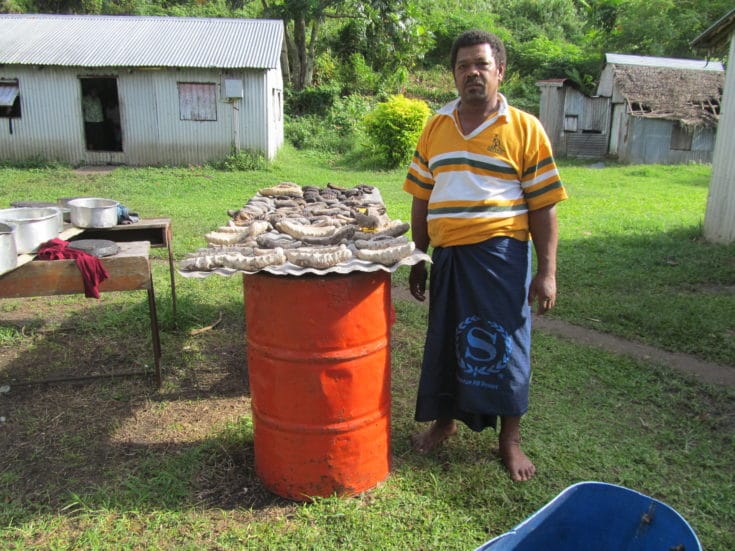
Declining sea cucumber populations are likely to blame for the extensive cyanobacterial mats found on the research mission. Sea cucumbers are not only an important economic resource for the community, but they are critical to maintaining the health of the reefs. Fisheries officer William Saladrau collected data on sea cucumber harvesting on the Expedition and found that remaining sea cucumber numbers were low.
Populations of some sea cucumber species were so low they would have difficulty reproducing. He says they found ‘less than one sea cucumber per hectare, this shows that there is overfishing of sea cucumbers across the Lau Province.’
Delivering the Report
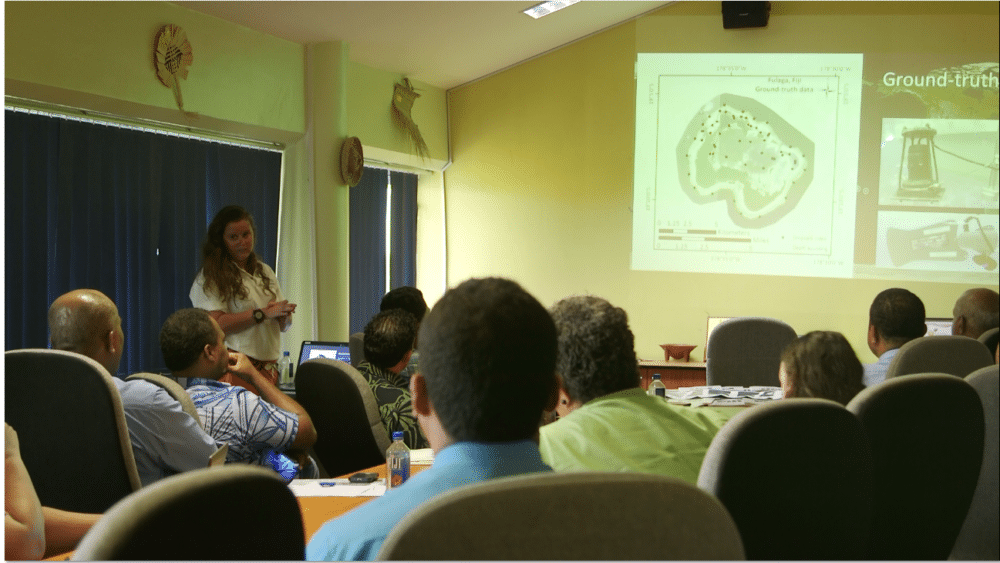
This month, Alex Dempsey, Coral Reef Ecologist at the Khaled bin Sultan Living Oceans Foundation, along with Roku Sau from the Pacific Blue Foundation and High Chief of Yasayasa Moala Group, presented copies of the final report to government officials in Suva.
She also presented the findings contained in the report to other scientists, traditional leaders, and conservation organizations working to preserve Fiji’s coral reefs. Ms. Dempsey says she hopes to ‘provide the people of Fiji with data and information they can use to successfully manage their marine resources for future generations.’