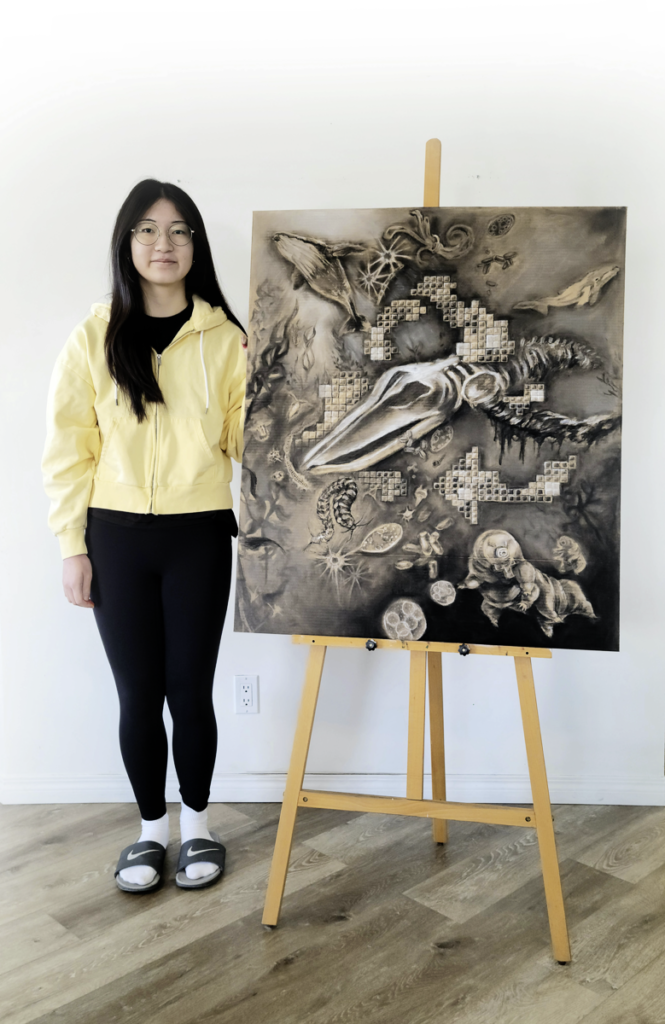
When we think about the largest animals on Earth, it’s hard to imagine that their final chapter depends on some of the smallest. That’s exactly the story Olivia Shin set out to tell in her award-winning piece, “The Giant and the Invisible: A Story of Ocean Recycling.” As the first-place winner in the 11–14 age group of the 2026 Science Without Borders® Challenge, Olivia brought this year’s theme, Microscopic Marine Life, to life in a way that feels both powerful and deeply thoughtful.
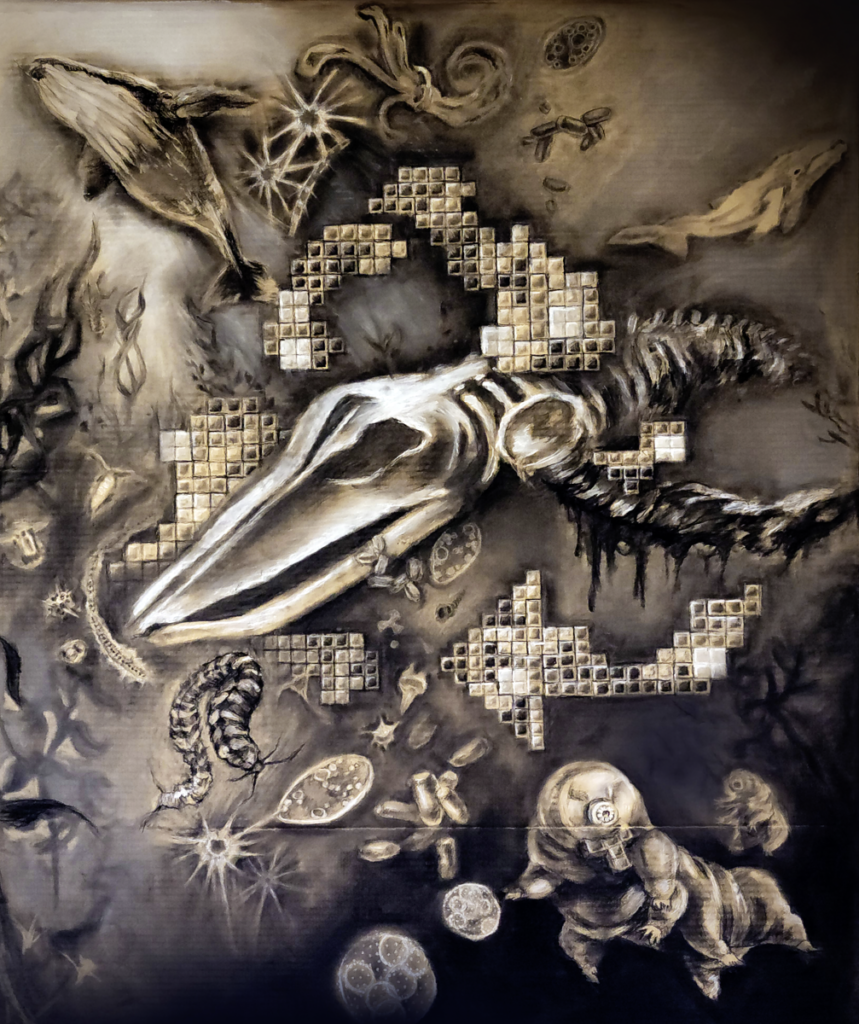
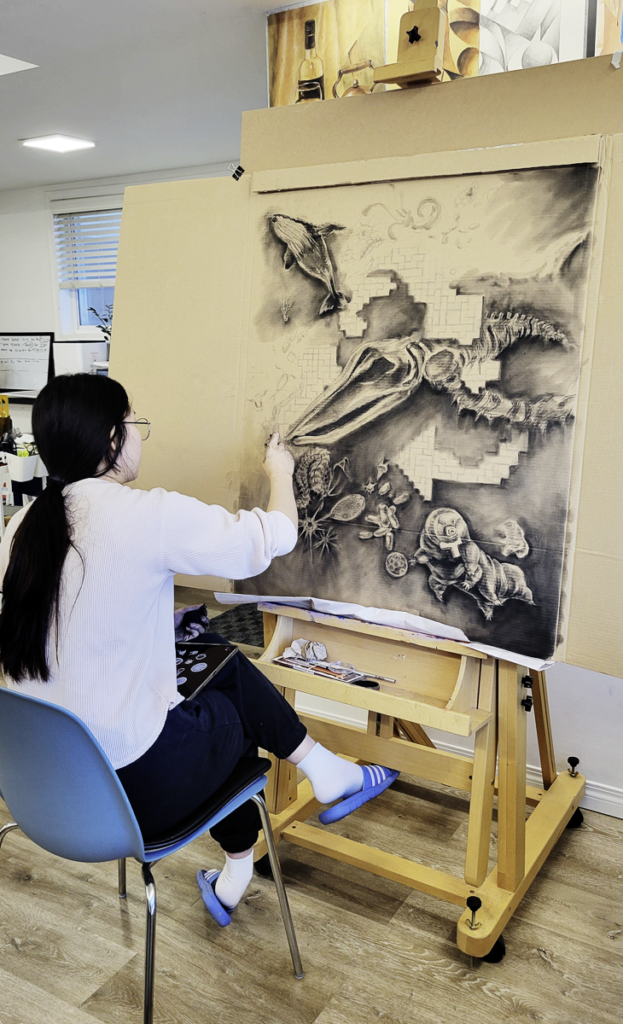
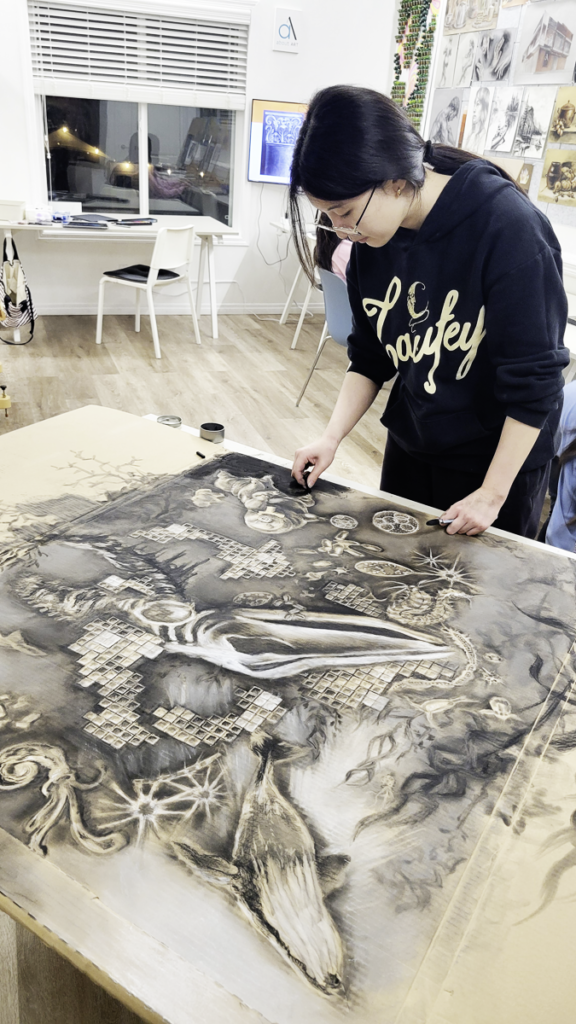
Using charcoal on recycled cardboard, Olivia illustrates the carcass of a blue whale being broken down by microscopic marine organisms—highlighting their critical role in ocean recycling. In her composition, these organisms form thick, mat-like layers around the whale, visualized as a circular system inspired by the universal recycling symbol. I especially liked how she carried this idea into her materials, using a recycled surface to reinforce the message in a simple but impactful way.
Her teacher at About Art Studio, Ms. Lily Kim, shared that this project became much more than just an art submission. “This work became a journey of research into marine microbiology,” she explained, noting how Olivia explored the role of microscopic life as the ocean’s primary recyclers. She also described this experience as a turning point, marking Olivia’s growth into “a purposeful artist” who uses her work to advocate for environmental awareness.
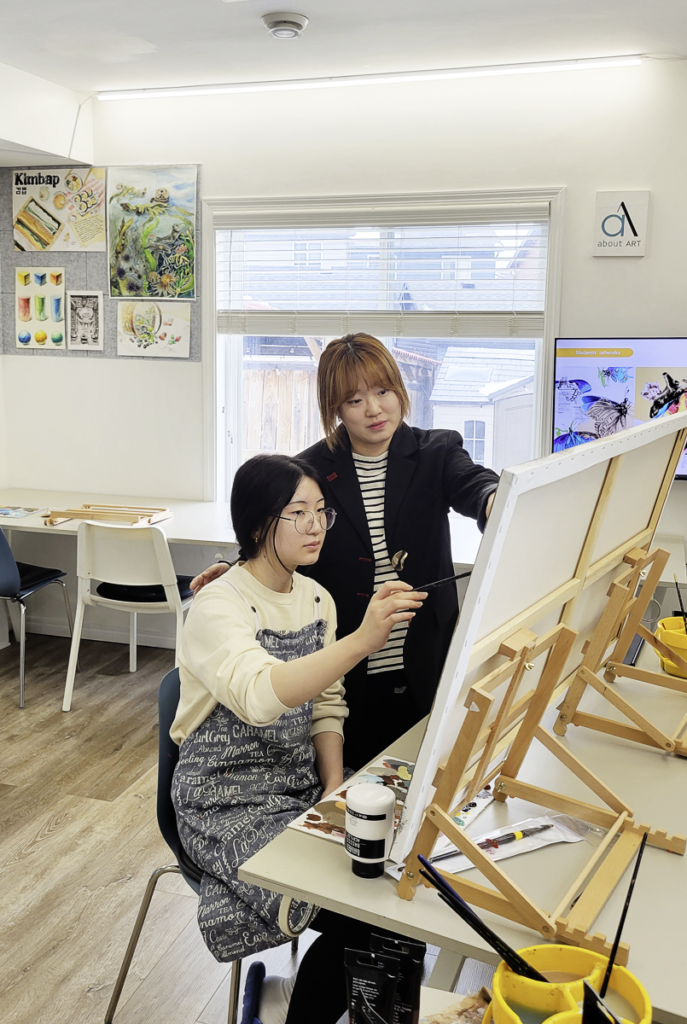
Olivia’s dedication also stood out. After a setback in last year’s competition, she used the experience as motivation, spending months researching and refining her approach. As Ms. Kim shared, this persistence and critical thinking helped her develop an “innovative and intellectually sharp” piece that translates complex science into a clear visual story.
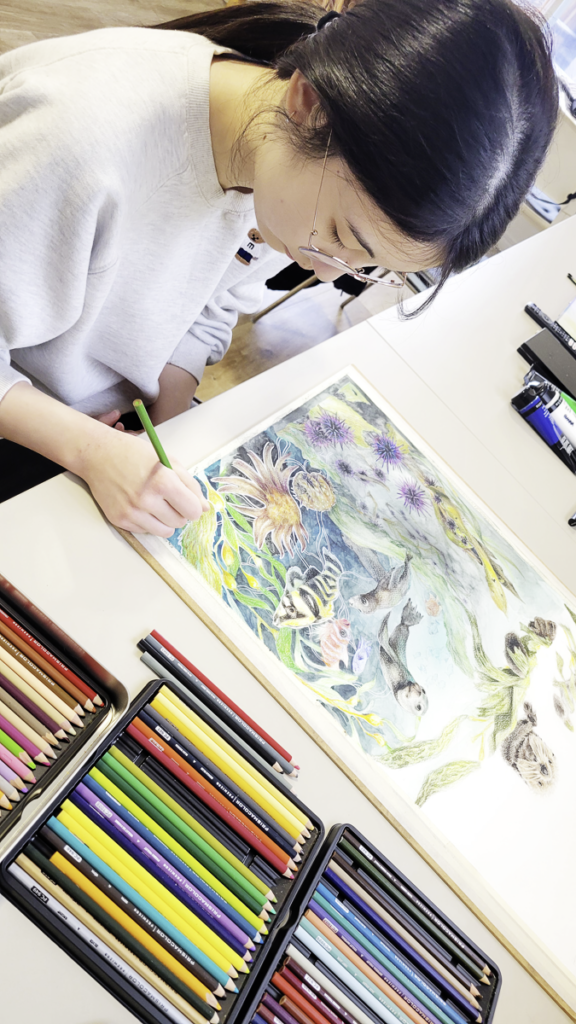
We hope you enjoyed meeting Sophia (Jiye) Lee, the first-place winner in the 15–19 age group. Now, let’s hear more from Olivia as she shares what inspired her artwork, what she learned through this experience, and why microscopic marine life matters.
Q: Congratulations on winning the Science Without Borders Challenge! What does winning this contest mean to you?
A: I am honoured to have been chosen as first place and be able to spread awareness on microorganisms to others.
Q: Tell me about your artwork. What does it mean to you?
A: My artwork is mainly based on the theme of recycling and how microorganisms within the deep-sea work together to keep the cycle going. Additionally, to further reinforce my theme of recycling, the canvas I used was cut out from an IKEA box, further incorporating the message into my artwork.
Q: What inspired your idea? What do you hope people think or feel when they see your work?
A: I was inspired by the game of Tetris and how it is a game of strategy. While doing research, I noticed how the bacteria clump together to form blankets and how they work with micro-organisms resembled the game. I hope that my artwork can encourage others’ thoughts and interest in marine life.
Q: What did you learn by participating in the Science Without Borders® Challenge?
A: From participating in the Science Without Borders Challenge, I learned more about how organisms of the deep-sea work together to survive. I was surprised by how even the tiniest of creatures can have such a vital role within marine life.
Q: Why do you think microscopic marine life is important? Has this experience changed how you see your role in protecting the ocean or the planet?
A: I strongly believe that microscopic marine life is important because they form the base of the food chain. They also work tirelessly to produce oxygen for other life on Earth.
Q: Is there anything else that you would like to add?
A: I enjoyed learning more about how microscopic organisms help not only marine life, but us humans on land as well. I think that this Challenge has given me the opportunity to learn more and broaden my understanding of various forms of life. I would also like to give thanks to my parents for always being supportive of my art and to my art teacher, Ms. Lily Kim, for providing me with great guidance.