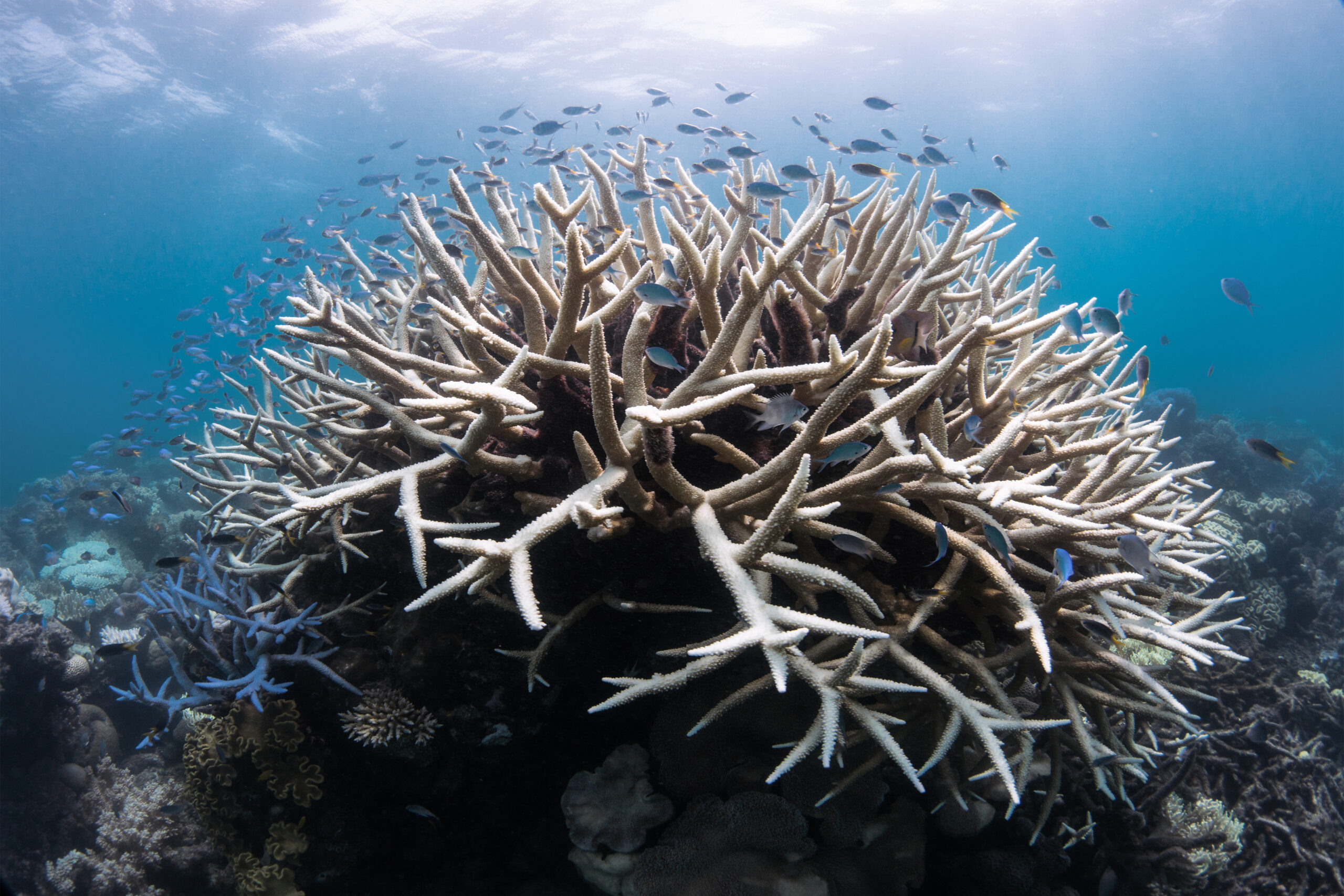
 The Khaled bin Sultan Living Oceans Foundation conducted a research mission to the Tuamotu and Gambier Archipelagos of French Polynesia in late 2012 and early 2013 as part of its Global Reef Expedition. This article on the significance of new records of Tridacna squamosa Lamarck is a result of research conducted during those missions.
Significance of new records of Tridacna squamosa Lamarck, 1819, in the Tuamotu and Gambier Archipelagos (French Polynesia)
Molluscan Research
September 16, 2014
By Serge Andréfouët, Simon Van Wynsberge, Cécile Fauvelot, Andrew W. Bruckner & Georges Remoissenet
ABSTRACT:
The giant clam subfamily Tridacninae (family Cardiidae) is an important group of bivalve molluscs found throughout the Red Sea and Indo-Pacific, from East Africa to the Eastern Pacific biogeographic region. The Tridacna genus is currently revised with numerous cryptic species identified with molecular markers. New Tridacna records from the fringe of the known distribution areas are extremely useful to identify genetically unique species, geographic ranges, and to examine processes associated with species differentiation. While Tridacna maxima is abundant in French Polynesia (Central South Pacific Ocean) the larger fluted giant clam Tridacna squamosa was formerly reported only in the Austral Islands in the south. Following a recent survey that spanned 23 islands and atolls of the Society, Tuamotu and Gambier Archipelagos, the presence of T. squamosa between the Cook Islands and Pitcairn Islands is confirmed using both morphological and molecular information, suggesting a relic distribution across the Central Pacific Ocean. Tridacna squamosa is rare, but present throughout Tuamotu and Gambier. However, it remained undetected from the Society Islands, probably due to historical over-fishing. This species is valued by local inhabitants, and is sought after mainly as gifts and also for a limited local shell trade. The rarity of T. squamosa may call for conservation measures in the near future.
INTRODUCTION:
The giant clam subfamily Tridacninae (family Cardiidae) is an important and conspicuous mollusc family found throughout the Red Sea and Indo-Pacific, from East Africa to the Eastern Pacific biogeographic region (Rosewater 1965; Othman et al. 2010). The Tridacninae includes two genera, Tridacna and Hippopus, with nine and two species, respectively. The genus Tridacna currently includes Tridacna squamosa Lamarck, 1819, Tridacna maxima (Röding, 1798), Tridacna crocea, Lamarck 1819, Tridacna derasa (Röding, 1798), Tridacna gigas (Linnaeus, 1758), Tridacna mbalavuana Ladd, 1934, Tridacna rosewateri Sirenko and Scarlato, 1991, Tridacna squamosina Sturany, 1899 and Tridacna noae (Röding, 1798). The taxonomy and phylogeography of Tridacna is currently experiencing substantial revisions: for example, a distinct clade of T. maxima, recently found from Taiwan south to the Solomon Islands (Huelsken et al. 2013; DeBoer et al. 2014a), is now the resurrected T. noae (Su et al. 2014). Tridacna costata (Roa-Quiaoit, Kochzius, Jantzen, Zibdah, Richter, 2008), described from the Red Sea, was synonymised with Tridacna squamosina by Huber and Eschner (2011). More changes may be expected, given the identification of cryptic species from the Coral Triangle using molecular techniques (Huelsken et al. 2013; DeBoer et al. 2008, 2014a, 2014b). This area comprises most of Malaysia and Indonesia, as well as Papua New Guinea, Philippines, Timor Leste and the Solomon Islands. It is characterised by a complex palaeo and present oceanography, coastline and climate. These configurations have created numerous physical barriers that have moved across time since the Pleistocene, resulting in species differentiation between isolated regions for a large number of marine taxa that often display concordant phylogeographic patterns (Carpenter et al. 2011), with some variations due to periods of recolonisation.
Taxonomic revisions of Tridacna in the Coral Triangle result from research aiming to define priority areas for conservation based on connectivity (DeBoer et al. 2014a; Beger et al. 2014). For this objective, it is necessary to elucidate which species are present, cryptic, genetically unique and how they are distributed, especially if they are endangered, such as giant clams. Indeed, all Tridacna species worldwide are protected by the Convention on International Trade in Endangered Species (CITES) and appear on the IUCN Red List of Threatened Species (Wijnstekers 2000). Giant clams are also a conservation priority outside the Coral Triangle (Gilbert et al. 2005; Van Wynsberge et al. 2013)…