During a recent dive I was struck by the number of Blue Lace Corals (Distichopora violacea) that were present. This is not a particularly rare or usually noteworthy species but it was notable on this dive due to its higher than normal abundance. I am more familiar with Rose Lace Coral (Stylaster roseus)— the sole member of the family Stylasteridae found in the tropical western Atlantic region. This species is similar in form but differs in that it has a finer “lace-like” branching pattern of rosy-pink branches and is usually only encountered under overhangs or in dark recesses. Though commonly called Blue Lace Coral, this species also comes in a wide range of colors other than blue: violet, red, orange and yellow. Interestingly, unlike reef-building corals which have white skeletons, the skeleton of lace corals contains colored pigments (mainly carotenoids and xanthophylls) embedded into the limestone so that the color persists after the living tissue is gone.
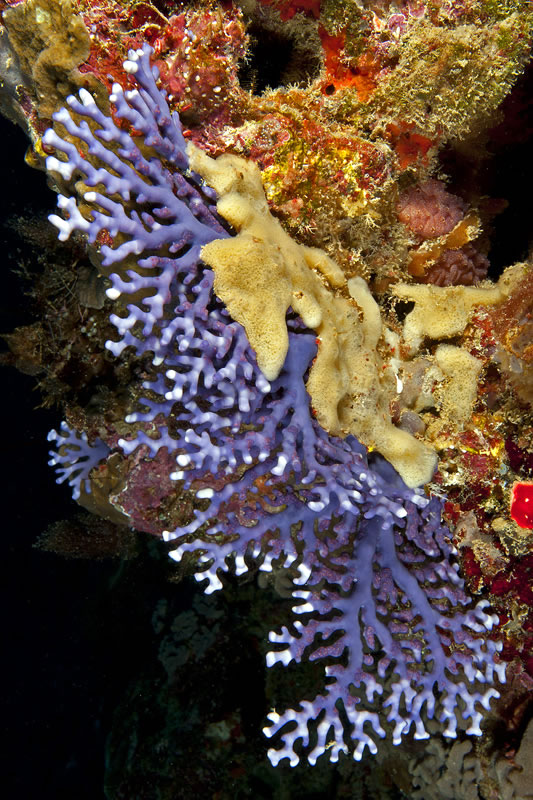
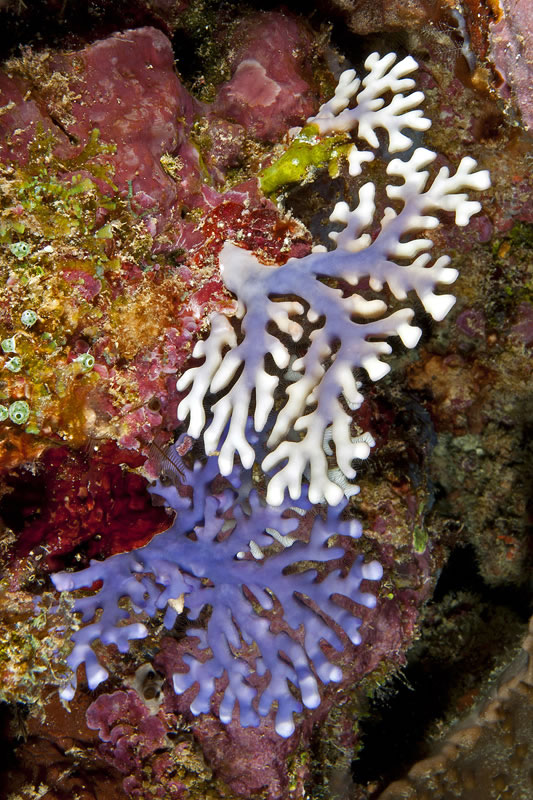
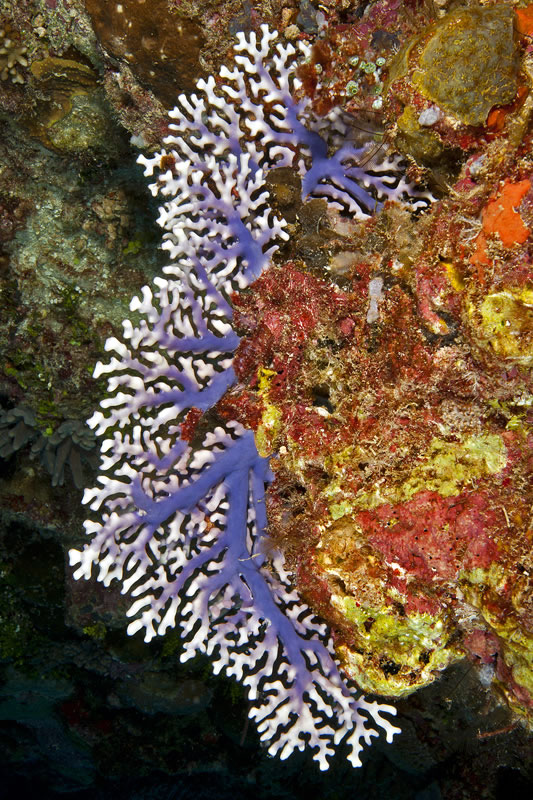
Blue Lace Coral colonies in varying shades of white and violet-blue.
(Click-thru on images for greater detail.)
Lace corals are in fact not actually corals but hydrozoans. That is they are grouped taxonomically in the class Hydrozoa along with the ubiquitous feather hydroids but they are actually more closely related to the commonly encountered fire corals with which they share the order Anthoathecata. Whereas the polyps of true corals have a mouth which is surrounded by a ring of tentacles bearing the stinging cells (nematocysts), the structure of polyps in hydrocorals is quite different. The polyps are near microscopic in size and are imbedded in the skeleton and interconnected by a network of canals. The relatively smooth surface of a hydrocoral is perforated with two types of fine pores: dactylopores and gastropores. Protruding through the dactylopores are long thin hairs which contain clusters of nematocysts. The nematocysts of lace corals do not seem to inflict the same painful stings on human skin as fire corals and many other hydroids. Prey captured by the dactylopores are consumed by gastrozooids, or feeding polyps, located within the gastropores.
The frilly branching patterns and bold colors of lace corals may be what first gets these reef inhabitants noticed but underlying their graceful beauty is an interesting story of a group called hydrocorals that seems bridge the world of hydroids and corals.
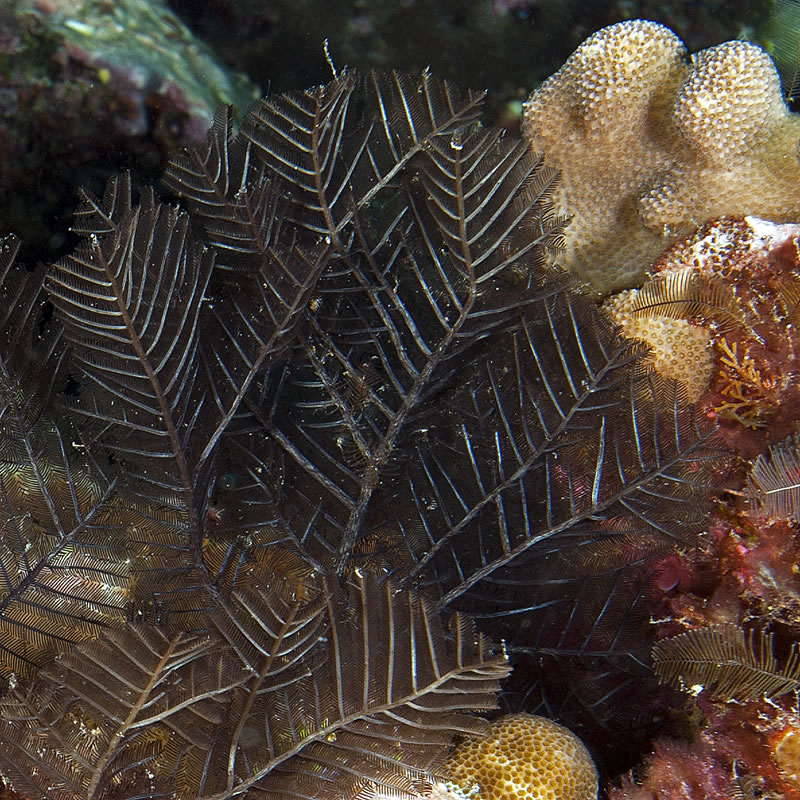
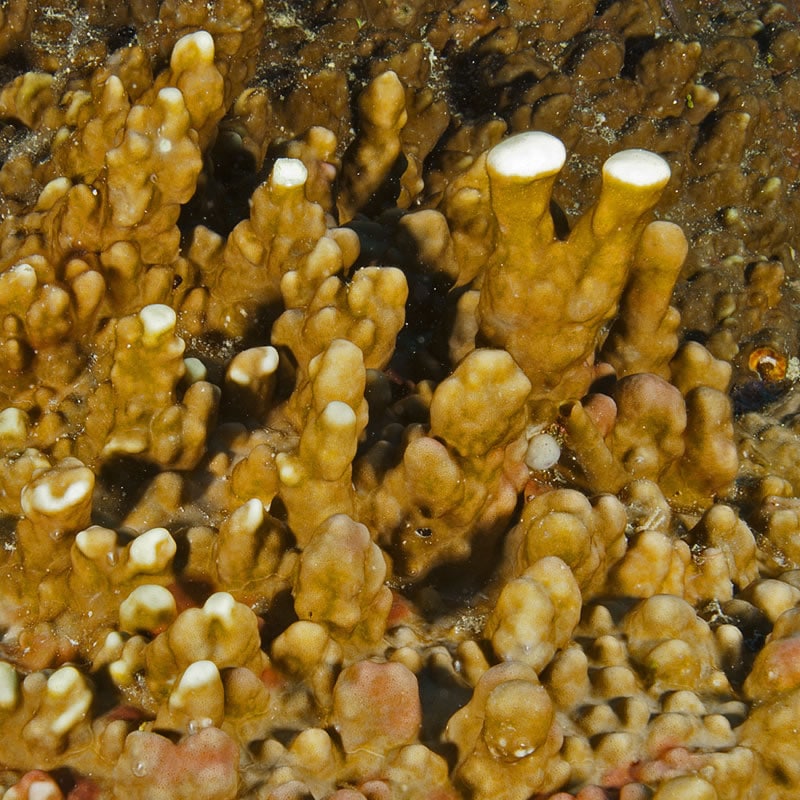
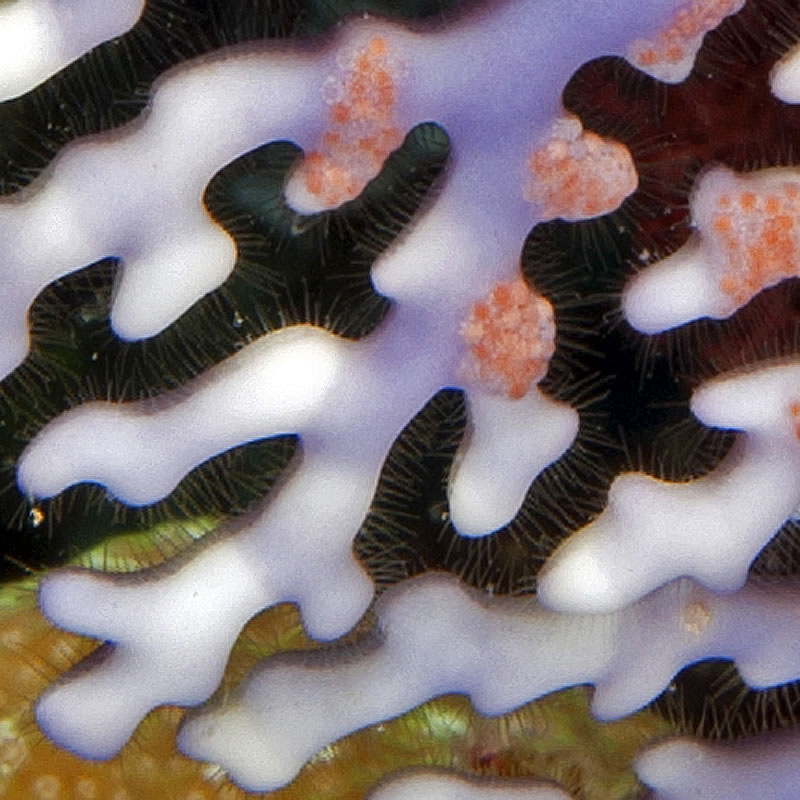
A cluster of aptly named “feather hydroids” [left]; Fire corals are most commonly found with a mustard brown coloration with white areas at the point of recent growth [middle]; Fine hairs protruding through the gastropores of this Blue Lace Coral barely visible along the edges of the branches [right].
(Click-thru on images for greater detail.)
ADDENDUM: While surveying a site this morning which was about ten hours away by ship from the location where I first noticed the abundance of Blue Lace Corals, we again encountered a high density of lace corals. What made this notable is that the lace corals on this site were all of a pale yellow coloration and a blue/violet colony could not be located despite considerable searching. It remains to be seen what future dives will turn up and if we will see other color forms or sites with a mixture of colors.
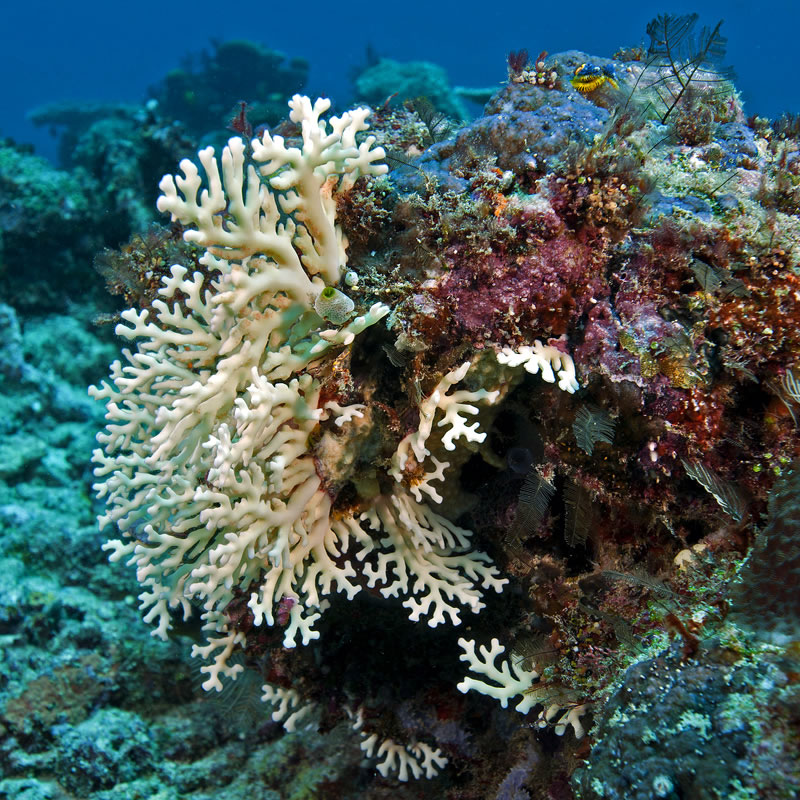
Yellow form of the lace coral Distichopora violacea.
(Click-thru on image for greater detail.)
SECOND ADDENDUM: I’ve been keeping my eye out for more color variations of the Distichopora lace coral. One of the other islands we surveyed had a nice bright orange color form as well as a more drab brownish variation. These seem to be the last colors we’re likely to encounter as our most recent islands have not had the high densities of lace corals we saw earlier in the trip.
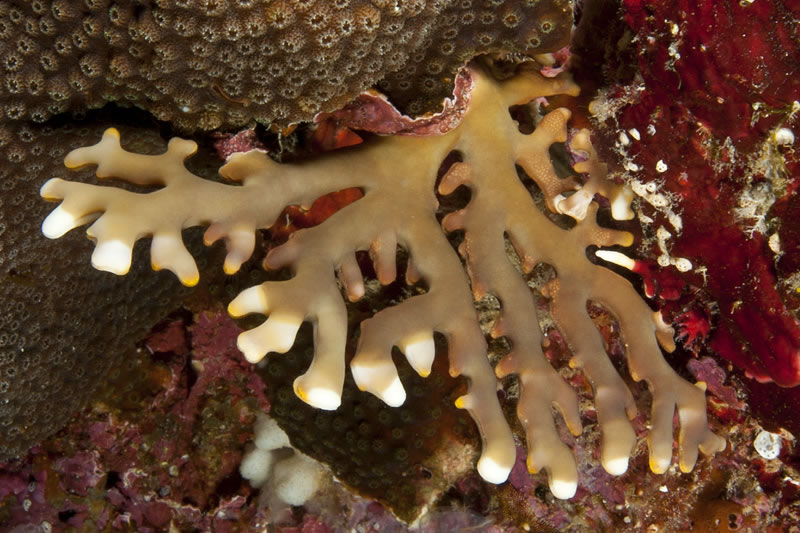
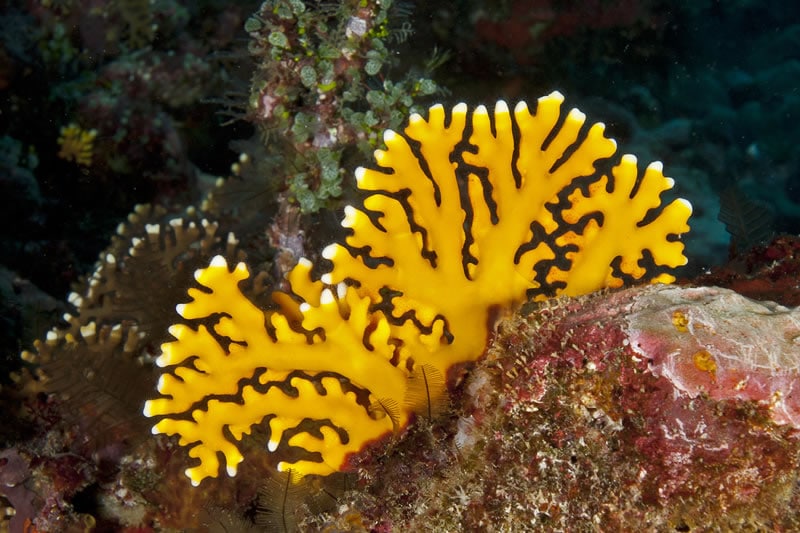
At Nono Lagoon the more drab tan-brown color form was plentiful but the bright orange was rarer. The violet-blue variety was mostly absent with just a few tiny colonies hiding under ledges.
Photos by Ken Marks.