
search-icon
Cauliflower Coral

Cauliflower coral, in the genus Pocillopora, are among the most widely distributed and most abundant corals found on the fore reef. These branching corals are covered with small bumps (called verrucae), which contain corallites and help in the identification of the genus.
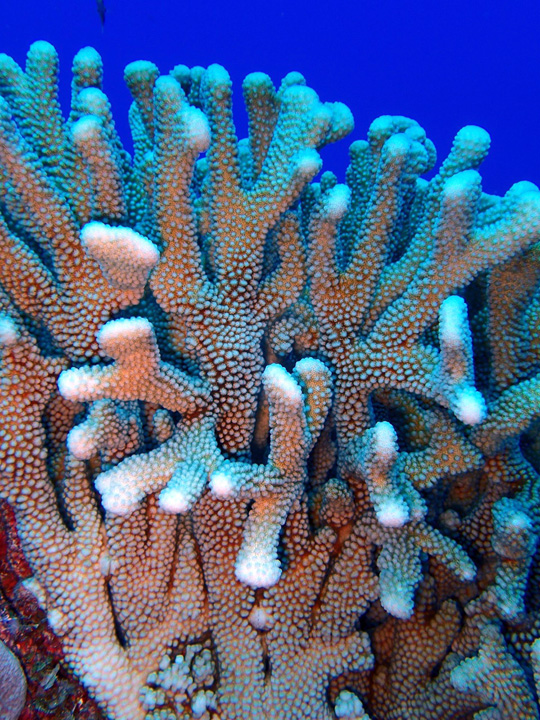
Details of Pocillipora branches with the typical verrucae
Cauliflower Coral: Details of Pocillipora branches with the typical verrucae


Identification of cauliflower coral to species level, however, is hardly an easy job. This genus is very plastic, taking on a different shapes, sizes, color and appearance depending on habitat and environmental conditions. The same species from exposed reefs usually have thicker branches than those in sheltered areas and in some cases this variation occurs within a single location.
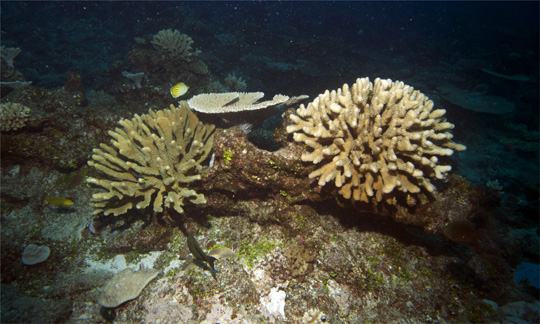
Two colonies of Pocillopora eydouxi with different appearance and color

Identifying Cauliflower Coral Species

In French Polynesia, the research team has been able to easily recognize some cauliflower coral species, but they have had difficulties distinguishing the Pocillopora corals that have characters that fit different species. Inspecting the skeleton structures under a microscope does not make this easier, as different species have overlapping features. For many, the scientists will have to resort to genetics to tell species apart. Sometimes, though, a unique structural feature can help distinguish two similar species.  In Tenarunga and Maria Est Atolls (Acteon Group), the scientists came across an almost hexagonal pattern surrounding packed colonies of one of the larger varieties of Pocillopora. This feature is a unique character of Pocillopora zelli, a species of cauliflower coral that had not been previously described to occur here.
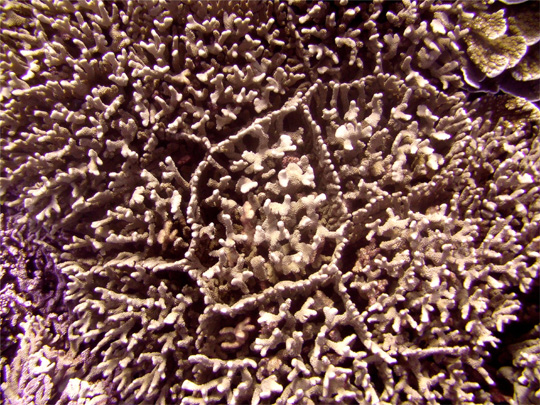
Top view of Pocillopora zelli colonies with branch fusion resulting in geometrical pattern separating colonies


The beauty of the almost mathematical pattern unveiled a new record for the local coral diversity and the range expansion of the distribution of Pocillopora zelli.

(Photos by: 1-2 Joao Monteiro, 3 Marie Kospartov)

If you liked this blog, you might also like: Corals in the Devil’s Crown from our Galapagos Mission.

Related Posts

Introducing Our New Website: A Fresh Look for the Foundation’s Future

As we celebrate the Khaled bin Sultan Living Oceans Foundation’s 25th anniversary, we are proud to unveil our newly redesigned website—a modern home for our science, conservation work, and educational programs. This launch marks an important moment for the Foundation as we honor our long history and look toward the future of ocean conservation.

For more than two decades, the Foundation has worked tirelessly to improve the health of our living oceans. We have advanced ocean science, led one of the largest coral reef research missions in history, restored mangrove forests with local communities, created award-winning education programs, and shared the wonders of the ocean with people around the world. Our new website reflects the organization we are today—focused on conserving coral reefs, restoring mangrove forests, and improving ocean literacy—while still highlighting the legacy of work that brought us here.

The redesigned site…

Read More

Connecting People, Art, and Oceans: Championing Conservation at the 2025 IUCN Congress

The IUCN World Conservation Congress brings together thousands of leaders and decision-makers from governments, non-profit organizations, civil society, Indigenous groups, and the private sector to shape global conservation policy and action. This influential gathering serves as a platform to share knowledge, build partnerships, and advance initiatives that protect our planet’s biodiversity.

As a member of the International Union for Conservation of Nature (IUCN), the Khaled bin Sultan Living Oceans Foundation was honored to take part in the Congress, joining a global community of leaders, organizations, and changemakers committed to protecting nature and advancing sustainable futures.

Read More
Privacy Overview

This website uses cookies so that we can provide you with the best user experience possible. Cookie information is stored in your browser and performs functions such as recognising you when you return to our website and helping our team to understand which sections of the website you find most interesting and useful.  You can view our complete Privacy Policy here.

Strictly Necessary Cookies

Most of our cookies are used to improve website security and reduce spam. These cookies should be enabled at all times. They also enable us to save your preferences for cookie settings.

3rd Party Cookies

This website uses Google Analytics to collect anonymous information such as the number of visitors to the site, and the most popular pages. Keeping this cookie enabled helps us to improve our website.