search-icon
Fish Communities at the Acteon Group

During our surveys in the Acteon group we saw very few fish.  There were few sharks or other large predators and even large herbivorous fish such as surgeonfishes and parrotfishes were noticeably low in number. The Acteon fish communities were dominated by small-bodied species such as damselfishes, wrasses, and butterflyfishes.
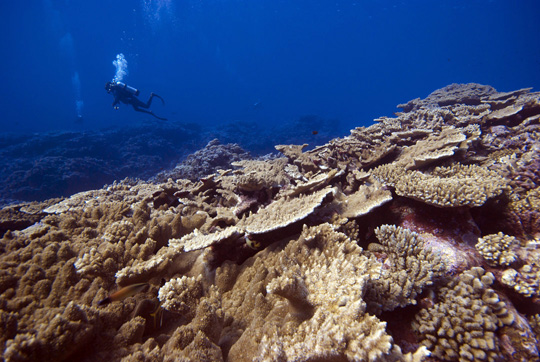
There were very few large fish on the otherwise beautiful reefs of the Acteon Islands

Factors Affecting Acteon Fish Communities

So why are the Acteon fish communities in such a pristine and isolated coral reef in such poor condition? Several factors may be at play. The Acteon group of islands is relatively isolated. The closest major land mass to the group is Mangareva, more than 220 km away. Due to its isolation the Acteon group is difficult to patrol and may be vulnerable to poaching. Both local and foreign fishing vessels may target tuna, jacks, groupers and snappers, and also sharks for the fin trade.
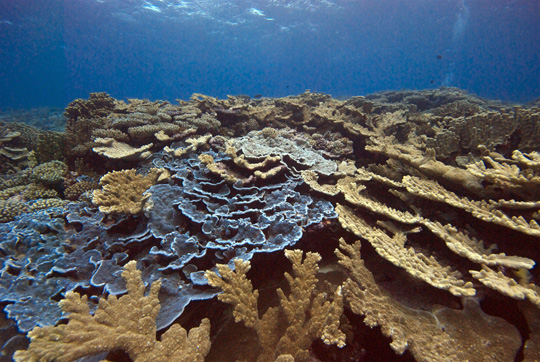
A few species of corals dominated the reefs.


Also due to the large distances between the Acteon islands the other major island groups, it is possible that recruitment of fish larvae and immigration of adult fish into the islands is limited. This means that if the fish stocks were depleted by fisheries, recovery would largely depend on Acteon’s own remaining stocks.
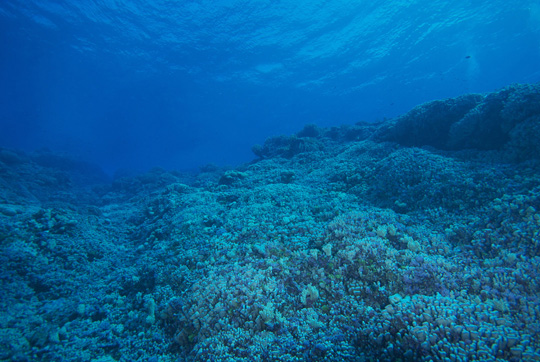
Acteon Fish Communities: Very few fish on this reef
Depleted Acteon Fish Communities: Very few fish on this reef


Despite the very high cover of live corals, the physical complexity of the reef was rather poor, with very little suitable habitat and shelter for large fish. The amount of large predatory reef fish has been associated with the availability of suitable shelter, and the physical complexity of the reef.
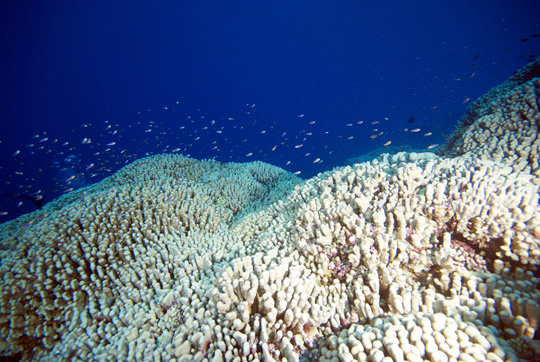
There is little available shelter for large fish in most of the reefs we surveyed at Acteon


But all is not lost. Improved efforts to patrol the area may help prevent possible poaching of fish. And together with the very good condition of the coral reef, which has been relatively buffered from stressors which cause tremendous damage to reefs elsewhere, the abundance and variety of the large predatory species of fish may increase at the Acteon in time.
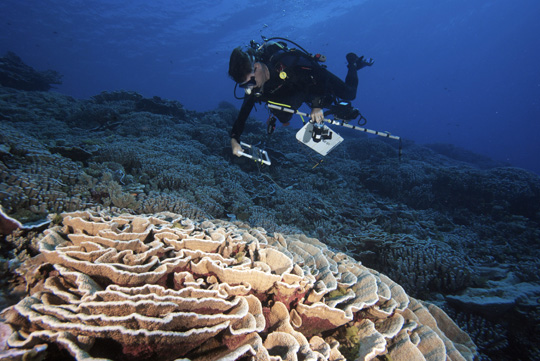
Live hard coral cover at the reefs of Acteon island group was 100% in many areas. Chief Scientis, Dr. Andrew Bruckner, laying a line to survey corals.
Live hard coral cover at the reefs of Acteon island group was 100% in many areas. Chief Scientist, Dr. Andrew Bruckner, laying a line to survey corals.

(Photos by Joao Monteiro)

Related Posts

After the Storm: Standing with Our J.A.M.I.N. Family in Jamaica

There are moments in this work that feel heartbreakingly familiar.

Two weeks after we completed our Jamaica Awareness of Mangroves in Nature (J.A.M.I.N.) programming, Hurricane Melissa made landfall. A powerful Category 5 hurricane, Melissa is now tied with Hurricane Allen in 1980 for the strongest winds ever recorded in an Atlantic storm. Like Hurricane Dorian, which devastated The Bahamas in 2019, Melissa will be remembered as one of the strongest hurricanes on record in the region.

For 11 years, the University of the West Indies Discovery Bay Marine Laboratory and William Knibb Memorial High School have been more than program partners. They have welcomed us into their classrooms and labs, shared meals and laughter, and committed themselves to educating their students about mangroves and coastal resilience. These colleagues and students are not distant collaborators. They are family.

And they were hit hard…

Read More

B.A.M. Turns 10: A Year of Milestones, Resilience, and Growth

The 2025–2026 academic year was one of those defining years for our Bahamas Awareness of Mangroves (B.A.M.) and Jamaica Awareness of Mangroves in Nature (J.A.M.I.N.) programs. It was a year marked by celebration, challenge, growth, and powerful full-circle moments, and a reminder of why mangrove education matters.

In The Bahamas, B.A.M. reached a major milestone: ten years of partnership and environmental education in Abaco. Since 2015, in collaboration with Friends of the Environment, we have worked alongside Patrick J. Bethel High School and Forest Heights Academy to bring hands-on mangrove science into classrooms and into the field. This year, we were proud to expand the program to S.C. Bootle High School, increasing access for students who live…

Read More
Privacy Overview

This website uses cookies so that we can provide you with the best user experience possible. Cookie information is stored in your browser and performs functions such as recognising you when you return to our website and helping our team to understand which sections of the website you find most interesting and useful.  You can view our complete Privacy Policy here.

Strictly Necessary Cookies

Most of our cookies are used to improve website security and reduce spam. These cookies should be enabled at all times. They also enable us to save your preferences for cookie settings.

3rd Party Cookies

This website uses Google Analytics to collect anonymous information such as the number of visitors to the site, and the most popular pages. Keeping this cookie enabled helps us to improve our website.