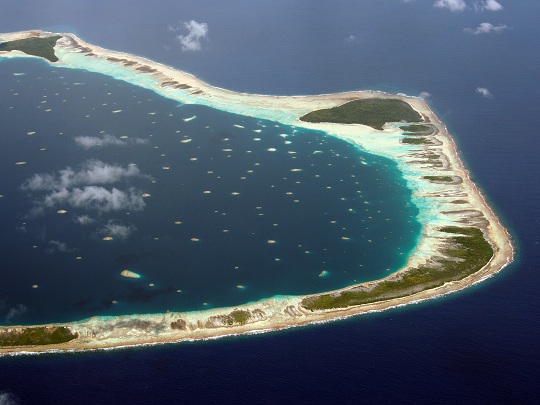
Navigation hazards are many in Hao Atoll, due to a myriad of submerged patch reefs that rise to the surface from the 60 m deep lagoon floor. These reefs are distributed in a seemingly random pattern. Some are circular and few centimeters below the surface, some are narrow and elongate, and others are little more than a pinnacle, a meter or so wide and a few meters in height. Unlike those in Fakarava, none of the patch reefs have an associated island or an emergent reef framework. They contain some of the same corals, but the corals vary in distribution and abundance from one patch reef to another, and a dominant species on one may be completely absent from another.
How do these patch reefs form? One theory is that they are built on a framework of the massive pore coral, Porites. Porites forms large mountainous colonies around the rim of many of these reefs. These corals grow up to the water’s surface and then their upper surfaces die, due to aerial exposure during low tides. This provides substrate for the settlement and growth of branching corals, mostly bushy, bottlebrush, arborescent and thickly branched Acropora, which prefer shallow depths.
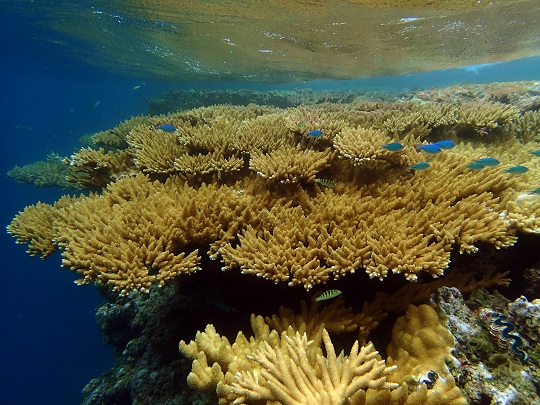
Even though parts of the Porites colonies eventually die, they continue growing outward, causing the reef to expand laterally in size. Because of the high turbidity and limited water motion in the lagoon, Porites exhibits low survival in deeper water, so they are usually dominant from 2-5 m depth. Over time, the shallows develop a mushroom-shape, with an extensive system of undercut ledges, caves and crevices at the base of the Porites colonies.
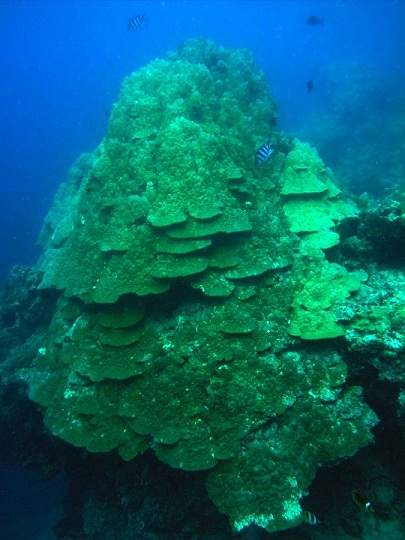
Below 5 m, the reef slopes steeply. The bottom consists mostly of sand, scattered boulders and rubble—broken branches, mollusk shells, and a lot of other debris—produced in shallow water that tumbles down the slope. Few corals can survive here, except on some of the rocky outcrops. At the base of the steep slope (12-15 m) is a dense band of thinly-branched tangles of staghorn coral (Acropora horrida), often 1-2 m in height and 20-30 m wide.
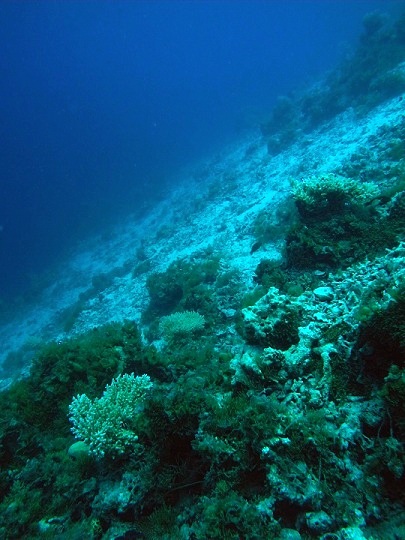
Below 15 m, the slope is much more gradual, continuing to 40-60 m depth. These deeper areas are mostly sand and rubble, interspersed with boulders and pinnacles of varying height and diameter. The pinnacles were draped with long strands of fleshy green algae (mostly Caulerpa) and occasionally disc-shaped calcareous green algae (Halimeda), with a thick layer of bright pink coralline algae beneath the green algae.
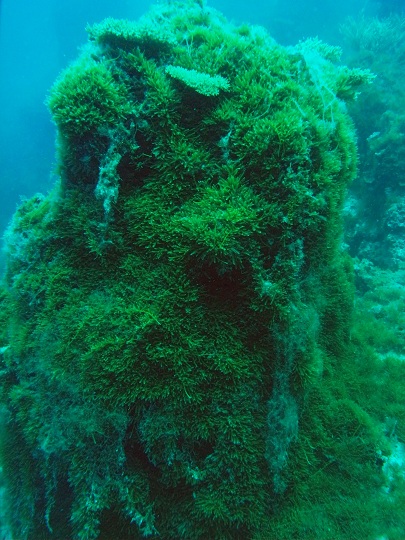
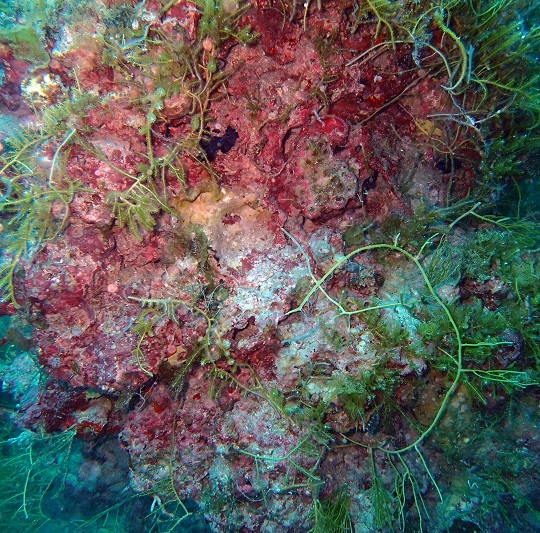
The pinnacles also support a high diversity of small encrusting, plating and branching corals, and numerous flat-topped bushy (corymbose) corals (Acropora granulosa), but live coral cover is generally low.
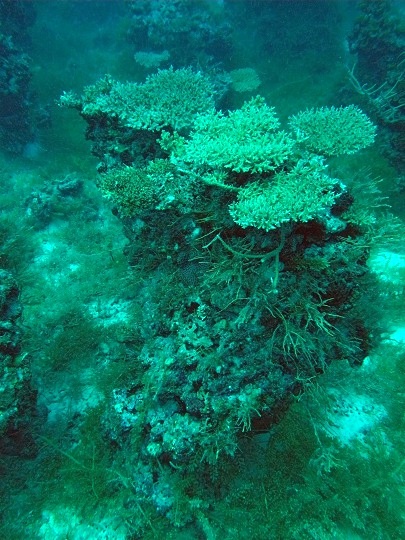
Why do some of the pinnacles make it to the water’s surface and form large patch reefs, while others appear to give up? One possibility is that these may have formed when sea level was lower, each starting as an individual coral or a few corals that settle in close proximity on a rocky substrate. Over time, some of these corals die from disease, or predation, or they are smothered by algae, sediment or debris. Others flourish, growing quickly to keep up with rising sea level and become patch reefs.
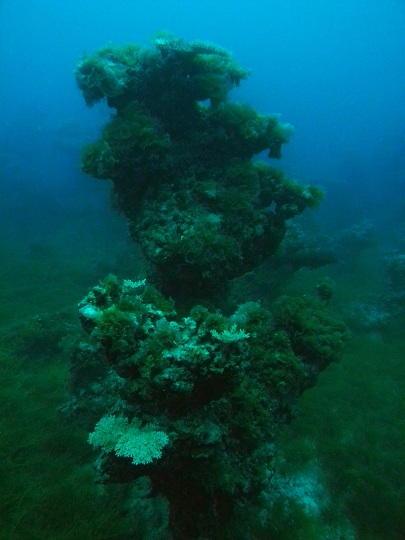
To determine what the pinnacles are constructed from, we collected a small pinnacle. These structures are highly bioeroded and have lots of nooks and crannies, yet they are very stable and difficult to break apart. What was surprising is that the pinnacle was not formed from a single coral. In fact, recognizable coral made up very little of the matrix. Most consisted of rubble, sand, shells and small corals that had been cemented together with coralline algae. This pinnacle was from shallow water (13 m), adjacent to rim of the atoll. In these areas, it is possible that storm-generated rubble and sediment is a much more important component of the framework, bound together by coralline algae. Deeper pinnacles may in fact consist of a coral skeleton in growth position. To verify this, we plan to collect a few more pinnacles from deeper water, when we begin our work in Mangareva next week.
(Photos 1-8 by Dr. Andrew Bruckner)