The CREW program offers high school teachers the opportunity to join the Global Reef Expedition (GRE) on one of its missions. Participants gain first-hand experience of life on board a working scientific research vessel, a greater understanding of the importance of coral reefs, and the inspiration to share what they have learned with their students and community. Mike Trimble, a teacher from Corona del Sol High School in Tempe, Arizona, is the first participant in the pilot program.
A Teacher’s View, by Mike Trimble
Here I am, aboard the M/Y Golden Shadow pinching myself to see if this is a fantasy or truly a remarkable once-in-a-lifetime experience. For an educator who has always tried to bring authenticity to the classroom, the Khaled bin Sultan Living Oceans Foundation has given me a first-hand look at the complex and exciting world of coral reef research. When my plane landed in Kingston, Jamaica, I soon met the guest researchers from NOAA and University of Miami. These friendly, dedicated people bring a treasure chest of knowledge and expertise concerning the changing conditions of Navassa.
My first sighting of the Golden Shadow, confirmed its reputation as a first-class research vessel capable of working anywhere. As the week has progressed, I have been able to see all of its resources put to full use–the dive locker, the three support crafts, and all the amazing technology, including full-face masks, buddy phones, underwater cameras, and, of course, the people responsible for them. From Phil Renaud, the Foundation’s Executive Director, to the Shadow crew, ship operations are a team effort.
Learning and working alongside these professionals is inspiring and provides rich material for me to engage STEM (Science, Technology, Engineering, and Math) students. As the first teacher in the Coral Reef Educators on the Water (CREW) program, I’m sharing the experience with my classes through emails, blogs, and video conference calls.
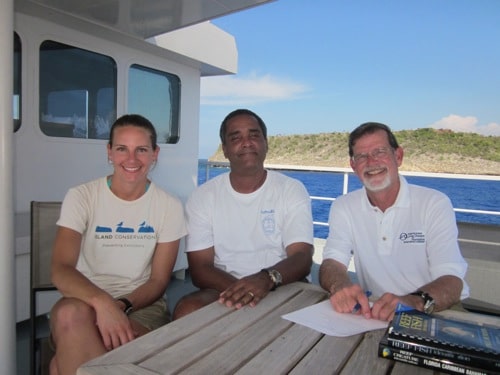
We filmed interviews with researchers, such as Aurora Alifano, from Island Conservation, and Jean Wiener, from the Foundation for the Protection of Marine Biodiversity.
But what has made the most impact for me? Exploring the coral reef itself.
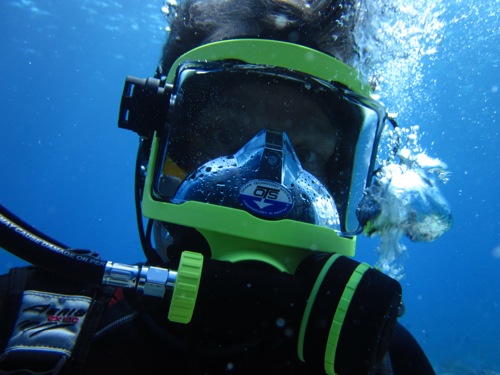
I have had some exceptional dives and utilized some amazing technology. Monday provided a reminder of basic ocean forces as we attempted to descend in stiff current. By Tuesday we were exploring the reef with underwater communications gear. The dramatic visibility unveils colorful varieties of corals, sponges, and fishes. I am also reminded of the challenges facing coral reefs. Lack of coral density, evidence of disease, abundance of algae, and the small size and numbers of fishes are all apparent.
Wednesday was our ‘field trip’ to Lulu Bay, a special shallow water reef that still has healthy Elkhorn coral. I had the pleasure of a personal tour of the reef with the Foundation’s Chief Scientist, Andy Bruckner. Andy gave me an underwater lesson using a full-face mask with audio capabilities that I heard using a buddy-phone system attached to my mask. The whole tour was filmed–with audio–for eventual showing on the web. Andy showcased the diversity of hard and soft corals, and the many symbiotic relationships that are found on the reef. As we dropped off the shallow shelf, we dove along a wall of sponges to a plain filled with a myriad of fish ranging from Blue Tang to Parrotfish to a huge Triggerfish.
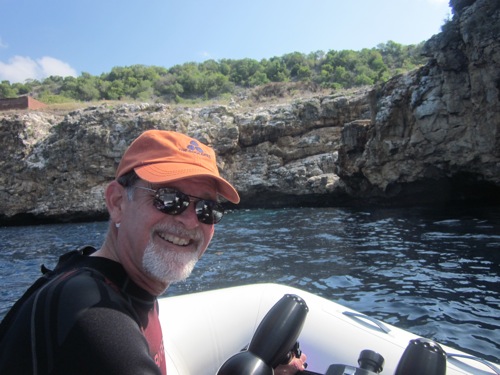
It has been an exceptional week and I have many to thank for providing this wonderful opportunity, but none would have been possible without the encouragement and support of my late father. I dedicate my participation in the CREW program to him. He devoted his life to education and service to others and his spirit continues to move me in powerful and positive ways.
(Photos/Images by Eddie Gonzalez)
To follow along and see more photos, please visit us on Facebook! You can also follow the expedition on our Global Reef Expedition page, where there is more information about our research and our team members.