search-icon
School’s out in the Maldives

Expedition Log: Maldives – Day 6

As a fish surveyor it is always exciting, sometimes daunting, to come across schools of fish in the thousands. We have seen huge schools of fish in other areas we surveyed on the Global Reef Expedition, especially during our mission to BIOT. When we were preparing for this mission we were unsure what the fish communities would be like as over 30% of the human population fishes and fishing is the second largest contributor to the nation’s GDP.
Fish Schools Maldives
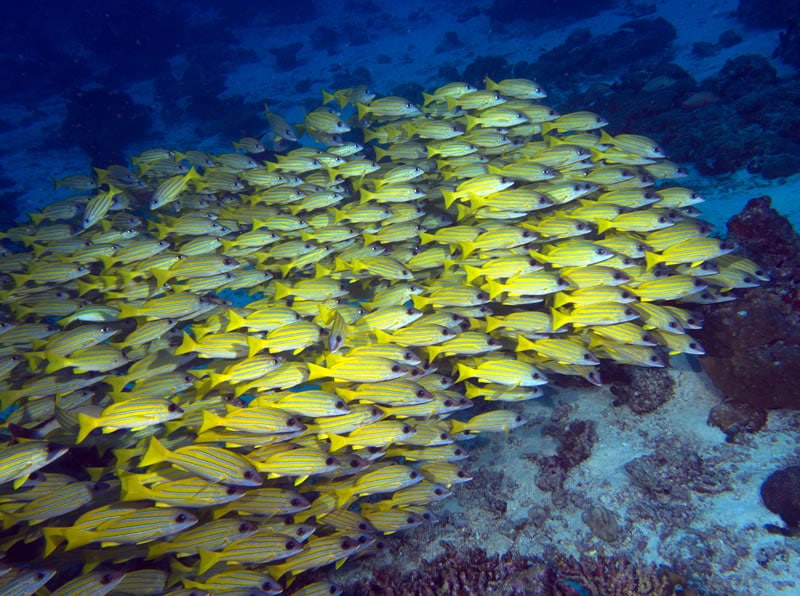
School of blue-lined snappers.

Our first few dives around the island of Gili Lankanfushi here in the Maldives were beautiful. Fish diversity was high, with most families represented. The density of fish was fairly low along the main stretch of house reef, although occasional schools of blue-lined snappers (Lutjanus kasmira), striped large-eye bream (Gnathodentex aureolineatus) and yellowfin goatfish (Mulloidichthys vanicolensis) would move around us as we surveyed and collected COTS. It was when we began moving north along the reef and dived in the channel between Gili and Himmafushi that the fish community was astounding.
surgeonfish and tuna bones
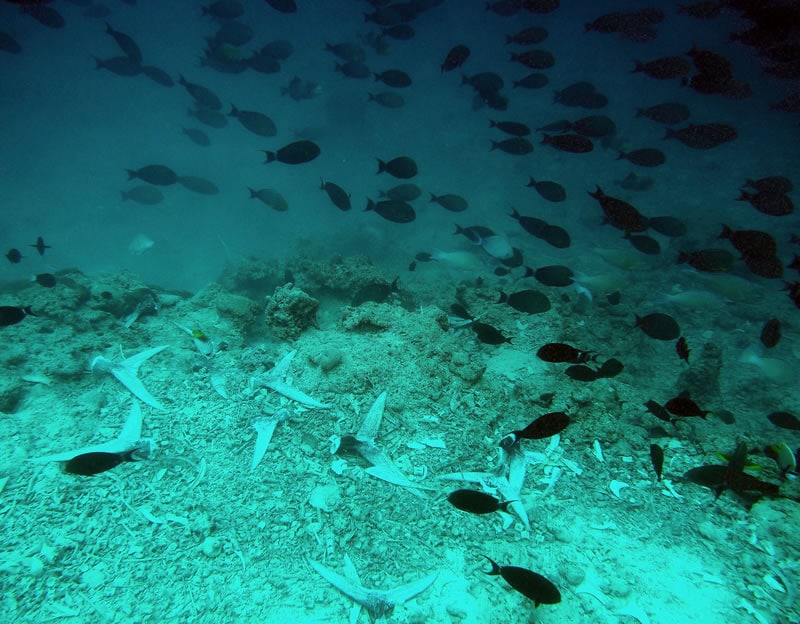
Surgeonfish and tuna bones.

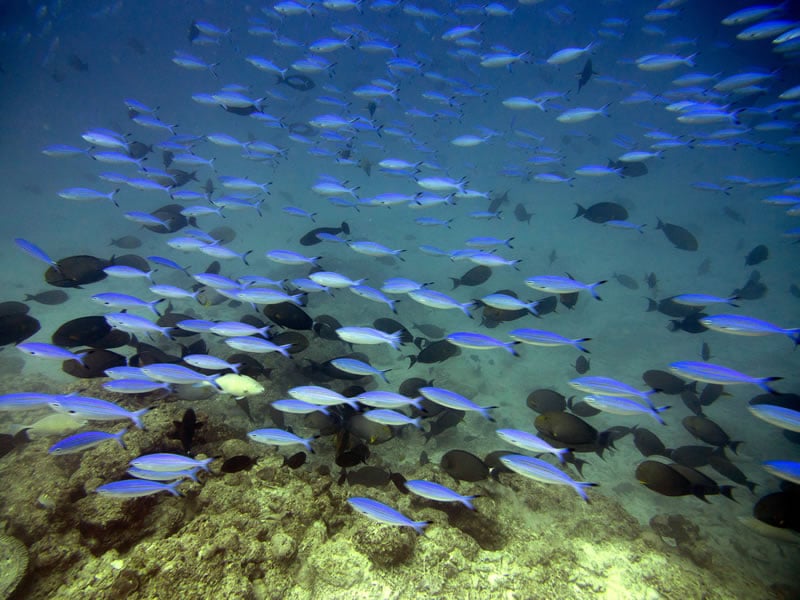
Fish tend to school near channels, as the water movement increases the availability of nutrients and plankton. Further, the tuna processing plant on Himmafushi and the fishing vessels regularly discharge tuna bones and carcasses into the channel. This attracts huge schools of opportunistic feeders and scavengers, and schools of planktivorous fish. Through the murky waters, at around 13-15m depth, schools of hundreds to thousands of bluespine unicornfish (Naso unicornis), humpback unicornfish (Naso brachycentron), yellowfin surgeonfish (Acanthurus xanthopterus), bluefin trevally (Caranx melampygus), lunar fusiliers (Caesio lunaris) and yellow-lined fusiliers (Caesio varilineata) filled the water column.
yellow lined fusiliers
Yellow-lined fusiliers.

In addition to these large schools, several enormous Napoleon wrasse (Cheilinus undulatus), whiprays and red snappers (Lutjanus bohar) were taking advantage of an easy feed. We were later told by the resort marine biologist that they normally see large pods of dolphins around this area as well.
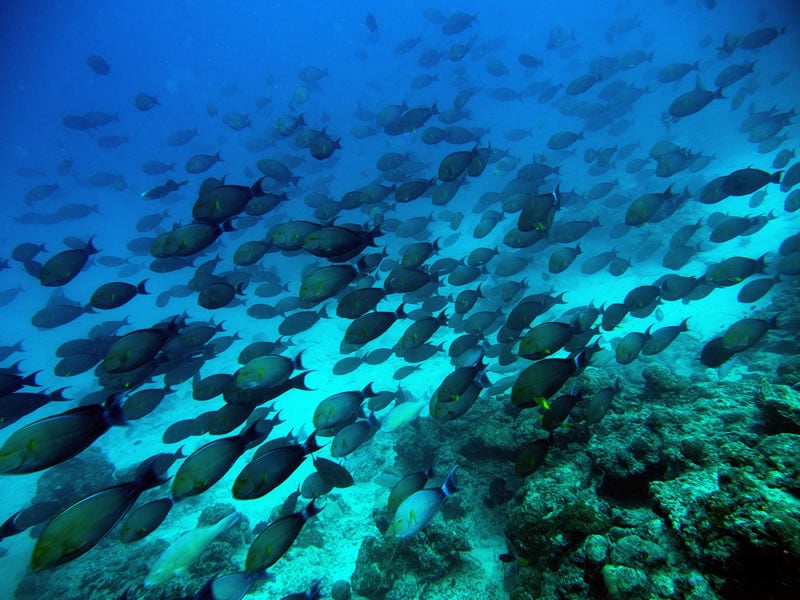
yellowfin surgeonfish
Yellowfin surgeonfish.

It was a great treat to take a break from collecting crown of thorns starfish and float in the water column as the large schools of fish surrounded us. The resort’s dive team had never dived this channel before and were excited by what we had to them about the giant schools of fish we saw there.


Photos by Andrew Bruckner.

Related Posts

Meet IFAN: Helping Bring Navigate with Care to the Next Generation

If you’ve ever seen a lighthouse flashing from the shore or a brightly colored buoy bobbing in the water, you’ve seen Aids to Navigation at work.

Aids to Navigation, often called AtoNs, help mariners navigate safely. They can mark channels, warn of hazards, help vessels determine their position, and provide other information people need to make safe decisions on the water. Around the world, these systems help guide everything from small recreational boats to large commercial or container ships. 

But safe navigation isn’t only about protecting vessels and the people aboard them. The choices mariners make can also affect the animals and ecosystems beneath and around them.

That connection between maritime safety and ocean conservation is at the heart of this year’s Science Without Borders® Challenge—and of our partnership with this year’s theme sponsor, the International Foundation for Aids to Navigation (IFAN).

Read More
OceanImageBank_TheOceanAgency_Bleaching_16-scaled-1

Coral Bleaching Awareness Month: Giving Coral Reefs a Chance to Recover

For hundreds of millions of years, coral reefs have supported life in our oceans. Although they cover less than 1% of the ocean floor, they provide habitat for at least 25% of all marine species. They also support people around the world by sustaining fisheries and tourism, providing food and livelihoods, and helping protect coastlines from waves and storms.

But coral reefs are under increasing pressure. Pollution, overfishing, coastal development, physical damage, and increasingly warm ocean temperatures can all affect reef health. One of the most visible signs that a coral reef is under stress is coral bleaching.

This September, in recognition of Coral Bleaching Awareness Month, we’re taking a closer look at what happens when corals bleach, why bleaching matters, and what scientists around the world are doing to better understand, protect, and restore coral reefs.

Read More
Privacy Overview

This website uses cookies so that we can provide you with the best user experience possible. Cookie information is stored in your browser and performs functions such as recognising you when you return to our website and helping our team to understand which sections of the website you find most interesting and useful.  You can view our complete Privacy Policy here.

Strictly Necessary Cookies

Most of our cookies are used to improve website security and reduce spam. These cookies should be enabled at all times. They also enable us to save your preferences for cookie settings.

3rd Party Cookies

This website uses Google Analytics to collect anonymous information such as the number of visitors to the site, and the most popular pages. Keeping this cookie enabled helps us to improve our website.