search-icon
Hitchhiker on the High Seas

Today is transit day. The Golden Shadow is moving from Prony Bay, at the southern end of the main island (Grande Terre) of New Caledonia to Cook Reef in the north.  It is a day for all the scientists to catch up on data entry, verify species identifications, process lab samples, and catalogue photographic records.

As we cruise along in smooth seas a hitchhiker joins us; a Red-footed Booby (Sulu sulu) has landed on the bow light.  For several hours now this bird has utilized the light as a vantage point to survey the seas and preen.  Perhaps spotting for small fish near the surface, it takes flight every couple of hours, swoops down near the water, and circles the ship before returning to its perch.  Maybe this seabird is simply taking advantage of the free ride and a safe spot to rest.
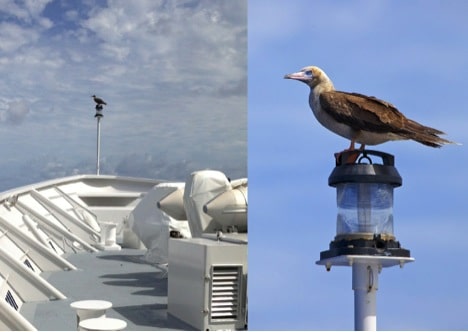
A Red-footed Booby hitches a ride on the bow light and surveys the seas as we travel north.

A Red-footed Booby hitches a ride on the bow light and surveys the seas as we travel north.

Throughout history these seabirds have been recorded in ships’ logs.  The red-footed booby will commonly land aboard sailing ships.  In fact, the name ‘booby’ likely comes from the observations of early Spanish explorers calling the birds ‘bobo’ meaning stupid, as they are tame and easy to capture and eat.

Red-footed boobies are long-flight birds, traveling up to 150 kilometers (93 miles) in search of food. This species of seabird does not migrate.  It lives year-round in tropical and subtropical regions of the Atlantic, Pacific, and Indian Oceans.  The red-footed booby nests on coral atolls or volcanic islands, producing only one egg per clutch once every 15 months; both parents care for the chick.  Young birds mature slowly, but the have a lifespan of 20 years or more.  These are the smallest of more than half a dozen booby species with a body size ranging from 64 to 76 centimeters (25 to 30 inches) and a wingspan up to 1 meter (3.3 feet).

Boobies are well adapted for diving, their bodies are lean and aerodynamic with long wings that wrap around their body.  Just before entering the water these seabirds close their nostrils and cover their eyes with a nictitating membrane, a biological adaptation of most diving birds.

It will be interesting to see how far north this seabird will travel with us. For now though it seems happy just hitching a ride.


Photos: 1 – Dawn Bailey, 2 – Ken Marks
 

Related Posts

Everything You Need to Know About the 2027 Science Without Borders® Challenge

Are you ready to combine your creativity with ocean science?

The 15th Annual Science Without Borders® Challenge is now open! Whether you’re participating for the first time or returning for another year, this guide will help you get started.

This year’s theme, Navigate With Care, invites students to explore how responsible navigation helps protect both people and life in the ocean. Through your artwork, you can compete for scholarships and international recognition while inspiring others to protect both people and life in the ocean.

Read More

Global Reef Expedition Data Contributes to Landmark Report on the World’s Coral Reefs

More than a decade after scientists aboard the Global Reef Expedition surveyed coral reefs across the Pacific, the data they collected continues to contribute to our understanding of the world’s coral reefs.

Today, the Global Coral Reef Monitoring Network (GCRMN) released Status of Coral Reefs of the World: 2025, the most comprehensive assessment to date of the status and trends of coral reefs worldwide. The report brings together an extraordinary amount of information collected over more than four decades—and the Khaled bin Sultan Living Oceans Foundation is proud to have contributed data from the Global Reef Expedition to this global effort. 

Read More
Privacy Overview

This website uses cookies so that we can provide you with the best user experience possible. Cookie information is stored in your browser and performs functions such as recognising you when you return to our website and helping our team to understand which sections of the website you find most interesting and useful.  You can view our complete Privacy Policy here.

Strictly Necessary Cookies

Most of our cookies are used to improve website security and reduce spam. These cookies should be enabled at all times. They also enable us to save your preferences for cookie settings.

3rd Party Cookies

This website uses Google Analytics to collect anonymous information such as the number of visitors to the site, and the most popular pages. Keeping this cookie enabled helps us to improve our website.