In 1953 Captain Jacques-Yves Cousteau and Frédéric Dumas co-authored the book The Silent World (with the rather verbose subtitle: A story of undersea discovery and adventure, by the first men to swim at record depths with the freedom of fish). Ten years earlier Cousteau and Émile Gagnan designed, built and tested the first “aqua-lung” off the southern coast of France. Over 70 years later commercial, scientific and recreational divers use scuba equipment to work in or simply explore the underwater world “with the freedom of fish.”
However, any diver will tell you that the phrase “silent world” really doesn’t apply to their experience underwater. While it is true that conversations tend to be in the form of mute hand gestures (with only the occasional grunt to catch a dive buddy’s attention), the underwater world is a cacophony of sounds that may be heard in the space between the breaths from a scuba regulator. Sounds can vary from the distant crashing of waves on the shore to the grunting and drumming noises fish can produce by vibrating their swim bladders. Herbivorous fishes can be heard as they scrape algae off the reef and grind the limestone chips, taken along with the algae, into a fine sand. Crustaceans are a major source of static on the reef as snapping shrimp communicate with popping noises and crabs and barnacles produce crackling sounds by moving their articulated appendages. These normal ambient sounds that accompany a dive are so ever present that they hardly attract a diver’s attention.
On a recent dive on the barrier reef off Morovo Lagoon we were treated to a novel sound shortly after we backrolled off our dive boat and headed down toward the reef to begin our survey work. Out of the blue (quite literally) we heard what sounded like a series of loud explosions about a second or so apart. In the dense underwater world we could not only hear the sound but feel it reverberate in the air spaces of our chests. The closest thing I could compare it to would be the volley of percussion bombs that are sometimes used to mark the finale of fireworks displays. The thudding detonations caused us all to stop and look at each other as we shrugged our shoulders and made quizzical hand gestures while wondering about the source. It was (thankfully) not coming from our dive boat—but the source was not apparent.
When it happened again a couple of minutes later—and lasted for several seconds this time, I started to wonder if what we were hearing was an earthquake. The Solomon Islands sit in a tectonically active region near the boundary of the Indian and Australian plates so it was entirely possible. Twice before I have been on a night dive in Indonesia during an earthquake. On those dives the sounds were just as intense but they felt more like the engines of a large ship passing directly overhead. The staccato sounds we were hearing were different though, coming in short percussive bursts of a few of seconds separated by a minute or more. In my mind’s eye I could picture these thunderous thuds being produced by the juddering of two undersea tectonic plates as they slipped past each other repeatedly catching and giving way. When the booming persisted at various intervals throughout the entire duration of our hour-long dive, I was really confused. If it was an earthquake it would have to be a major one to persist this long.
Back on the dive boat, speculations on the source of the sounds trumped all other conversation about the dive. It was suggested that possibly there was some underwater seismic tests related to oil prospecting occurring nearby. When I returned to the Golden Shadow I used the ship’s satellite Internet connection to quickly consult the USGS (U.S. Geological Survey) earthquake website. Indeed, there was a 5.1 earthquake that occurred nearby, between the Solomon Islands and Papua New Guinea to the west, but it was at 10:28 am—several hours before our noisy dive.
The mystery was finally solved by one of the local experts that we have with us on this mission—Wade Fairley, an Australian filmmaker and cameraman who lives part time in Morovo Lagoon in the Solomon Islands. Wade said the source of our mysterious booming sounds was in fact: Kavachi.
Kavachi, it turns out, is one of the most active submarine volcanoes in the southwest Pacific. It is located south of Vangunu Island about 20 miles from the spot where we were diving. This undersea volcano rises from a depth of over a kilometer and peaks at about 20 meters below the surface. At times (most recently in 2003) the volcano has broken the surface only to be eroded away once the eruptions subside. The last time Kavachi was active was in 2007 but in early 2014 it sparked to life again and has been grumbling on and off all year. We’ve had a lot of interesting experiences on our survey dives during the Global Reef Expedition and being serenaded by humpback whales in Tonga still probably wins for best soundtrack during a dive but diving in the neighborhood of an active undersea volcano made for a unique and most memorable dive.
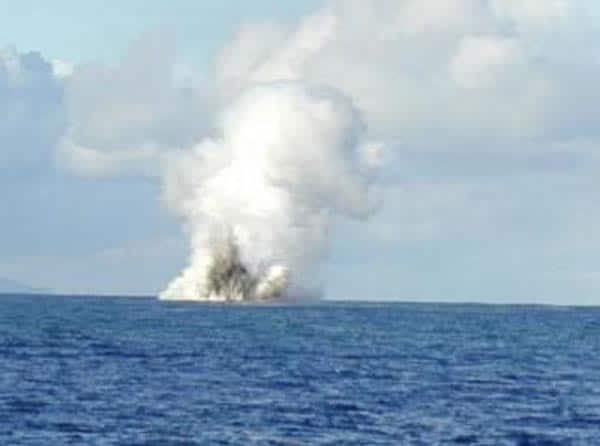
Kavachi Undersea Volcano erupting on May 14, 2000.
[Source: Wikipedia; Image courtesy of Submarine Ring of Fire 2002: Explorer Ridge]