
search-icon
Amphistegina lobifera Foraminifera Are Excellent Bioindicators of Heat Stress on High Latitude Red Sea Reefs

Published in Coral Reefs


Abstract

Coral reefs are in global decline and anomalously hot temperatures shoulder the blame. Foraminferal bioindicators are important because they record historical reef stress over periods of centuries to millennia, as compared to the few decades offered by diver surveys. For a region lacking systematic long-term reef monitoring programs, the use of bioindicators in the Red Sea is compelling. Whereas foraminfera-based indices exist to reconstruct histories of nutrient stress on reefs, there is a paucity of equivalent bioindicators that respond to temperature. Capitalizing on a portfolio of surficial sediment samples collected along the eastern margin of the N. Red Sea and Gulf of Aqaba, this study shows that the relative abundance of Amphisteginidae foraminifera—specifically Amphistegina lobifera—closely track heat stress, as has recently been reported for this family in the S. Pacific. This result is consequential for at least three reasons. First, the Red Sea hosts some of the most northerly coral reefs on Earth. Establishment of a thermal bioindicator here confirms the strategy can be deployed on high-latitude reefs, which are disproportionally afflicted with heat extremes. Second, the considered reefs, and the foraminifera they host, are famed for their thermal resilience. Foraminiferal bioindicators have not previously been trialed on reefs that have adapted in this way. Finally, as a restricted offshoot of the Indian Ocean, the level of endemism in the Red Sea is especially high. The bioindicator that we propose is apparently not compromised by endemism. Our findings advocate for an expanded deployment of Amphistegina-based reef bioindicators.
 

Related Posts

From Students to Stewards: A Full-Circle Moment for J.A.M.I.N.

There are certain faces you never forget.

Over the years, hundreds of students have stepped into mangrove forests with us through the Jamaica Awareness of Mangroves in Nature (J.A.M.I.N.) program. I may not always remember every name, but I remember the expressions — the hesitation before stepping into thick mud, the laughter when someone loses a shoe, the look of surprise when they catch that unmistakable sulfur smell rising from the mangrove soil…

Read More

World Oceans Day: Protecting the Ecosystems That Protect Us

This World Oceans Day, the global community is being challenged to think differently about the ocean.

The 2026 World Oceans Day theme, “Reimagine: Beyond the World We Know, A New Relationship With Our Ocean,” invites us to recognize that the ocean is not something distant or separate from our lives. It regulates our climate, supports our economies, provides food for billions of people, and sustains the natural systems that make life on Earth possible.

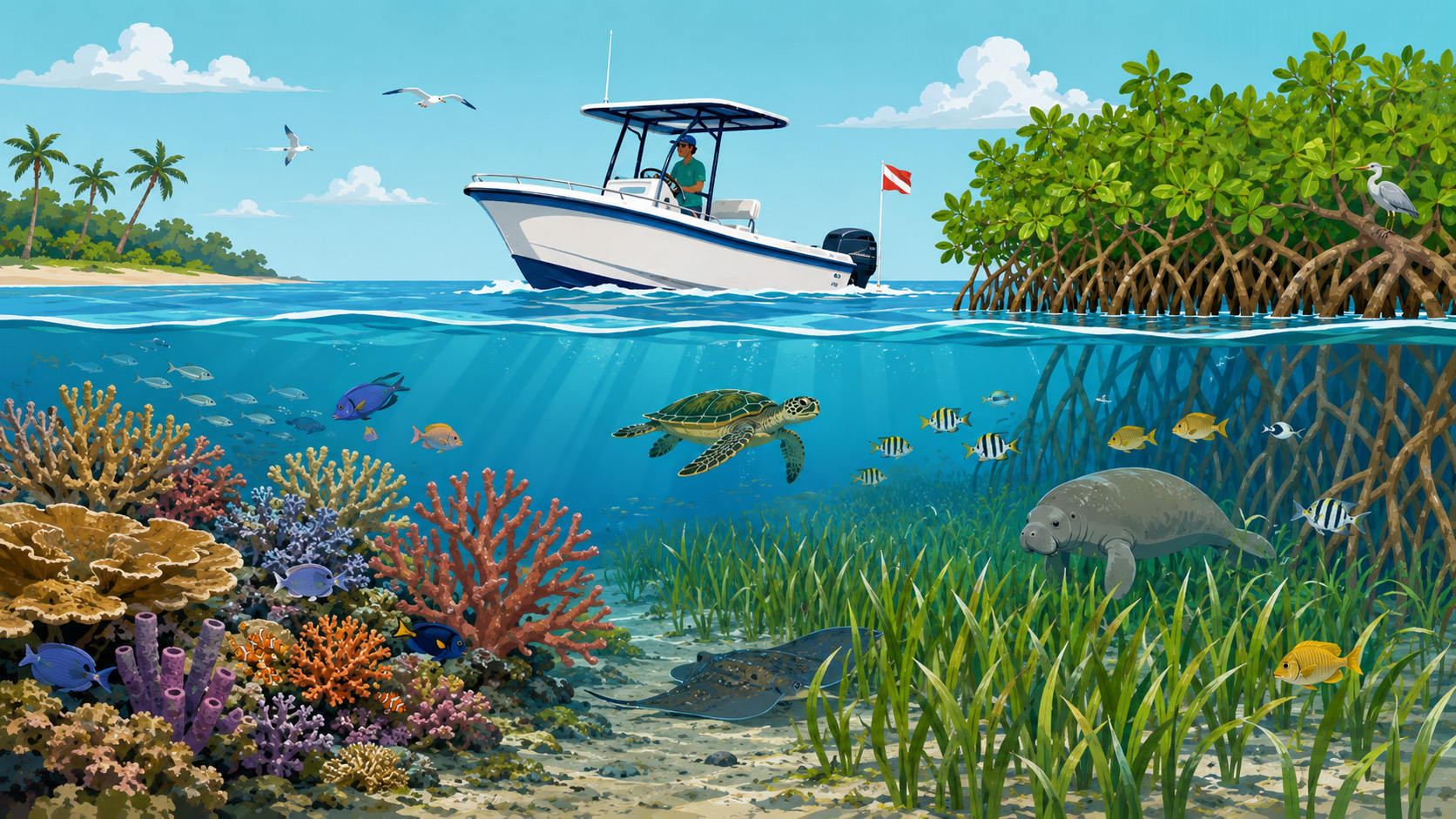
Few places illustrate this connection more clearly than the coastal ecosystems that protect our shores and support marine life. While coral reefs, mangrove forests, and seagrass meadows are often…

Read More
Privacy Overview

This website uses cookies so that we can provide you with the best user experience possible. Cookie information is stored in your browser and performs functions such as recognising you when you return to our website and helping our team to understand which sections of the website you find most interesting and useful.  You can view our complete Privacy Policy here.

Strictly Necessary Cookies

Most of our cookies are used to improve website security and reduce spam. These cookies should be enabled at all times. They also enable us to save your preferences for cookie settings.

3rd Party Cookies

This website uses Google Analytics to collect anonymous information such as the number of visitors to the site, and the most popular pages. Keeping this cookie enabled helps us to improve our website.