This article, published by one of the Living Oceans Foundation Research Fellows, Sonia Bejarano, PhD and science team member, Professor Peter Mumby, looks at changes in the spear fishery of herbivores associated with closed grouper season in Palau, Micronesia.
Changes in the spear fishery of herbivores associated with closed grouper season in Palau, Micronesia
Animal Conservation
August 29, 2013
By Sonia Bejarano, PhD, P.J. Mumby, and Y. Golbuu
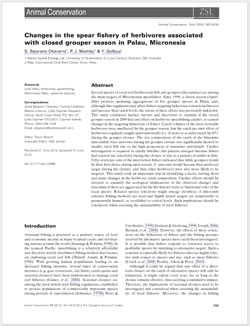 Several species of coral reef herbivorous fish and groupers (Serranidae) are among the main targets of Micronesian spearfishers. Since 1994, a closed season (April–July) protects spawning aggregations of five grouper species in Palau, and, although this regulation may affect fishers targeting behavior towards herbivores and increase their catch levels, the extent of these effects was previously unknown. This study conducted market surveys and interviews to examine if the closed grouper season in 2009 had any effect on herbivore spearfishing catches, or caused changes in the targeting behavior of fishers. Catch volumes of the most desirable herbivores were unaffected by the grouper season, but the catch per unit effort of herbivores regularly caught opportunistically (i.e. if seen) or avoided raised by 45% during the grouper closure. The size composition of the catch of the bluespine unicornfish Naso unicornis during the grouper closure was significantly skewed to smaller sized fish due to the high proportion of immature individuals. Further investigation is required to clarify whether this pattern emerged because fishers had relaxed size selectivity during the closure or due to a paucity of adults in July. Fifty-seven per cent of the interviewed fishers indicated that while groupers would be their first choice during open season, N. unicornis would become their preferred target during the closure, and that other herbivores were also more likely to be targeted. This study took an important step in identifying a factor driving short and acute changes in the herbivore catch composition. Further efforts should be directed to quantify the ecological implications of the observed changes and determine if these are aggravated by the life-history traits or functional roles of the focal species. Relaxed species selectivity might emerge elsewhere, if inherently selective fishing methods are used and highly prized targets are temporarily or permanently banned, or overfished to critical levels. Such implications should be considered when assessing the sustainability of local fisheries.