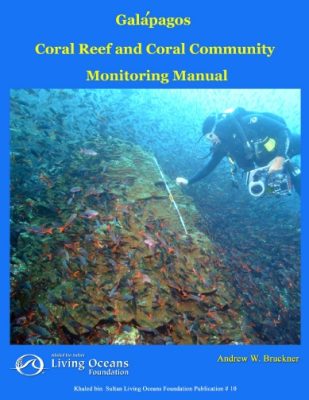
 The Galápagos Coral Reef and Community Monitoring Manual was developed at the request of the Galápagos National Park in response to coral surveys undertaken by the Khaled bin Sultan Living Oceans Foundation during the Global Reef Expedition. It is intended to serve as a practical guide for scientists, managers and dive operators to document changes to the condition of coral reefs and coral communities within the Galápagos.
The Galápagos is an isolated archipelago of volcanic islands that straddle the equator, about 1000 km (620 miles) off the coast of Ecuador, in the Eastern Pacific Ocean. There are 14 main islands and over 100 small islets that sit on a deep platform and are surrounded by deep (2000-4000 m) water. Shallow waters adjacent to the islands support large populations of marine mammals, turtles, cartilaginous fishes and bony fishes, as well as hundreds of species of invertebrates and diverse algal communities. Stony (scleractinian) corals are one of the key habitat forming species present throughout much of the archipelago.
Scleractinian corals in the Galápagos are represented by characteristic eastern Pacific species, with no known endemics. They consist of many fewer species than found in the Caribbean and IndoPacific (22 in total) and form true coral reefs in only a single location, off Darwin Island. In other locations, the coral communities typically occur as scattered colonies, and infrequently as carbonate build-ups. Coral communities in the Galápagos Islands are dominated by aggregations of massive corals, Pavona clavus, Pavona gigantea and Porites lobata. Scattered colonies of branching Pocillopora species occur in many locations, but Pocillopora build-ups that were common prior to 1982 appear to be much more restricted today. Unique assemblage of free-living fungiid corals and Psammocora sp. are also found at Devil’s Crown and a few other locations.