search-icon
Global Reef Expedition Pedro Bank, Jamaica Field Report March 10‐20, 2012

Global Reef Expedition Pedro Bank, Jamaica Field Report March 10‐20, 2012
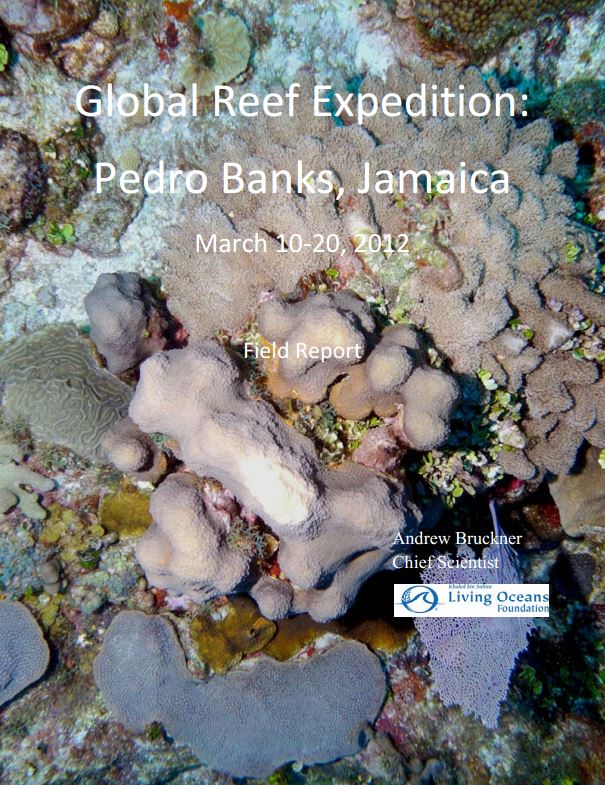
Global Reef Expedition Pedro Bank, Jamaica Field Report - Living Oceans FoundationThe coral reefs located off the north coast of the Jamaican mainland are some of the best and most studied reefs in the world (Hughes 1994). In contrast, very few research studies have been conducted on the banks located off the south coast of Jamaica. The first and only comprehensive coral reef assessment conducted on a portion of Pedro Bank was completed in 2005 (Kramer 2006). Since this time, considerable work has been done in the development of management measures to protect these resources. This includes development of a possible zoning strategy, including the adoption of marine protected areas (i.e. a fishery reserve off southwest Cay). To date, no protection has yet been adopted for these areas, although stakeholder consultations have been completed and recommendations have been provided to the relevant government agencies in Jamaica.

Pedro Bank is Jamaica’s most valuable and largest fishing ground. It is beginning to experience overfishing, like most other locations in Jamaica. A long history of fishing of lobster, conch, and fish has led to the overexploitation of these fisheries on Pedro Bank (Aiken et al. 1997; Gittens 2001; Koslow et al. 1988; Munro 1983; Nicholson and Hartsuijker 1983). The number of people living on Pedro Cays has increased over the years resulting in increased resource extraction, destruction of coastal vegetation, excessive trash debris, no sewage treatment, and diminishing habitat for nesting turtles and seabirds (Espeut 2006, Hay 2006).

We conducted an extensive survey of coral reef habitats within Pedro Bank to help inform constituents of the value of these resources and the benefits that would ensue through the development of a network of marine protected areas. In particular, the establishment of fish sanctuaries will help build connectivity, enhance resilience, and protect vital larval supplies, fish stocks and keystone habitats. The current research used the Atlantic and Gulf Rapid Reef Assessment protocol, which is the same methodology applied in 2005. Many of the same areas assessed in 2005 were evaluated during this study and we expanded surveys to new locations.  Additional pilot efforts to map the proposed fish sanctuary were undertaken.
 

Related Posts

Introducing Our New Website: A Fresh Look for the Foundation’s Future

As we celebrate the Khaled bin Sultan Living Oceans Foundation’s 25th anniversary, we are proud to unveil our newly redesigned website—a modern home for our science, conservation work, and educational programs. This launch marks an important moment for the Foundation as we honor our long history and look toward the future of ocean conservation.

For more than two decades, the Foundation has worked tirelessly to improve the health of our living oceans. We have advanced ocean science, led one of the largest coral reef research missions in history, restored mangrove forests with local communities, created award-winning education programs, and shared the wonders of the ocean with people around the world. Our new website reflects the organization we are today—focused on conserving coral reefs, restoring mangrove forests, and improving ocean literacy—while still highlighting the legacy of work that brought us here.

The redesigned site…

Read More

Connecting People, Art, and Oceans: Championing Conservation at the 2025 IUCN Congress

The IUCN World Conservation Congress brings together thousands of leaders and decision-makers from governments, non-profit organizations, civil society, Indigenous groups, and the private sector to shape global conservation policy and action. This influential gathering serves as a platform to share knowledge, build partnerships, and advance initiatives that protect our planet’s biodiversity.

As a member of the International Union for Conservation of Nature (IUCN), the Khaled bin Sultan Living Oceans Foundation was honored to take part in the Congress, joining a global community of leaders, organizations, and changemakers committed to protecting nature and advancing sustainable futures.

Read More
Privacy Overview

This website uses cookies so that we can provide you with the best user experience possible. Cookie information is stored in your browser and performs functions such as recognising you when you return to our website and helping our team to understand which sections of the website you find most interesting and useful.  You can view our complete Privacy Policy here.

Strictly Necessary Cookies

Most of our cookies are used to improve website security and reduce spam. These cookies should be enabled at all times. They also enable us to save your preferences for cookie settings.

3rd Party Cookies

This website uses Google Analytics to collect anonymous information such as the number of visitors to the site, and the most popular pages. Keeping this cookie enabled helps us to improve our website.