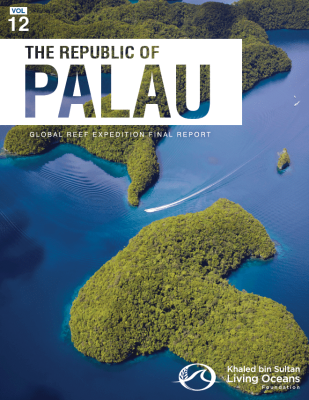
The Global Reef Expedition: The Republic of Palau Final Report provides a comprehensive summary of our findings from the Global Reef Expedition mission to assess the status of coral reefs and reef fish in Palau. It also includes recommendations that can help Palau continue to preserve their reefs and coastal marine resources.
On the Khaled bin Sultan Living Ocean Foundation’s Global Reef Expedition—the largest coral reef survey and mapping expedition in history—an international team of scientists assessed the health and resiliency of coral reefs around the world. Over the course of five years, we circumnavigated the globe collecting valuable baseline data and conducting standardized assessments of coral reefs and reef fish. In 2015, scientists visited Palau as part of the Expedition to assess the state of the reefs. Working closely with local partners, our international team of scientists spent nearly a month at sea conducting over 1,800 benthic and fish surveys across 10 states in Palau.
We found Palau’s coral communities to be in excellent condition compared to other reefs in the region. In fact, Palau had the highest overall live coral cover of any of the reefs surveyed on the Global Reef Expedition. Palau’s reefs and coral communities have benefited from the efforts to conserve the natural marine heritage found there.
Although the Global Reef Expedition found the coral to be in good condition, reef fish communities in Palau were similar to other reefs surveyed in the Western Pacific. Signs of overfishing were observed on nearshore reefs despite existing regulations, particularly on reefs near population centers. However, by expanding current fisheries management regulations, and expanding no-take no-entry areas, Palau’s reef fish communities could become some of the best in the world.
The Global Reef Expedition: The Republic of Palau Final Report provides scientists, managers, and stakeholders with critical information to manage Palau’s coastal marine resources. We understand the reefs have likely changed since they were surveyed on the Global Reef Expedition in 2015, but this report provides valuable baseline data on the state of the reefs at a point in time. This information can help managers identify priority sites for conservation action and track changes to the reef over time.
The Khaled bin Sultan Living Oceans Foundation hopes the data included in this report will be used to protect and conserve these coral reefs, so they can continue to be used and enjoyed by the people of Palau for generations to come.
Global Reef Expedition: The Kingdom of Palau Final Report
The Global Reef Expedition: The Republic of Palau Final Report presents the Foundation’s findings from the Global Reef Expedition mission to Palau in 2015, along with recommendations that can help preserve the reefs into the future.
Global Reef Expedition Final Report: Palau (4 MB PDF)