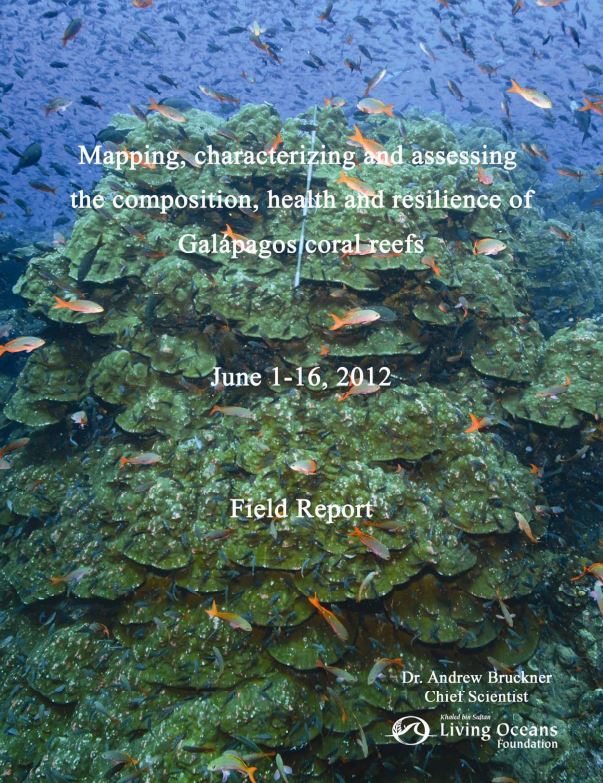
Mapping, Characterizing and Assessing the Composition, Health and Resilience of Galápagos Coral Reefs.
Between June 1-16, 2012, a multidisciplinary research team from the Khaled bin Sultan Living Oceans Foundation (KSLOF), University of Miami, University of the Virgin Islands, Pennsylvania State University, Nova Southeastern University National Coral Reef Institute, the National Oceanic and Atmospherics’ AOML, Instituto NAZCA de Investigaciones Marinas, and the Galápagos National Park conducted groundtruthing, detailed SCUBA assessments, physiochemical sampling, and biological sampling of corals and their symbionts within coral reefs and coral communities located in the Galápagos. All research was staged from the M/Y Golden Shadow, a 67 m research vessel, with use of small catamarans and tenders to access the sites. The main targets were Darwin and Wolf Island coral reefs, with additional assessments and
research on coral communities surrounding Marchena, Floreana, Santa Cruz/Baltra, San Cristóbal, Isabela and Urvina (Fig. 1). The research provides information on: a) the spatial distribution and extent of different shallow marine communities and detailed coral zonation patterns within these communities; b) population dynamics of corals and reef fishes within these communities; c) the current status, health and resilience of coral ecosystems; d) patterns of recovery from past ENSO disturbances; and e) specific factors and processes contributing to the stability, resilience and expansion of these communities.
The research team conducted work within 23 sites, spending a total of 411 hours under water and conducted groundtruthing over a total area of 750 km2. The groundtruthing team surveyed shallow marine habitats off seven islands, collecting 295 drop camera videos and 1,258,413 bathymetric readings. SCUBA assessments and underwater research was conducted off eight islands in 23 different locations.
Coral assessments included 54 quantitative belt transects completed off 5 islands, population surveys using quadrats in six locations, multiple phototransects, and additional roving coral surveys within coral communities off seven islands. Recorded measurements for corals included species, size (width and height), extent of partial mortality and cause of mortality, if it could be determined. Twenty two species of corals were observed, although many species were identified from a single location. Massive colonies of Porites lobata, Pavona clavus and branching Pocillopora damicornis were the dominant taxa, although Pocillopora colonies in general have declined substantially since the 1980s and were absent or extremely rare in many locations where they once formed large build-ups. Large aggregations of Pavona varians, P. gigantea, Psammocora stellata and Diaseris distorta were also identified in one or two locations. Concurrently, point intercept surveys were completed in each location to measure living cover of corals, other invertebrates and algae, and to quantify the type and amount of each substrate (sand, coral, hardground, rubble). Fish size (total length) and abundance for ecologically and commercially-important species was characterized within 146 belt transects and were conducted in 23 locations. A total of 154 species of reef fish were recorded during roving surveys…