Published in Geophysical Research Letters
Abstract
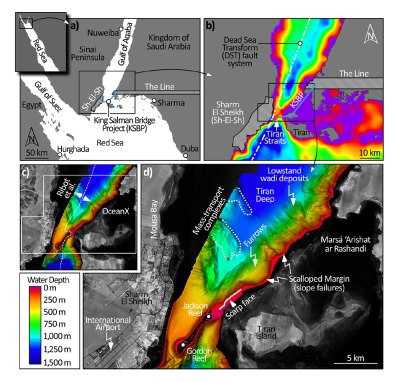 The Red Sea is a maritime rift. Tsunamigenic submarine landslides are common in these deep, steep-sided, and seismically active basins. Because the rift is narrow, tsunami formed on one margin dissipate little before impacting the opposite side. Red Sea slope failures are therefore especially hazardous. We examine the tsunamigenic potential of an incipient landslide in the Tiran Straits that started, but then stopped after a short distance. Radiometric and biotic analyses fix the age of this landslide to within the last 500 years. Tsunami modeling of the incipient slide predicts ∼10 m wave heights on the Egyptian coastline. Of present concern is that the slope will eventually slide to completion with even more hazardous results. Tsunami simulated for this future event are twice as large as that generated by the incipient slide, so the threat posed by a future slide is consequential. Sharm El Sheikh, an Egyptian resort town now lies in its path, as does “The Line,” a vast Saudi infrastructure project. This study warns of credible tsunami risk in the rapidly urbanizing Tiran Straits.
Plain Language Summary
We present the discovery of an incipient submarine landslide in the Tiran Straits. Our study reveals how even incipient submarine landslides can spawn tsunami as tall as those from Mw = 9 earthquakes, at least locally. Incipient failures also carry the dual threat of eventually sliding to completion, yielding still larger tsunami sometime in the future. Should this incipient slide complete, it will gravely threaten the rapidly urbanizing coastline of the Tiran Straits and adjacent Gulf of Aqaba.