
search-icon
Rare Fossil Formations

The most critical part of creating benthic habitat maps is the ground-truthing process for several reasons. First, exploring the research site improves the producer’s understanding of the landscape being mapped, thus allowing them to assess the maps qualitatively as they are being produced. Second, the field data gathered by the ground-truthing team is used to fine-tune parameters in statistical models, enabling the models to reliably predict the occurrences of different habitats within the imagery. A major component of the statistical modeling for mapping is collecting information throughout the study area. The field effort is often guided by the map maker as they must visit all of the visible landscape features, especially those that are not immediately recognizable. Visiting these unknown features often leads to surprising observations with important implications. Such an event happened during the ground-truthing of Scilly atoll in the Society Islands of French Polynesia.
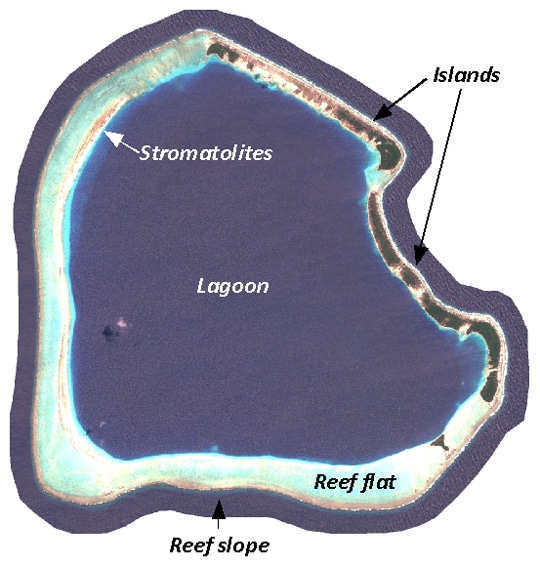
A WorldView-2 satellite image of Scilly, French Polynesia, an atoll in the Society Islands

At a first glance of the satellite imagery, Scilly appears to be a standard atoll. There is a large, deep lagoon encircled by a reef flat transitioning into a coral-covered reef slope. However, a particular landscape feature stands out within the satellite imagery. From this bird’s-eye-view, there appears to be lithified sand dunes (i.e. loose grains of sediment converted to rock) between the reef flat and lagoon.
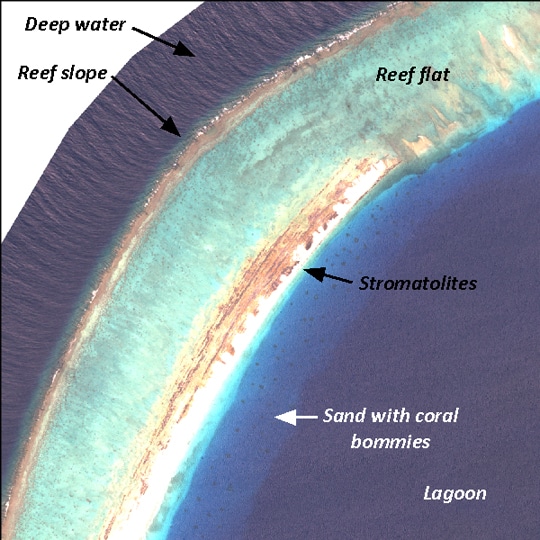
A close-up of the Worldview-2 satellite image showing the stromatolites


The ground-truthing team visited this feature to confirm this observation, but what they found was much more interesting. It was a large expanse of stromatolites.
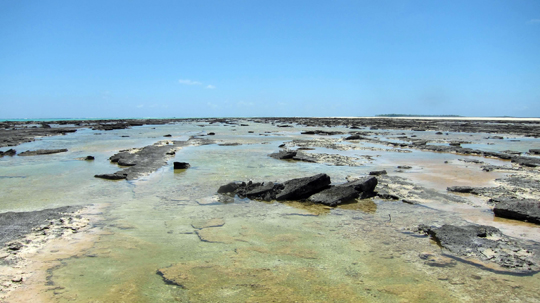
A landscape view of the stromatolites


Stromatolites are laminated structures formed when microbial mats, often composed of cyanobacteria, trap and cement sediments into rock. Some of the earliest fossil records are those of stromatolites. They take on one of several morphologies, such as conical, stratified, branching, domal, or columnar.
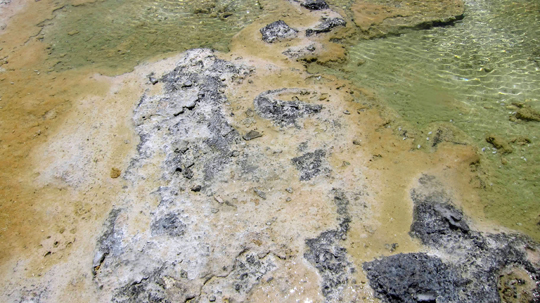
A stromatolite emerging from the water’s surface. The living microbial mat is orange in color, and as it grows, it rises above the water’s surface and becomes desiccated.


Stromatolites were common in the Precambrian, a geologic Supereon that accounts for 88% of geologic time, but they are rare in the Modern due to the development of burrowing and grazing life forms. Today, they are found primarily in locations with hypersaline conditions, such as lakes or marine lagoons, which prevent larger animals from grazing on the microbes.

Two of the best examples of modern stromatolite formations are found in Shark Bay, Western Australia, and Exuma Cay, Bahamas. In Pavilion Lake, Canada, National Aeronautics and Space Administration (NASA), the Canadian Space Agency (CSA), and several universities are studying the stromatolites to assess how environmental conditions influence microbial life in an effort to understand how life on other planets may develop.
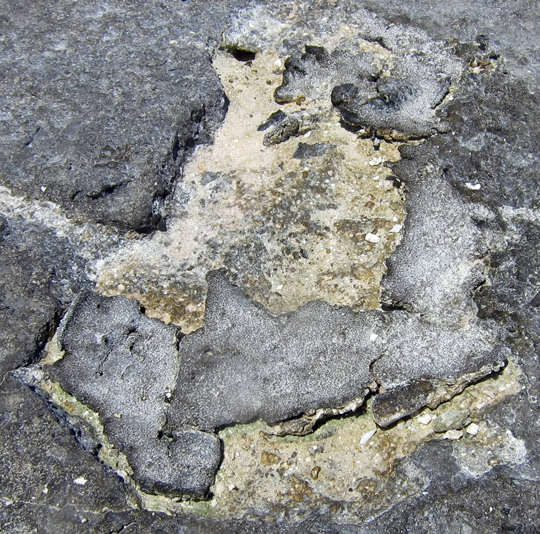
A desiccated (dried out) layer of the stromatolite


In French Polynesia, stromatolites have been observed in several atolls, and the finding of a large extent of stromatolites, which is observable in the satellite imagery, has several implications. The structures are delicate, and the presence of this large expanse indicates that the microbial mats are rarely disturbed. This is important in a geologic perspective because the microbial communities contribute to the creation of rocks on which islands and sand cays can begin to form.
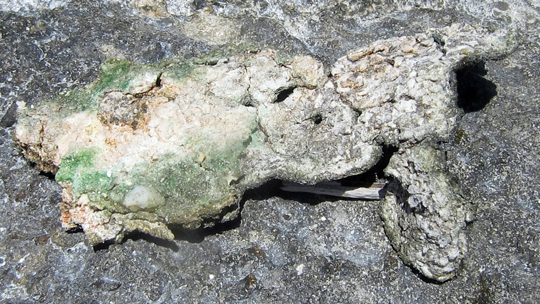
The underside of the desiccated stromatolite. The blue-green color is from the cyanobacteria that trap and bind the sediment grains.


Scilly is thus a great example of multiple biological processes driving geologic activity and shaping those landscapes observed in the satellite imagery.

(Photos/Images by: Jeremy Kerr)

To follow along and see more photos, please visit us on Facebook! You can also follow the expedition on our Global Reef Expedition page, where there is more information about our research and team members.
Related Posts

Introducing Our New Website: A Fresh Look for the Foundation’s Future

As we celebrate the Khaled bin Sultan Living Oceans Foundation’s 25th anniversary, we are proud to unveil our newly redesigned website—a modern home for our science, conservation work, and educational programs. This launch marks an important moment for the Foundation as we honor our long history and look toward the future of ocean conservation.

For more than two decades, the Foundation has worked tirelessly to improve the health of our living oceans. We have advanced ocean science, led one of the largest coral reef research missions in history, restored mangrove forests with local communities, created award-winning education programs, and shared the wonders of the ocean with people around the world. Our new website reflects the organization we are today—focused on conserving coral reefs, restoring mangrove forests, and improving ocean literacy—while still highlighting the legacy of work that brought us here.

The redesigned site…

Read More

Connecting People, Art, and Oceans: Championing Conservation at the 2025 IUCN Congress

The IUCN World Conservation Congress brings together thousands of leaders and decision-makers from governments, non-profit organizations, civil society, Indigenous groups, and the private sector to shape global conservation policy and action. This influential gathering serves as a platform to share knowledge, build partnerships, and advance initiatives that protect our planet’s biodiversity.

As a member of the International Union for Conservation of Nature (IUCN), the Khaled bin Sultan Living Oceans Foundation was honored to take part in the Congress, joining a global community of leaders, organizations, and changemakers committed to protecting nature and advancing sustainable futures.

Read More
Privacy Overview

This website uses cookies so that we can provide you with the best user experience possible. Cookie information is stored in your browser and performs functions such as recognising you when you return to our website and helping our team to understand which sections of the website you find most interesting and useful.  You can view our complete Privacy Policy here.

Strictly Necessary Cookies

Most of our cookies are used to improve website security and reduce spam. These cookies should be enabled at all times. They also enable us to save your preferences for cookie settings.

3rd Party Cookies

This website uses Google Analytics to collect anonymous information such as the number of visitors to the site, and the most popular pages. Keeping this cookie enabled helps us to improve our website.