Today we finished survey work at Huon Atoll, in the north west of the D’entrecasteaux Atolls Natural Park. As I descended on my dive, I was greeted by the now common site of a couple of grey reef sharks, a school of jacks swam past, while a few large Malabar Grouper poked their heads out of reef crevasses nearby (see Great Groupers and Sharks, Sharks Everywhere!). These top predators are a welcome sight on the coral reef. All too often they are overfished and absent.
As I begin my work looking at the bottom community, I begin to consider predators operating at a different scale. I pass over a school of juvenile fish. Semi-translucent, I can make out some of their internal organs. Intermingled with these juveniles are small damsel fish, only a few centimeters in length. Such fish are seemingly oblivious of the sharks and jacks circling above, which focus on much larger prey. Their vigilance is better placed closer by. Perched atop a nearby coral head is a much more menacing prospect – the lizardfish. While small, little bigger than the palm of my hand, in fact, the lizard fish is a voracious predator.
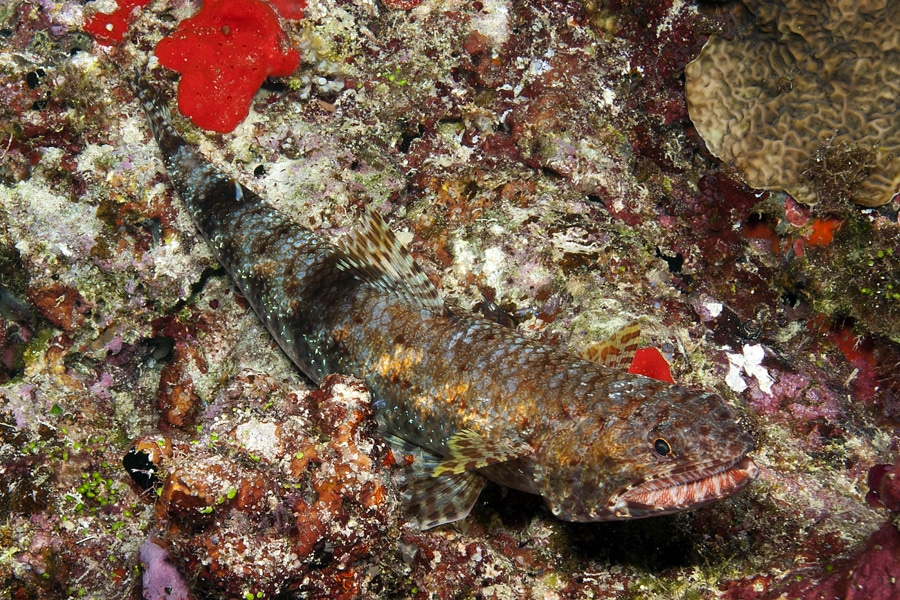
A Lizard fish perched on the bottom and scanning the coral reef for potential prey.
It is easy to see how the lizardfish got its name. Close examination of the fish reveals a mouth of razor sharp interlocking teeth. The potential death knell for any small and unsuspecting fish that passes by. With its mottled pattern the lizardfish blends into the coral reef background. Lying stationary on the seafloor with its pectoral fins splayed out to the side, the lizardfish arches its back and scans the water above. From this position it spots unwary prey, before launching lightning fast attacks.
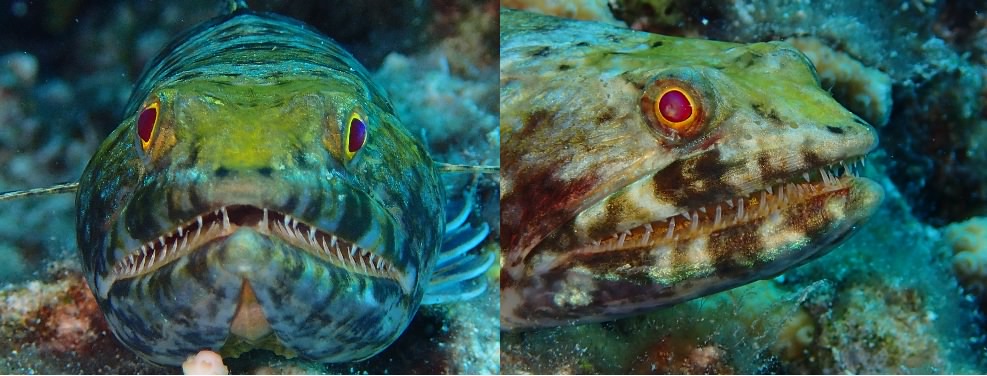
Though small, the lizardfish boasts a mouth of sharp and menacing teeth. Perfect for clutching hold of prey.
Seen from the perspective of a small juvenile fish, the coral reef is a very scary place full of dangerous predators and demanding constant vigilance.
Photos: 1 – Ken Marks; 2,3 – Badi Samaniego