For the last few days, we have been in northern New Caledonia, near the protected D’entrecasteaux Atolls National Park. It feels very remote up here, and from where the M/Y Golden Shadow sits just outside the park boundary, we can see nothing but ocean stretching to the horizon in every direction … and seabirds.
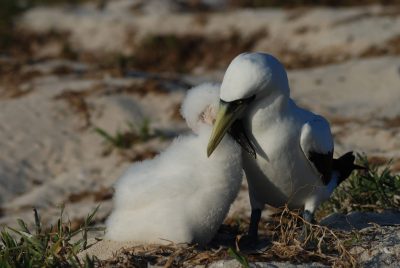
Seabird Chicks: Masked booby adult and chick reunite when the parent returns from sea with food for the young bird.
Home to Hundreds of Seabird Chicks
But there is plenty of life here. Using a smaller boat we reached the island of Huon, it’s not much more than a large sand bar with sparse short grass growing on top. But, it is home to hundreds of seabirds and right now it is spring in the Southern Hemisphere which means they are all busy nesting and raising chicks.
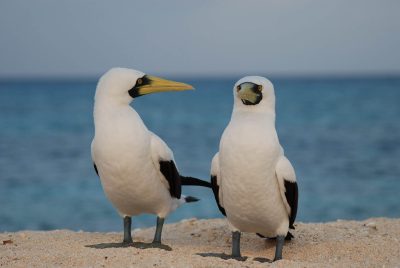
Two masked boobies on the beach on Huon.
When we arrived on the island, we immediately noticed the masked boobies, Sula dactylatra. They are big and noisy seabirds, making everything from whistling to squawking noises. We saw every stage of breeding in these birds, from eggs on the nest to seabird chicks to fledglings trying desperately to take off along the shore line.
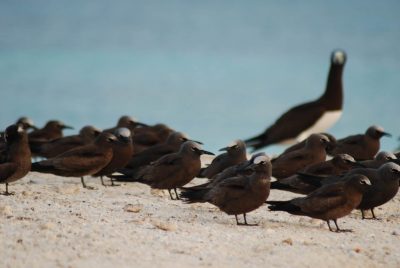
More Seabirds: Brown noddy, huddled together on the leeward side to the island to take shelter from the constant wind.
One of the most numerous seabirds were the brown noddys, Anous stolidus. During the day, they seemed to favor the windward side of the islet, where they swooped and dived in the strong onshore winds. But as the sun went down, they huddled together on the leeward side of the islet, taking shelter from the wind.
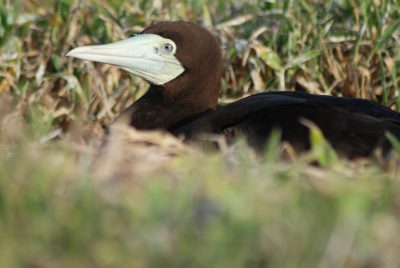
Waiting for Seabird Chicks: Adult brown booby sits on the nest.
Brown boobies Sula leucogaster sat on eggs in nests that were little more than flattened patches of the grass. These seabirds looked a bit awkward on the ground, but they were spectacular in the air, as they have a four foot wingspan. We watched as they swooped low over the water, almost touching it with their wing tips. They were fast and graceful. Watching them soar through the air, it was easy to see how well suited they are for a life at sea.
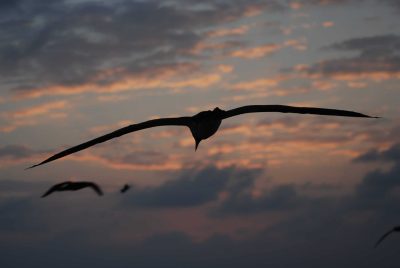
Adult brown booby soars out to sea on large wings.
Photos: 1-5 – Alison Barrat