Today the education team visited Asumbuo Village on Utupua Island. The village warmly welcomed us with flower headbands and then they sang us a beautiful welcome song. Today’s blog is about a story that is passed down from generation to generation. Paramount Chief John of Utupua described the story to us.
Amatelege Village used to be way up in the hills. Every day a young boy from this village would watch the fishing canoes leave the adjoining village, Nembao. The boy was observant, counting the number of fisherman in the boat. When the canoes reached the coral reef, near two large rocks in the middle of the ocean, the boy would count the number of fisherman again. There would always be one additional person in the canoes. In the evening, when the canoes would come home, the boy would count the men returning. There would be the same number of men as had left in the morning.
The boy was really perplexed by this. One morning he counted all of the fisherman in the canoe. Then he took his canoe and paddled out to the reef. He tied his canoe to the small rock called Refeta. He counted the fisherman again and noticed that there was still one additional person. The boy waited for all the fisherman to leave, and an unknown girl was left behind.
She wanted to get on the rock but the boy was blocking it. He started to ask her questions.
He said to her, “Where are you going?”
She responded, “I want to go to the rock.”
He asked, “Why do you want to go to the rock?”
She replied, “This is where I live.”
The boy asked to see her home. She asked the boy to kneel at her back, close his eyes, and then she led him down a secret passageway. When they arrived in the home, the boy opened his eyes. To his surprise there was a sea snake in the home. The boy was very scared until the girl introduced the snake as her mother named Hkolo.
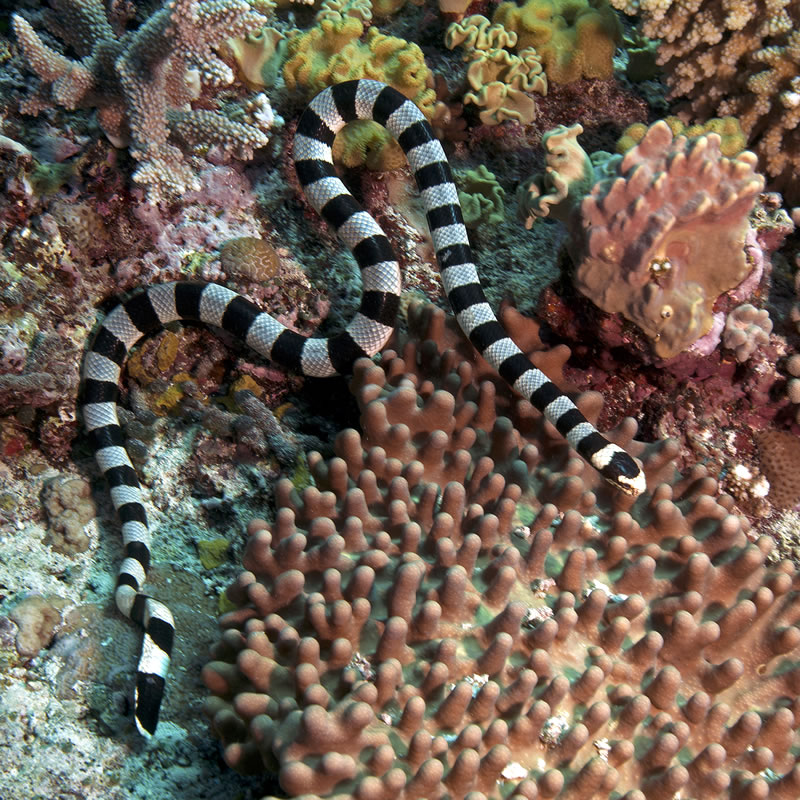
Banded sea snake, Laticauda colubrina.
The mother told the boy that he could marry her daughter. The boy agreed and took the girl back to his village.
After some time, the couple had a child. Every day the boy, now a man, would go fishing at the small rock. His wife would tend to all of the chores and the man was surprised that his wife could accomplish so much with a young baby to look after.
One day, the man lied to his wife and said he was going fishing. Instead, he returned home early from fishing to see how his wife could accomplish so much. When he entered their home, he found their child on the floor with a sea snake coiled around the baby. Out of fear, the man grabbed the baby and then chopped up the sea snake.
The man threw the pieces of the sea snake into the ocean. The pieces of the sea snake rejoined and the sea snake returned to the rock, never to return again to the village.
This story describes the relationship between humans and their environment. This type of information is often referred to as Traditional Ecological Knowledge (TEK). This traditional story teaches people from the village to not be afraid or harm sea snakes.
Photo by Ken Marks.