Mangrove Education and Restoration Blog
It’s spring break in North America, which means that many families are traveling to warmer destinations to enjoy some rest, relaxation, and much needed warmth and sunshine. This is evident by the many travelers on my plane ride from Miami to Marsh Harbour, Bahamas who are dressed in flip flops, shorts, and many varieties of hats to protect them against the sun. I envy their excitement; however, I’m excited for a different reason – I’m going to the Bahamas and then Jamaica to implement the second phase of our Mangrove Education and Restoration Program.
During this phase of the year 1 B.A.M. and J.A.M.I.N. programs, we focus on teaching Biology 10th grade students about the mangrove food web. We not only discuss the role and trophic level of organisms in this ecosystem, but we also provide opportunities to classify the organisms into their correct phyla. We use a hands-on approach to learning about food webs by bringing organisms that live in the mangrove ecosystem into the classroom. Students are able to identify, touch, and hold some of the animals that we bring in. For many students, this is their first experience observing these organisms.
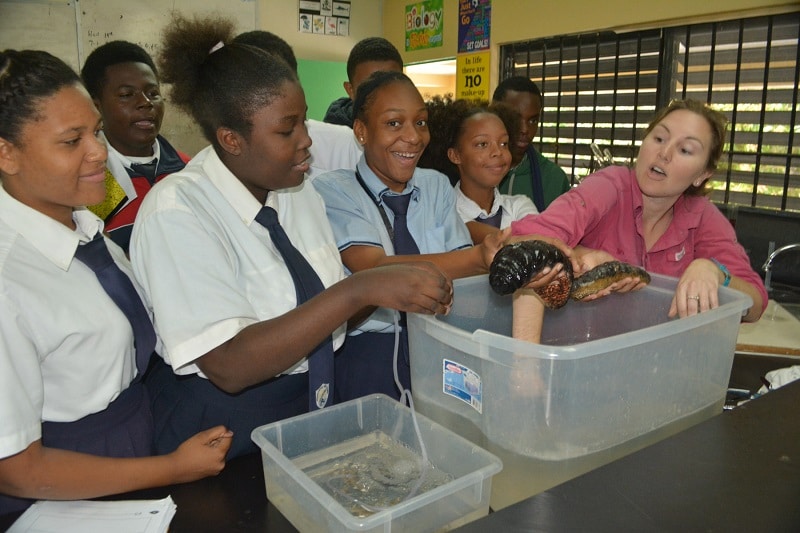
Students at Abaco Central High School touch a sea cucumber for the first time. As part of the BAM year 1 program, we bring organisms in the mangrove food web into the classroom so that students can learn about how they are connected to each other.
Additionally, we implement an activity that allows the class to literally “string” together a mangrove food web. Standing in a circle students pretend to be an organism in the food web and after they decide their trophic role, they pass the string (representing energy) to the student (different organism) who preys on them. By the end of the activity, there are strings zigzagging in every direction around the circle and the students have created a mangrove food web.
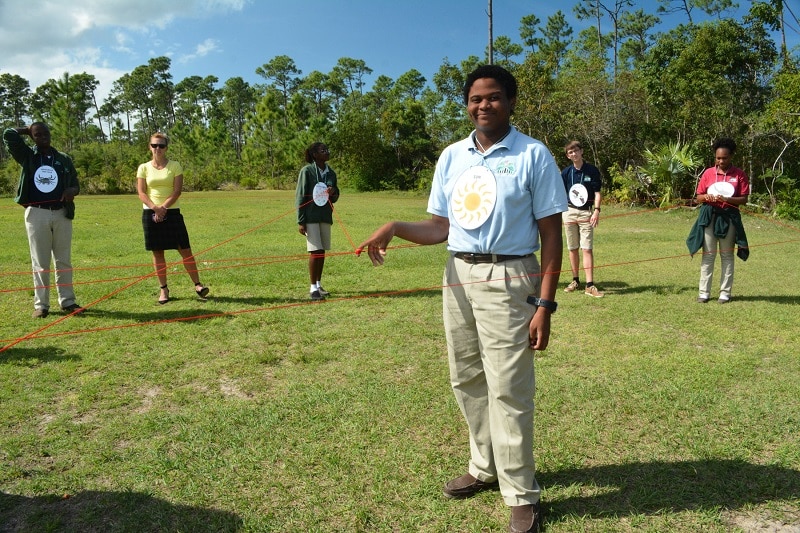
Students at Forest Heights Academy work together to build a mangrove food web.
As part of the B.A.M. and J.A.M.I.N. year 2 programs, we continue to monitor mangroves with 11th grade Biology students. We return to the mangrove site that the students restored in the first year and with their groups, the students find the 5 x 5 meter squared quadrats that they set up during the first phase. For a second time, the students collect non-living environmental data such as pH, temperature, dissolved oxygen, and salinity inside their quadrat. The students then learn a new field technique – they learn to tag and measure the mangrove trees in their quadrat, which are the living components. After a third trip to the mangroves, students will analyze this data to come up with a management plan.
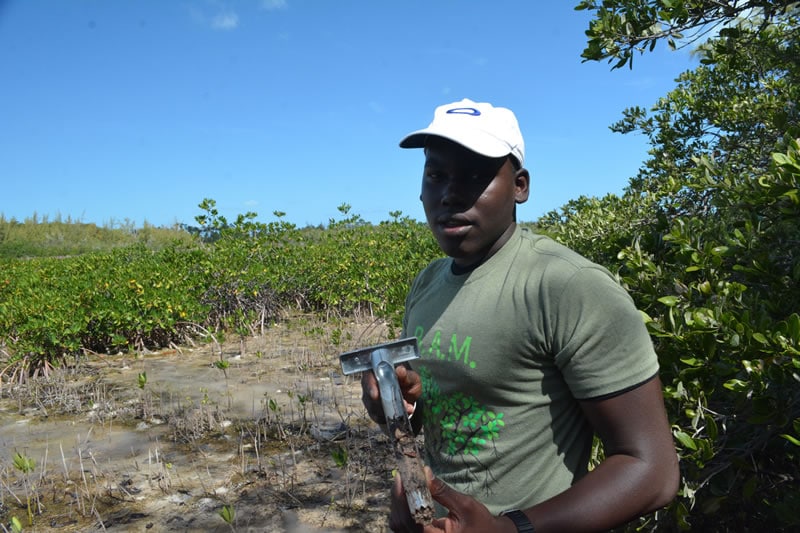
Forest Heights Academy 12th grade Marine Biology student collects a soil sample from his group’s quadrat.
Another new and exciting component to the year 2 program is teaching students about mangrove disease, particularly in the Bahamas. In collaboration with our partners at FRIENDS of the Environment, we have partnered with scientists at North Carolina State University Department of Applied Ecology to provide students with an opportunity to participate in a citizen science project. There will be more information about this in the following blogs.
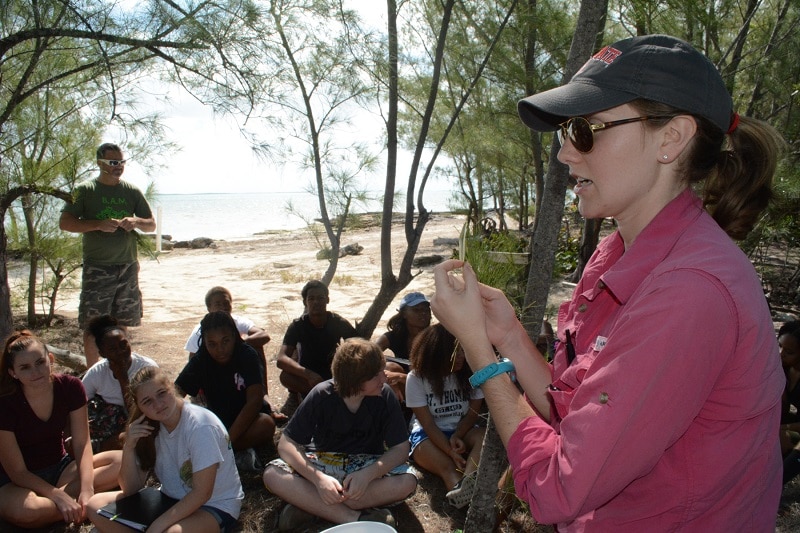
Ryann Rossi, PhD Candidate at North Carolina State University explains the disease symptoms that the students should be looking for when collecting leaves.
Keep following our blogs for more information about the new additions to the year 2 program.