Tunicates, commonly called sea squirts include a diverse assemblage of invertebrates that are usually attached to the bottom, but also include 10 species that live in the water column. These invertebrates share some similarities with vertebrates by having a tail, a dorsal nerve cords and notochords and pharyngeal gill cleft at some point in their life.
Most of the larger tunicates are solitary individuals, while smaller ones tend to form colonies made up of identical zooids, and some are social tunicates that tend to cluster together. They typically have a sac-like body with two tubular openings (siphons). They are highly efficient filter feeders, taking in the equivalent of their body size in water every second through the incurrent siphon, which is then pumped through a gill net to remove plankton and oxygen and discharged through the excurrent siphon.
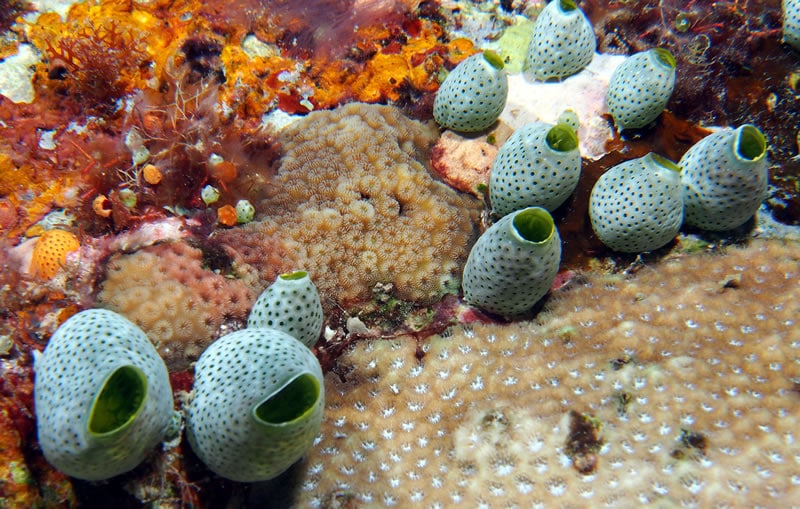
Solitary tunicate, Atriolum robustum
(Click-thru on image for greater detail.)
Tunicates have a variety of shapes and growth forms and can be quite colorful. Their body is surrounded by a tunic which may be tough, resembling cartilage, thin and delicate, or transparent and gelatinous. The tunic is unique among invertebrates in that it contains cellulose (something found in plants), and that it can grow as the animal enlarges and does not need to be periodically shed.
On our dives, one encrusting tunicate (Lissoclinum) has been unusually common, often covering large areas of reef and growing over dead corals. This species is greenish in color due to a symbiotic single-celled “algae” (prokaryote) called Prochloron.
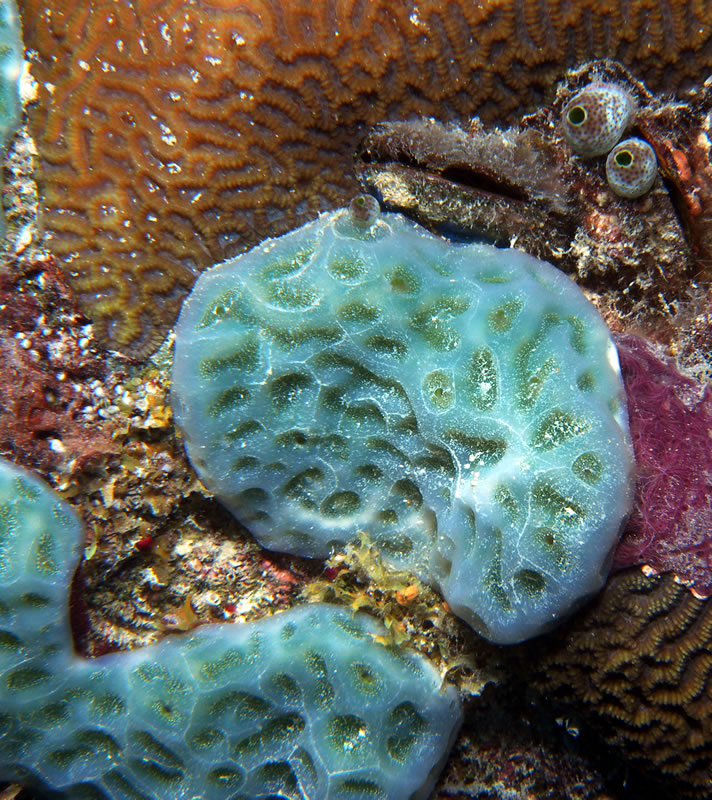
Lissoclinum patellum tunicate.
(Click-thru on image for greater detail.)
We also see a number of larger, bulbous tunicates such as Polycarpa as well as stalked tunicates (also called sea tulips) in the genus Pyura.
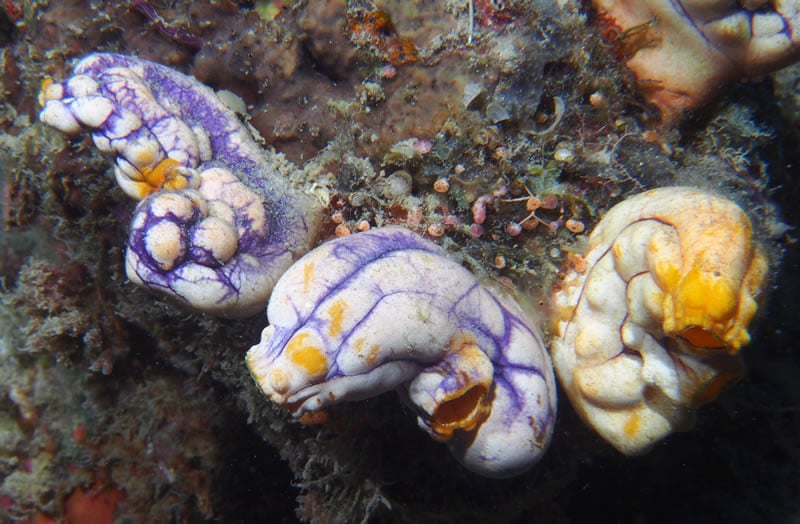
Solitary tunicate, Polycarpa aurata.
(Click-thru on image for greater detail.)
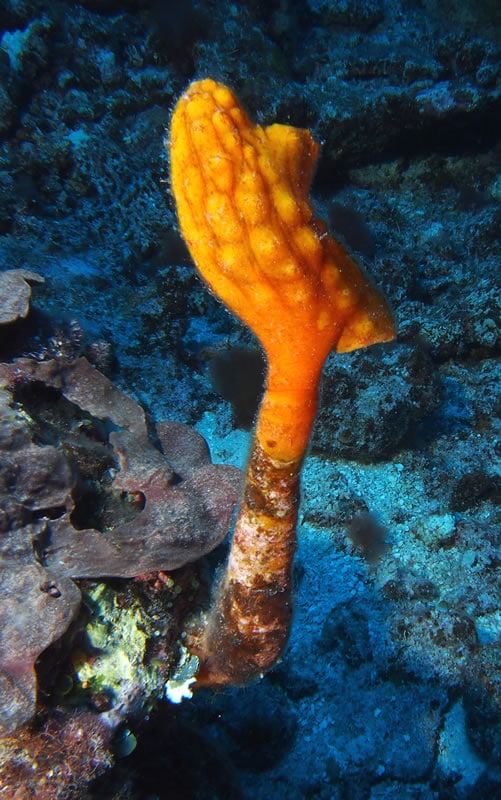
Pyura, stalked sea tulips.
(Click-thru on image for greater detail.)
Some of the smaller, spectacularly colored social and colonial tunicates have also been common on leeward reefs.
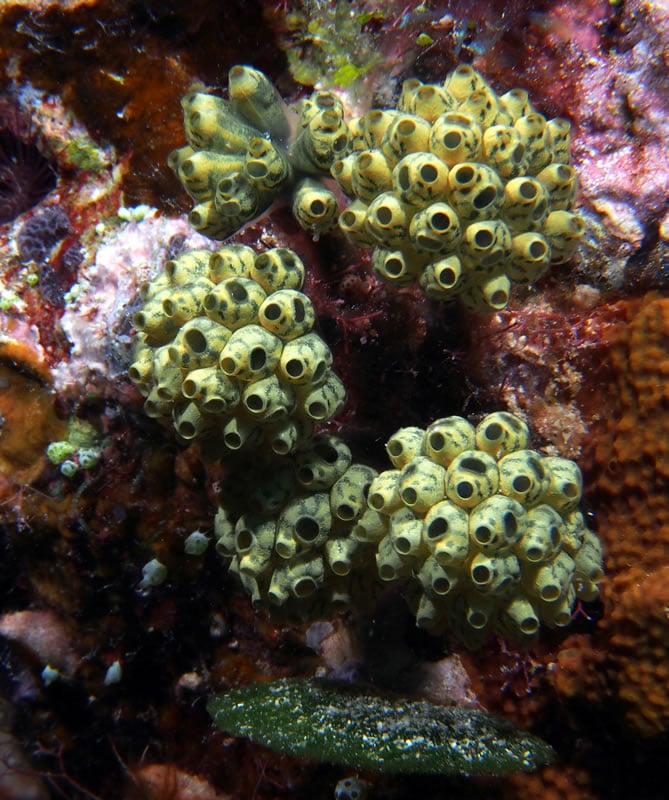
Social tunicate, Clavelina.
(Click-thru on image for greater detail.)
While tunicates are often overlooked, they are extremely important to humans. They have few natural predators which may be due to a host of chemical compounds, several of which have been harvested for use as antiviral and cancer fighting compounds (Didemnins, Aplidine, and Trabectedin). There is also some research into the use of their cellulose body as a source ethanol. Some species are consumed as food, especially in Japan and Korea, where they are being cultured.
Photos by Andrew Bruckner.