As we travel across the Pacific Ocean during the course of the Global Reef Expedition we encounter many species of fishes on our survey dives. Many are widespread species that we see in most of the countries we visit though sometimes they are more common or more rare in different locations. It is always a special treat when we see a new species that we haven’t encountered before. A novel sighting usually has us scurrying for the many guidebooks we have onboard the Golden Shadow as soon as we return from our dives.
As we traveled further north along the Cape York Peninsula toward Horn Island at the very northern tip of Australia, we started to notice a distinctive species of fish that was new to us. We had not seen this species on the hundreds of dives we’ve made over the last three years. It turns out there is a good reason for this as the fish we were seeing—the Threadfin Pearl Perch (Glaucosoma magnificum)—has a restricted range, limited to the northern coast of Australia and just across the Torres Straits into southern Papua New Guinea.
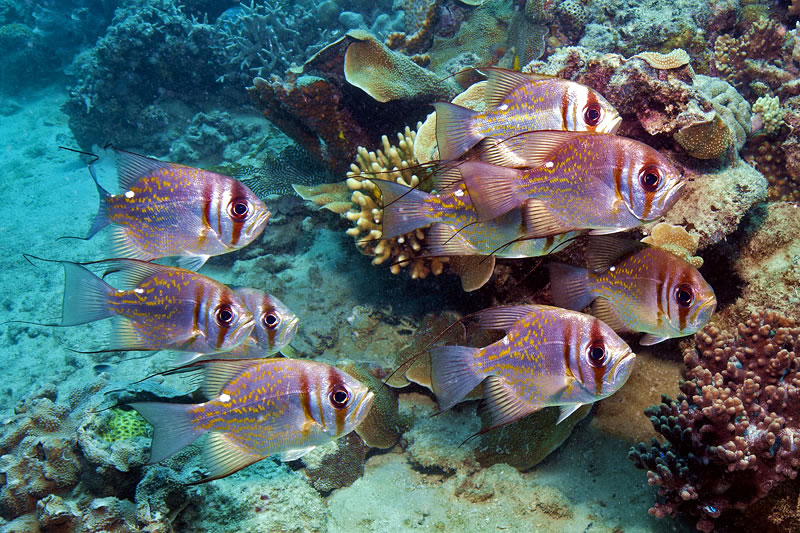
Threadfin Pearl Perch most commonly seen in shallow water in small
schools of a dozen or so fish.
(Click-thru on image for more detail.)
The family of Pearl Perches (Glaucosomatidae) is small, containing only four species. The Threadfin Pearl Perch is the species most likely to be encountered by divers as it tends to be found in water less than 10 meters deep. It is also the smallest of the family, usually ranging around 20 cm in length though it has a maximum recorded length of just over 30 cm. The other species in the family are both larger and found in deeper water with the West Australian Pearl Perch (Glaucosoma hebraicum) reaching a length of 122 cm (4 feet) and extending to depths of 200 meters or more.
The Threadfin Pearl Perch is the most striking of the pearl perches with its namesake “threads” streaming from the rear edge of the dorsal and anal fins as well as the corners of the tail fin. Combined with the golden orange spotting on the rear body which sometimes forms diagonal bands, the pair of white spots on the tail base, and the three bars at the front of the body with the widest running through the eye, this colorful little fish has caught the attention of all the survey divers who’ve spotted it during their work.
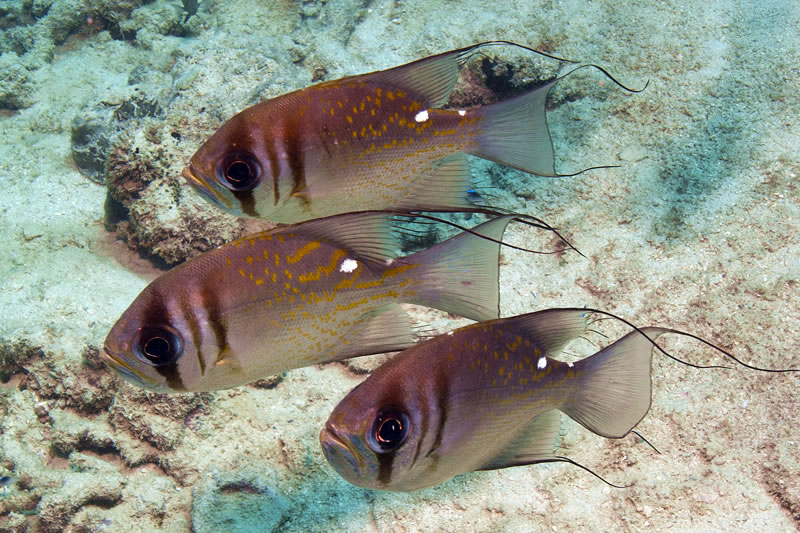
The distinctive markings and frilly fins make this species easy to identify
and a pleasure to encounter on our survey dives.
(Click-thru on image for more detail.)
Photos by Ken Marks.