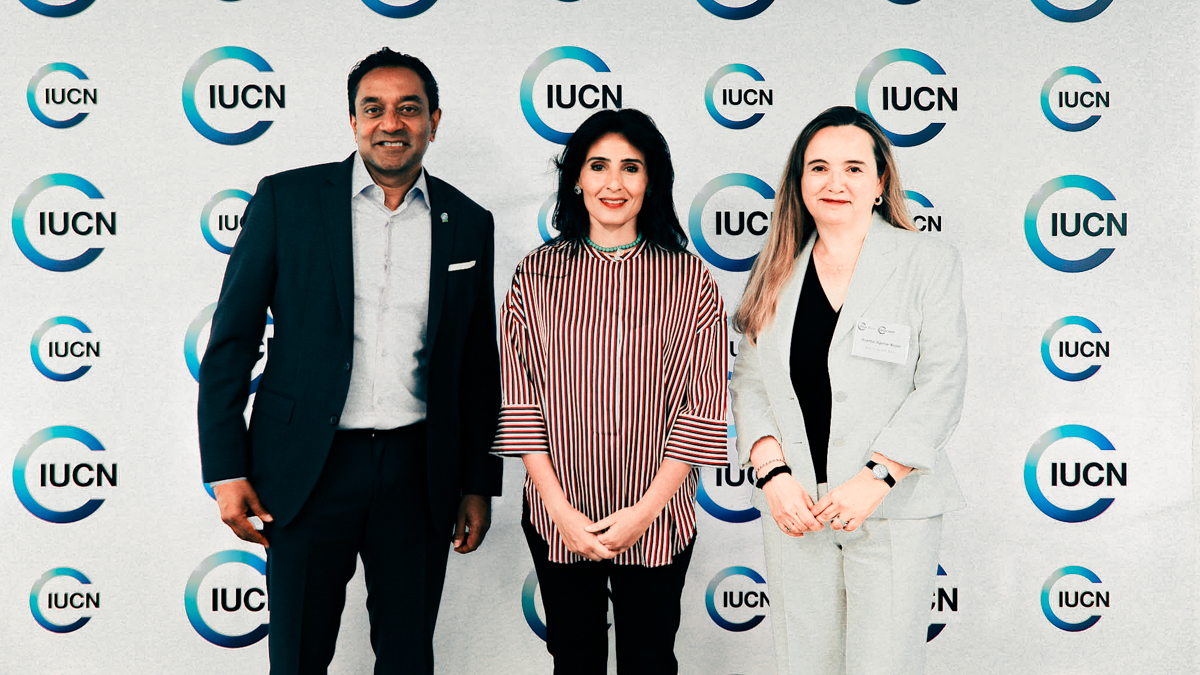
As a committed member of the International Union for Conservation of Nature (IUCN), the Khaled bin Sultan Living Oceans Foundation is proud to actively contribute to global and regional conservation efforts. Last week, we had the opportunity to participate in two IUCN events in the United States: the IUCN-US Annual Meeting and the 8th Regional Conservation Forum for the United States. These events, held at Conservation International in Arlington, VA and online, brought together key stakeholders from across the nation to address transformative actions necessary for achieving a nature-positive future.
The Regional Conservation Forum (RCF), convened every four years by the IUCN North America Regional Office and the U.S. National Committee, serves as a platform to exchange knowledge and build partnerships among IUCN members in the U.S. This year’s forum focused on evaluating conservation progress, revisiting priority goals, and proposing strategic directions to tackle the pressing environmental and biodiversity challenges facing the United States and the world.
As IUCN President Razan Al Mubarak stated during the forum, “As we gather for the Regional Conservation Forum, we stand at a pivotal moment in our journey toward a nature-positive future. This Forum, along with the eight other regional fora taking place globally, is not only an opportunity to reflect on our achievements but also to contribute to a unified, bold, long-term vision that will guide our collective efforts over the next two decades.”
As a member of the IUCN-US Membership and Communications Subcommittee, the Living Oceans Foundation is dedicated to fostering collaboration and enhancing communication among IUCN members and partners. Our involvement in these events underscores our commitment to playing an active role in shaping the future of conservation both regionally and globally.
Dr. M. Sanjayan, CEO of Conservation International, captured the spirit of the forum in his welcoming remarks: “In a world that is more divided today – on politics, ethnicity, religion, racial distinctions, economic distinctions, really on everything – we’re finding this unbelievable commonality in nature. Countries and leaders across the globe are seeing the importance and value of nature. It is an extraordinary thing.”
During the forum, discussions centered on the development of a 20-year vision for IUCN, as well as plans leading up to 2030 in alignment with the Global Biodiversity Framework. The forum provided an invaluable opportunity to contribute our expertise in marine conservation and to engage with like-minded organizations striving to protect and restore the world’s oceans and natural ecosystems.
The IUCN-US Annual Meeting, themed “Honoring Our History, Forging Our Future: Members at the Heart of IUCN,” was held immediately after the RCF and allowed members to reflect on the progress made over the past year and to strategize on how best to advance conservation goals in the coming year. The meeting brought together key stakeholders to reflect on the current state of IUCN, examine its historical foundations, and strategize for the future. Throughout the meeting, the Living Oceans Foundation’s contributions to IUCN were prominently featured, particularly in the development of the IUCN-US membership brochure and the recently launched Unite for Nature magazine, which continues to amplify the voices and stories of IUCN members worldwide.
The Living Oceans Foundation is grateful to be able to participate in these events and contribute to the IUCN community. The Foundation is committed to continuing its collaboration with IUCN and its members to safeguard the future of our planet.

About IUCN
IUCN (International Union for Conservation of Nature) is the world’s largest and most diverse environmental network, harnessing the knowledge, resources and reach of our more than 1,400 Member organisations and 16,000 experts. This diversity and expertise makes IUCN the global authority on the status of the natural world and the measures needed to safeguard it.