
search-icon
The Reef at First Sight: Inaguas

At last we have reached the Inaguas!  After a few days underway, the Golden Shadow is laying at anchor off the western shore of Great Inagua.  Great Inagua is located between 20.9° to 21.4° North latitude and 73° to 73.9° West longitude.  As this blog is being written, divers are counting and identifying fish, corals and invertebrates, measuring coral coverage, searching for corals affected by disease, and mapping the underwater habitats of the area using high tech electronics.

The day began with checkout dives for the divers in need of a refresher and a brief soak in the cerulean waters.  Once everyone had all the details of dive gear and scientific sampling equipment sorted out, the real work began.  A small scouting team left the Golden Shadow in one of the rigid-hull inflatable boats (known as a RHIB, or a tender) to check out a reef they had spotted in aerial photographs on the over-flight reconnaissance mission several weeks ago (read more about that airborne expedition in a previously posted blog by clicking here).  The spot proved to be perfect for scientific study and was agreed upon as the first dive sight of the expedition.
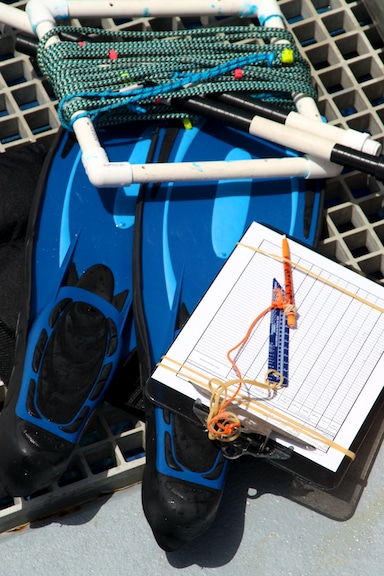
 

Data sheets, quadrats and meter sticks are just some of the equipment used to survey the coral reefs during the expedition
Data sheets, survey lines, quadrats and meter sticks are just some of the equipment used to survey the coral reefs during the expedition


After lunch, the first group of scientific divers departed for the dive site and began sampling and surveying.  Throughout the afternoon’s dives, the research divers were pleased to find healthy corals, representative fish populations and few signs of overfishing or damage from boat anchors.  Because the Inaguas are relatively isolated and support a small population of people (less than 2000 individuals), the man-made impacts and pressures that are all too common on many reefs are not immediately apparent here.
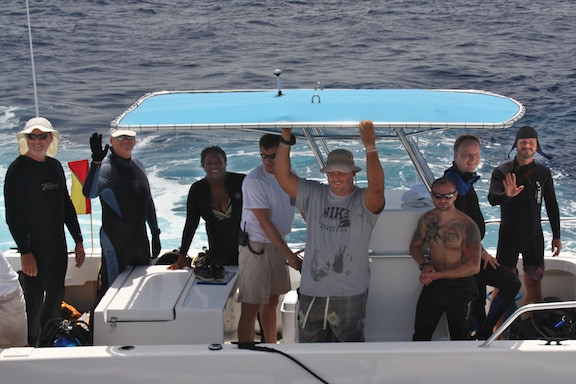
 

Research divers head out for the first fish, coral, and coral disease surveys of the Inaguas Global Reef Expedition
Research divers head out on the first fish, coral, and coral disease surveys of the Inaguas Global Reef Expedition


Once the afternoon’s hard work was completed, a few members of the research team went ashore near the northern tip of Great Inagua to investigate the geology and ecology of the island, firsthand.  The highest point of land on the island is 33 meters above sea level.  The sandy soils that run along the island’s shores support salt tolerant plants, such as sea grapes (Coccoloba uvifera), a few hardy grasses, sea purslane (Sesuvium portulacastrum) and saw palmetto (Serenoa repens).  Several Australian pine trees (Casuarina sp.) appear along the coast with their shaggy branches reaching out above the rest of the vegetation.  This species is not native to the Bahamas, but has established itself throughout the Caribbean and is now a common sight in the islands.  Walking a little further inland, the researchers noted slightly more organic soils that support resilient tropical hardwoods and shrubs, such as the gumbo limbo tree (Bursera simaruba) and bushy, fragrant stoppers (Eugenia sp.).
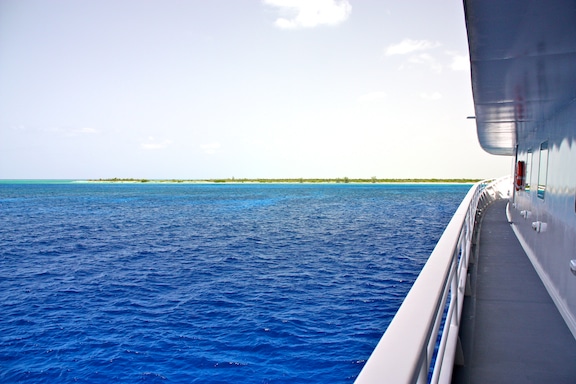
 

Several Australian pine trees can be seen poking up above the native trees along the Great Inagua shoreline from the Golden Shadow
From the Golden Shadow, several Australian pine trees can be seen poking up above the native tree line along the Great Inagua shoreline


Back on board, showered and fed, the team shared the day’s findings during a brief meeting.  All were pleased with the outcome of our first day of diving and surveying at the Inaguas.  The weather forecast looks good for another day of continued coral reef research in our present location tomorrow, and the team is prepared to continue diving and collecting data on the Inaguas portion of the Global Reef Expedition.


Written by Kit van Wagner

(Photo/Images by:  1 – 3 Kit van Wagner)

To follow along and see more photos, please visit us on Facebook! You can also follow the expedition on our Global Reef Expedition page, where there is more information about our research and our team members.
Related Posts

Introducing Our New Website: A Fresh Look for the Foundation’s Future

As we celebrate the Khaled bin Sultan Living Oceans Foundation’s 25th anniversary, we are proud to unveil our newly redesigned website—a modern home for our science, conservation work, and educational programs. This launch marks an important moment for the Foundation as we honor our long history and look toward the future of ocean conservation.

For more than two decades, the Foundation has worked tirelessly to improve the health of our living oceans. We have advanced ocean science, led one of the largest coral reef research missions in history, restored mangrove forests with local communities, created award-winning education programs, and shared the wonders of the ocean with people around the world. Our new website reflects the organization we are today—focused on conserving coral reefs, restoring mangrove forests, and improving ocean literacy—while still highlighting the legacy of work that brought us here.

The redesigned site…

Read More

Connecting People, Art, and Oceans: Championing Conservation at the 2025 IUCN Congress

The IUCN World Conservation Congress brings together thousands of leaders and decision-makers from governments, non-profit organizations, civil society, Indigenous groups, and the private sector to shape global conservation policy and action. This influential gathering serves as a platform to share knowledge, build partnerships, and advance initiatives that protect our planet’s biodiversity.

As a member of the International Union for Conservation of Nature (IUCN), the Khaled bin Sultan Living Oceans Foundation was honored to take part in the Congress, joining a global community of leaders, organizations, and changemakers committed to protecting nature and advancing sustainable futures.

Read More
Privacy Overview

This website uses cookies so that we can provide you with the best user experience possible. Cookie information is stored in your browser and performs functions such as recognising you when you return to our website and helping our team to understand which sections of the website you find most interesting and useful.  You can view our complete Privacy Policy here.

Strictly Necessary Cookies

Most of our cookies are used to improve website security and reduce spam. These cookies should be enabled at all times. They also enable us to save your preferences for cookie settings.

3rd Party Cookies

This website uses Google Analytics to collect anonymous information such as the number of visitors to the site, and the most popular pages. Keeping this cookie enabled helps us to improve our website.