
search-icon
The Dark Side of Corals: Dark Spot Syndrome

Over the past few decades there has been a rapid decline in the health of shallow water scleractinian corals (stony or hard corals).  Simultaneously, there has been a steady increase in the number of coral diseases being reported.  Many of these diseases have been identified by field characteristics – the color of the affected tissue, the shape of exposed skeleton, advancing patterns of tissue loss, or the presence of unusual structural features – rather than by the agent causing the disease.  For this reason, coral diseases have acquired names like black-band disease, red-band disease, dark spots, white pox disease and white plague.  Unfortunately, there have been relatively few scientific studies that have conclusively described the structural and cellular (morphological) changes underlying these different syndromes, or even the causes of the various changes.
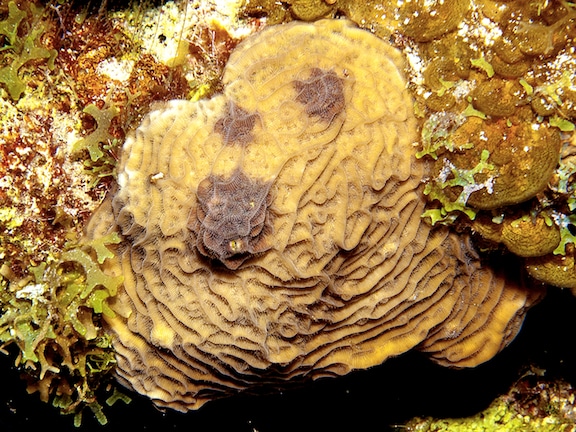
 

Agaricia agaricites showing dark spots disease on reefs around Great Inagua
Agaricia agaricites showing dark spots disease on the reef around Great Inagua

Dark spot syndrome is a disease that has been identified most frequently in three corals found in the Caribbean, including Siderastrea siderea, Stephanocoenia intersepta and Montastraea annularis.  The syndrome appears as dark, often purple, black, or brown circular or ring-shaped spots that are scattered across the surface of an affected coral. Tissue loss and mortality are not always associated with these spots.  The cause of the discolorations is unknown, as are the underlying morphological changes.  Factors that scientists think may be responsible for dark spot syndrome include an increase in zooxanthellae pigments, an endolithic fungi (one living inside coral crevasses), a general stress response, or accumulations of zymogen (enzyme) granules acting as a defensive mechanism against endolithic cellular invasion.  Recently, similar dark spots have been observed in other coral species, in particular lettuce corals, Agaricia agaricites.
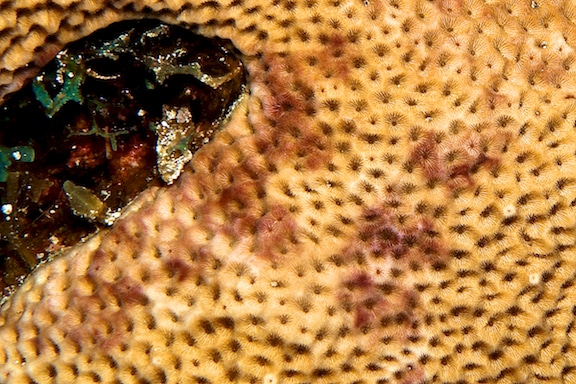
 

Siderastrea siderea with dark spots disease on reefs around Great Inagua
Siderastrea siderea with dark spot syndrome on the reef around Great Inagua


Dr. Matti Kiupel is a board certified veterinary pathologist who has spent most of his career working to understand infectious diseases in vertebrate species, mainly in mammals.  As an avid scuba diver, he has been deeply concerned about the decline of corals and the emergence of widespread disease syndromes.  Gladly following an invitation by the Living Oceans Foundation, he is participating in this expedition to collaborate with known experts in coral biology who are on the research team, including Drs. Andy Bruckner, Bernhard Riegl and Judy Lang.  Together they are working to shed more light on the morphological basis of dark spot syndrome in various coral species and to possibly determine the cause of the syndrome.
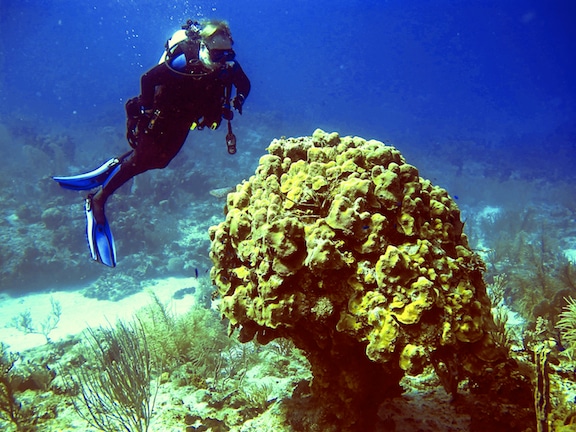
 

Dr. Matti Kiupel during a research dive on this leg of the Global Reef Expedition in Great Inagua, Bahamas


During the expedition in the Inaguas, Dr. Kiupel will collect samples of healthy and affected corals for future microscopic examination in his laboratory at Michigan State University.  This project is possible due to the multi-disciplinary research team assembled by the Living Ocean Foundation and with the support of the Bahamian government that provided the permits for collecting diseased and normal coral samples.


Written by Dr. Matti Kiupel

(Photo/Images by:  1 – 3 Ken Marks)

To follow along and see more photos, please visit us on Facebook! You can also follow the expedition on our Global Reef Expedition page, where there is more information about our research and our team members.
Related Posts

Introducing Our New Website: A Fresh Look for the Foundation’s Future

As we celebrate the Khaled bin Sultan Living Oceans Foundation’s 25th anniversary, we are proud to unveil our newly redesigned website—a modern home for our science, conservation work, and educational programs. This launch marks an important moment for the Foundation as we honor our long history and look toward the future of ocean conservation.

For more than two decades, the Foundation has worked tirelessly to improve the health of our living oceans. We have advanced ocean science, led one of the largest coral reef research missions in history, restored mangrove forests with local communities, created award-winning education programs, and shared the wonders of the ocean with people around the world. Our new website reflects the organization we are today—focused on conserving coral reefs, restoring mangrove forests, and improving ocean literacy—while still highlighting the legacy of work that brought us here.

The redesigned site…

Read More

Connecting People, Art, and Oceans: Championing Conservation at the 2025 IUCN Congress

The IUCN World Conservation Congress brings together thousands of leaders and decision-makers from governments, non-profit organizations, civil society, Indigenous groups, and the private sector to shape global conservation policy and action. This influential gathering serves as a platform to share knowledge, build partnerships, and advance initiatives that protect our planet’s biodiversity.

As a member of the International Union for Conservation of Nature (IUCN), the Khaled bin Sultan Living Oceans Foundation was honored to take part in the Congress, joining a global community of leaders, organizations, and changemakers committed to protecting nature and advancing sustainable futures.

Read More
Privacy Overview

This website uses cookies so that we can provide you with the best user experience possible. Cookie information is stored in your browser and performs functions such as recognising you when you return to our website and helping our team to understand which sections of the website you find most interesting and useful.  You can view our complete Privacy Policy here.

Strictly Necessary Cookies

Most of our cookies are used to improve website security and reduce spam. These cookies should be enabled at all times. They also enable us to save your preferences for cookie settings.

3rd Party Cookies

This website uses Google Analytics to collect anonymous information such as the number of visitors to the site, and the most popular pages. Keeping this cookie enabled helps us to improve our website.