
search-icon
Regionally Rare, Locally Abundant

Throughout most of the Caribbean, there are species of coral that are common and easily spotted on a dive, and those that are rare corals and difficult to locate.   Experienced divers can usually characterize a reef fairly quickly based on the types of corals growing there.  Some common corals that are generally easy to find include star corals (Montastrea sp.), starlet corals (Siderastrea sp.) and brain corals (Diploria sp.).  On the other hand, rare corals include pillar corals (Dendrogyra cylindrus) and staghorn corals (Acropora cervicornis).  The corals of Hogsty Reef and Great Inagua have so far not followed this formula.  Living Oceans Foundation researchers have seen an unusually high number of rare corals.  Specifically, pillar corals appear to be thriving on the reefs here and staghorn corals are demonstrating remarkable resilience.
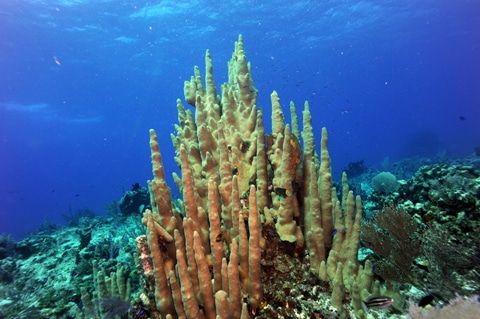
Pillar coral (Dendrogyra cylindrus), though one of the rare corals of the Caribbean, is not a rare find around the Inaguas

Pillar coral is the only representative of an evolutionarily distinct genus.  It grows as multiple vertical spires that reach up towards the surface in clusters.  Pillar coral is distinct in appearance as its polyps (individual coral animals) are extended during the daytime. Remarkably, pillar corals seem to be very resistant to diseases affecting many other Caribbean coral species. Pillar corals extend their tentacles into the water column day and night to sting and grab morsels of plankton floating by in the water column. In contrast, most stony corals feed actively at night, and their polyps remain withdrawn during the day.  Pillar corals can reproduce either by spawning (releasing eggs and sperm into the water column) or when fragments break off and begin to re-grow (fragmentation).  Scientists and coral reef managers in other parts of the Caribbean have had some success in transplanting branches of pillar coral onto reefs where it no longer occurs.   The International Union for the Conservation of Nature (IUCN) has listed this species as vulnerable on its Red List of Threatened Species.
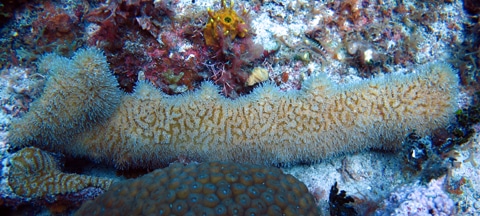
This fragment of pillar coral is growing new upward pillars, also note the extended tentacles giving the coral a furry appearance


Staghorn coral is native to the Caribbean and grows in branching, tangled stands.  The long branches can grow from 10-20 cm a year.  This is record speed for coral growth in the western Atlantic.  Most other corals grow only about 1 cm each year.  As you might imagine, the species is important for creating habitat for reef fish and invertebrates.   Similar to pillar coral, it can re-grow from broken fragments, which helps it rebound from damage due to hurricanes.  Coral disease, predation by reef invertebrates, and algae overgrowth has largely wiped out staghorn corals from the western Atlantic.  Disease, especially white band disease, has hit staghorn corals particularly hard.  IUCN has listed the species as threatened on its Red List of Threatened Species.
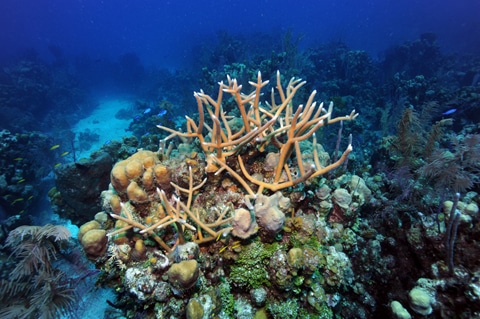
Another one of the rare corals of the Caribbean, staghorn coral (Acropora cervicornis), has been found at a number of sites in the Inaguas


One of the major impacts of climate change on coral reef environments is warming sea surface temperatures. This leads to coral bleaching and reduces the corals resistance to coral diseases resulting in mortality.  Climate change and chronic human stressors impact Caribbean corals’ sustainability.  Living Oceans Foundation researchers are, therefore, encouraged to have observed pillar coral and staghorn coral species doing quite well in the Inaguas.


Written by Kit van Wagner

(Photo/Images by:  1 , 3 Phil Renaud, 2 Amanda Williams)

To follow along and see more photos, please visit us on Facebook! You can also follow the expedition on our Global Reef Expedition page, where there is more information about our research and our team members.
Related Posts

After the Storm: Standing with Our J.A.M.I.N. Family in Jamaica

There are moments in this work that feel heartbreakingly familiar.

Two weeks after we completed our Jamaica Awareness of Mangroves in Nature (J.A.M.I.N.) programming, Hurricane Melissa made landfall. A powerful Category 5 hurricane, Melissa is now tied with Hurricane Allen in 1980 for the strongest winds ever recorded in an Atlantic storm. Like Hurricane Dorian, which devastated The Bahamas in 2019, Melissa will be remembered as one of the strongest hurricanes on record in the region.

For 11 years, the University of the West Indies Discovery Bay Marine Laboratory and William Knibb Memorial High School have been more than program partners. They have welcomed us into their classrooms and labs, shared meals and laughter, and committed themselves to educating their students about mangroves and coastal resilience. These colleagues and students are not distant collaborators. They are family.

And they were hit hard…

Read More

B.A.M. Turns 10: A Year of Milestones, Resilience, and Growth

The 2025–2026 academic year was one of those defining years for our Bahamas Awareness of Mangroves (B.A.M.) and Jamaica Awareness of Mangroves in Nature (J.A.M.I.N.) programs. It was a year marked by celebration, challenge, growth, and powerful full-circle moments, and a reminder of why mangrove education matters.

In The Bahamas, B.A.M. reached a major milestone: ten years of partnership and environmental education in Abaco. Since 2015, in collaboration with Friends of the Environment, we have worked alongside Patrick J. Bethel High School and Forest Heights Academy to bring hands-on mangrove science into classrooms and into the field. This year, we were proud to expand the program to S.C. Bootle High School, increasing access for students who live…

Read More
Privacy Overview

This website uses cookies so that we can provide you with the best user experience possible. Cookie information is stored in your browser and performs functions such as recognising you when you return to our website and helping our team to understand which sections of the website you find most interesting and useful.  You can view our complete Privacy Policy here.

Strictly Necessary Cookies

Most of our cookies are used to improve website security and reduce spam. These cookies should be enabled at all times. They also enable us to save your preferences for cookie settings.

3rd Party Cookies

This website uses Google Analytics to collect anonymous information such as the number of visitors to the site, and the most popular pages. Keeping this cookie enabled helps us to improve our website.