Expedition Log: BIOT – Day 7
Before starting our research in Chagos, I read several reports stating how many fish we could expect to see during the mission. Chagos is supposed to have more fish than anywhere else in the Indian Ocean, both in terms of numbers of individuals and their sizes. I also read that biomass was up to 6 times higher than that found in surrounding countries. After my first few dives, and throughout the rest of the mission, our surveys verified this for all species including some of the top predators like the groupers. On every dive it was not unusual to see up to a dozen or more large groupers and we often saw multiple species in a single location.
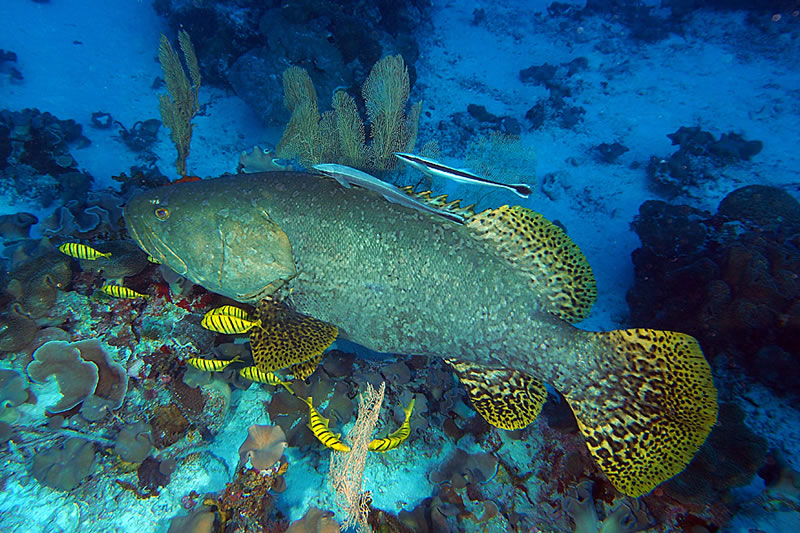
One of many Giant Groupers found on our dives.
(Epinephelus lanceolatus)
There are at least 36 known groupers in Chagos. Half of these have been observed during the surveys that have been conducted at shallow reef habitats during the Global Reef Expedition (GRE). The four most commonly encountered species were the yellow-edged lyretail (Variola louti), white-edged lyretail (Variola albomarginata), black-saddled grouper (Plectropomus laevis), and the blackfin grouper (Cephalopholis nigripinnis).
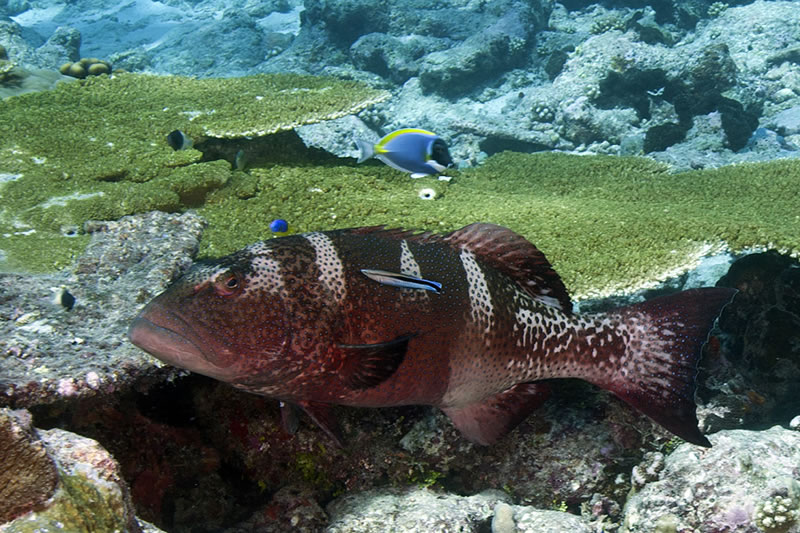
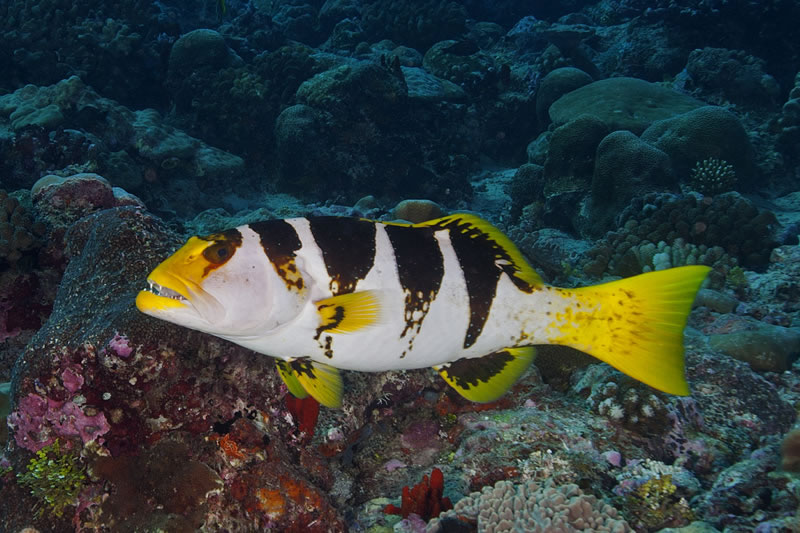
Blacksaddle Coral Groupers (Plectopomus laevis):
Dark Variation (left) & Pale Variation (right)
(click-thru on images for greater detail)
The black-saddled grouper is one of the biggest groupers in the area, large individuals known to reach lengths of 1.25 m. We have encountered black-saddled groupers as large as 1 m repeatedly in our survey transects. Black-saddled groupers are fairly common but tend to occur in patches through the sites we have surveyed. They appear to be less dependent on shelter for protection, perhaps due to their large size, and can be observed swimming in mid-water, or close to the bottom.
The blackfin grouper is small for a grouper and appears to be highly dependent on reef structure for shelter. They were common in sites where small coral bommies were available for shelter and protection.
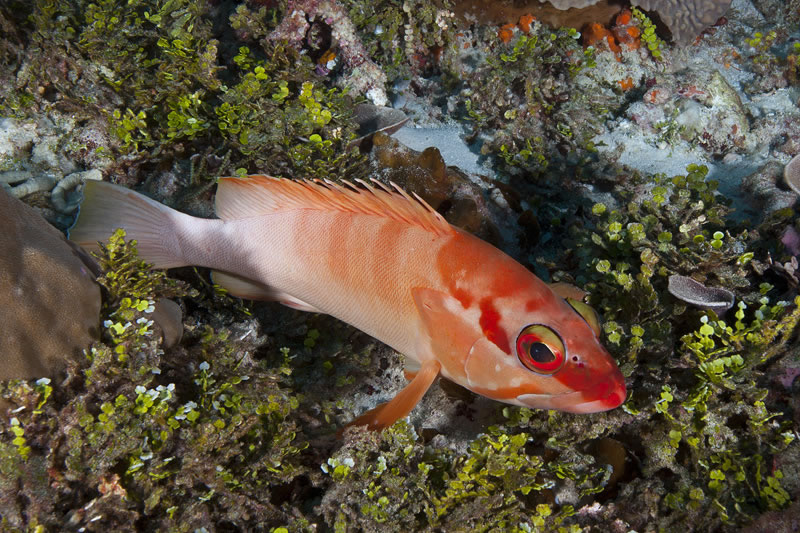
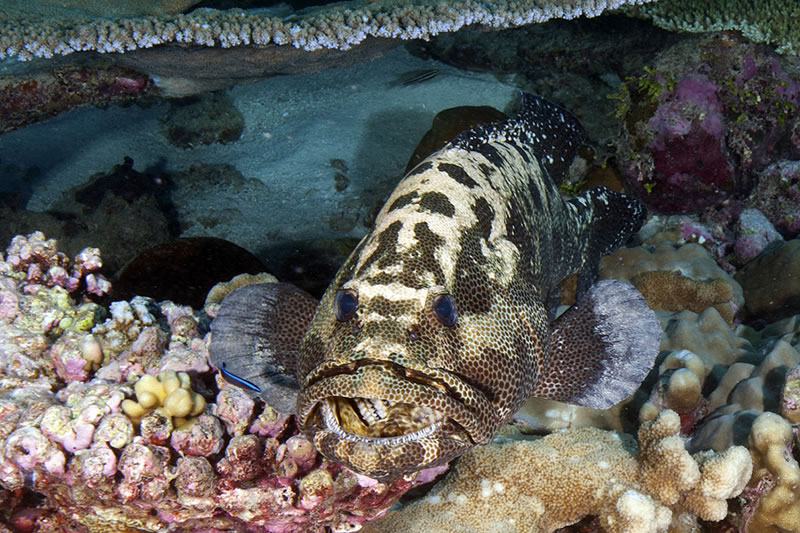
Blacktip Grouper (Epinephelus fasciatus) (left)
Camouflage Grouper (Epinephelus polyphekadion) (right)
(click-thru on images for greater detail)
The lyretails are moderate in size and grow up to half a meter in length. They were the most common of the four species of grouper and we found them in virtually all habitat types, be it coralline, paved, deep, shallow, inside lagoons or at submerged banks or outer reefs, so long as there is some structure. We observed lyretail groupers swimming freely above the reef, close to the seafloor, and even at cleaning stations.
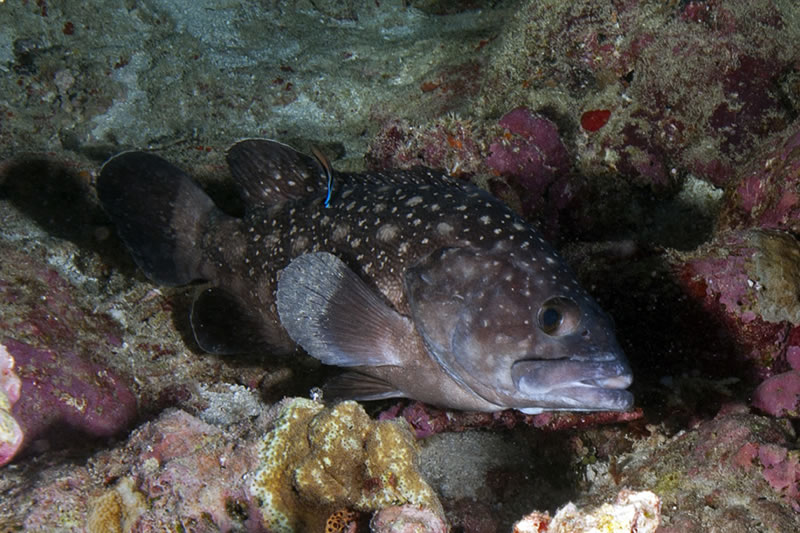
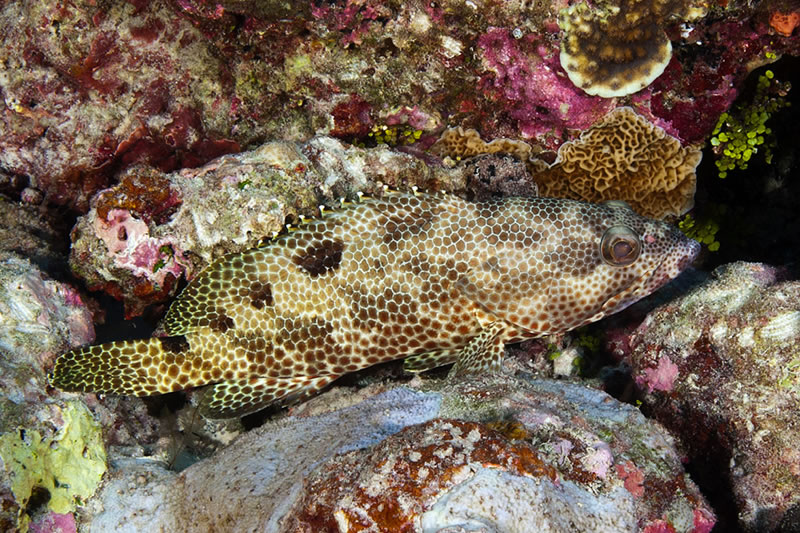
Whitespotted Grouper (Epinephelus caeruleopunctatus) (left) / Foursaddle Grouper (Epinephelus spilotoceps) (right)
(click-thru on images for greater detail)
Groupers are among the most sought after species of fish, and are very popular in the live fish food trade. It is of great importance that they are quite abundant and common in Chagos. Perhaps the inherent isolation of the location and the protection these waters enjoy provides these fish with an undisturbed refuge and respite from fishing pressure. In any case, Chagos clearly serves as a safe haven for these fish and many other marine species in this part of the Indian Ocean.
Photos: 1 Andrew Bruckner, 2-7 Ken Marks.