Written by Chris Mirbach
Expedition Log: BIOT – Day 19
On a single dive on Victory Bank in the British Indian Ocean Territory (BIOT), I saw the greatest abundance of fish I have ever witnessed, after having completed nearly 1000 dives on the Great Barrier Reef, Caribbean reefs, Hawaii, Fiji and west coasts of the USA and Costa Rica. At first I was astounded and impressed, but as I had been tasked with counting and ID’ing all the fish, I was soon overwhelmed. Luckily, I had been trained well. The seafloor was literally moving, it was hard to see any solid substrate underneath the large schools of snappers like Paddletails (Lutjanus gibbus) and midnight snappers (Macolor macularis), plus clouds of surgeonfish and fusiliers. This was particularly interesting, because in all my experience, I am used to fish moving quickly away from divers (called the diver effect in marine biology literature)… here, they didn’t seem bothered. It may be the closest look I have ever had at an ecosystem, seemingly unaffected by my presence.
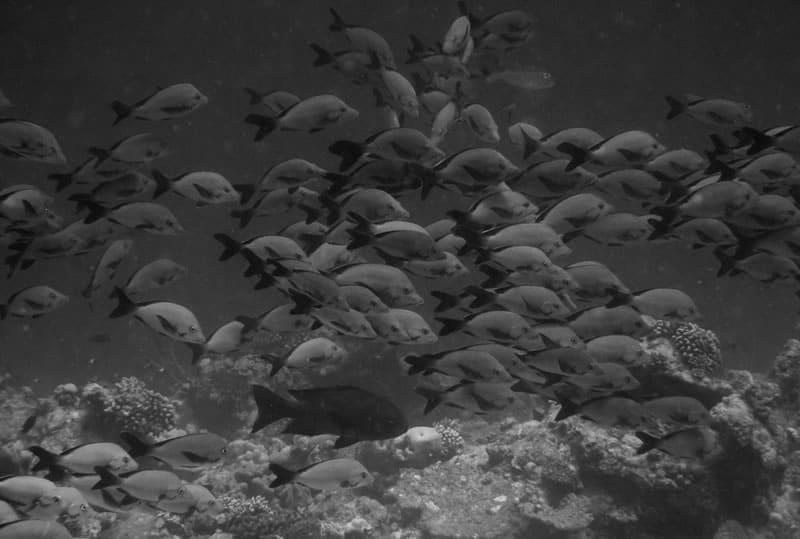
A dense school of Lutjanus gibbus. Imagine this density, covering almost the entire area of the reef we surveyed!
In addition, there were clouds of fusiliers swirling around us as we ran our transects…
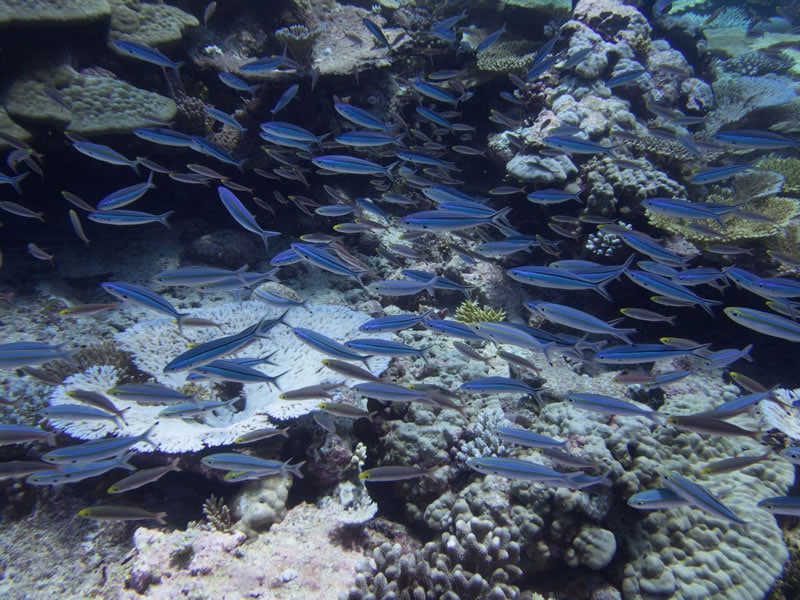
A school of ruddy fusiliers (Pterocaesio pisang), Dark-banned fusiliers (Pterocaesio tile) and double-lined fusiliers (Pterocaesio digramma). These schooling species dart quickly and seemingly randomly around the water column feeding on small planktonic organisms, but when threatened by a predator, all instantly begin to move in unison! Four other magnificent species of fish were forming large schools above us, two of which can be very difficult to tell apart, see if you can guess which two I mean…
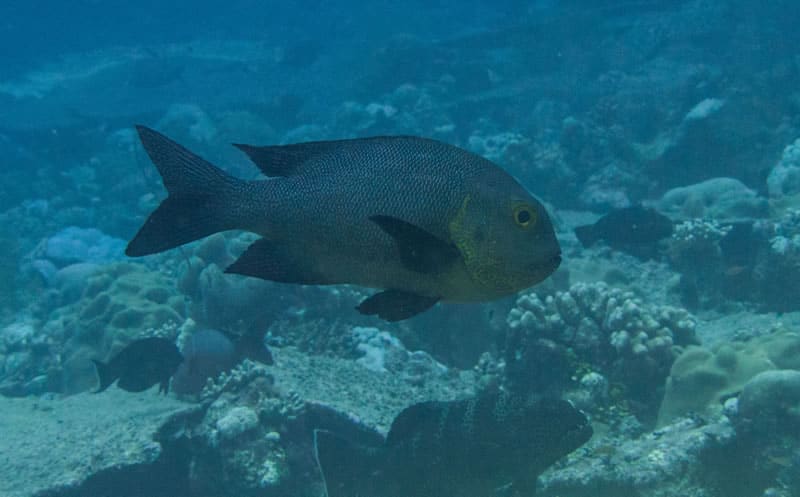
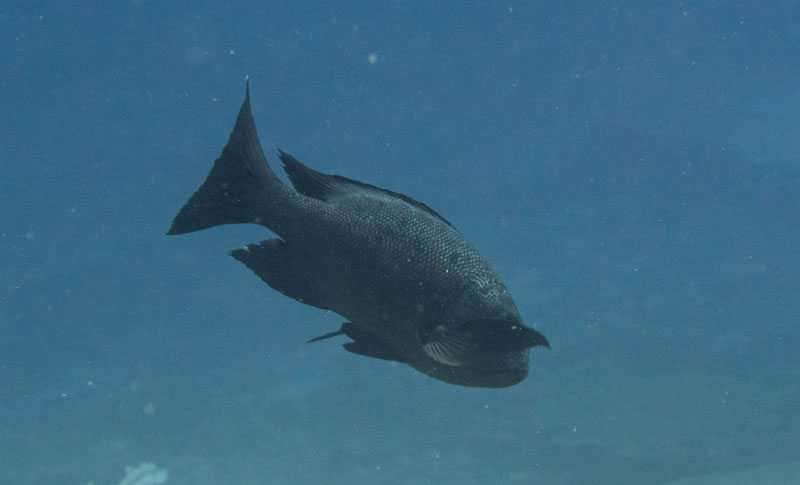
Midnight snapper (Macolor macularis) on the left, and the seemingly more timid black snapper (Macolor niger) on the right. As juveniles they have distinctly different black and white markings (to a trained eye) but as adults, there are only very slight differences, such as a yellowish tint around the Midnight snappers gills, and a slightly more yellow eye. However, these features can be difficult to distinguish from a distance.
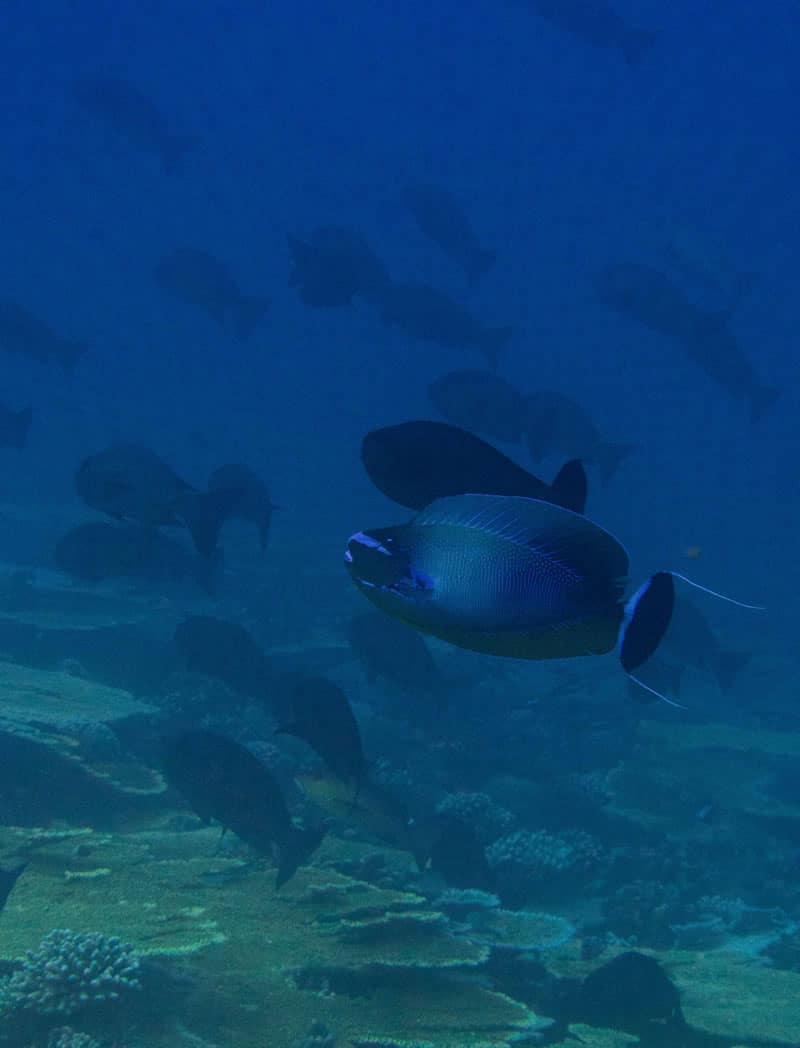
A bignose unicornfish (Naso vlamingii) flashing its display colors with another of the same species behind it showing none. Even further in the background is a school of black snapper (Macolor niger).
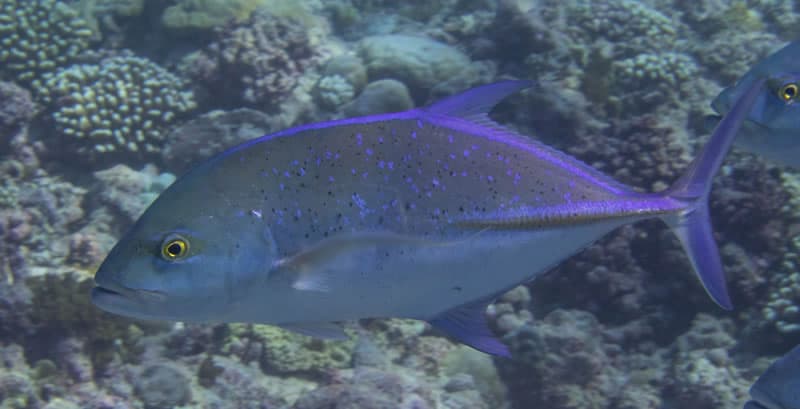
Bluefin trevally (Caranx melampygus) are a fast and aggressive predatory fish. They can be seen chasing smaller fish into the reef, often smashing their heads into the sand or rubble to pin and crush their prey. To add further excitement (and difficulty) to our fish surveys, this area was incredibly diverse. The reef was packed with brightly colored pairing butterflyfish, quick moving wrasses, nearly invisible sand perch, and sometimes timid, sometimes bold, groupers.
More butterflyfish, angelfish, trout, groupers and parrotfish…
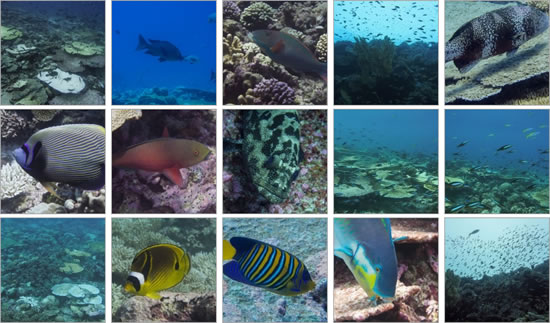
There are no definite explanations for why fish aggregate in such densities. Some fish aggregate for protection from predators, others to hunt in packs and some for social and reproductive reasons. Each school of fish we encountered may have had its own agenda, some hunting, some fleeing, and some flirting. Additionally, this dive took place in the late afternoon, as the sun began to set. The time of day could have also influenced fish abundance, as fish moved onto the reef for the night, maybe for protection from the large pelagic predators lurking out in the blue…
Photos by Chris Mirbach.