Mangrove Education and Restoration Blog
Did you know that there is a native Jamaican dialect? You have probably heard it before if you listen to Bob Marley or other Jamaican reggae musicians. The dialect is called Patois or Patwa. The title of this blog, Jamdung Patois, written in this dialect means Jamaica Patois. Throughout history it has evolved, and as a result, there are various dialects of Patois spoken throughout this island nation.
Patois is a blending of languages from various cultures that left their imprint on Jamaica dating back to the island’s original inhabitants, the Arawak. From the 15th-18th centuries, Jamaica was colonized by European countries in an effort to expand power overseas. The first people to colonize Jamaica were the Spanish. Later in the 1655, the British conquered Spain, taking control for nearly two centuries. During the reign of the Spanish and British in Jamaica, there was one common theme – slavery.
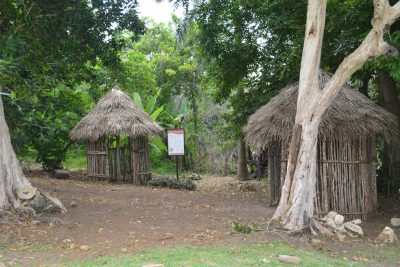
Reproduction of Arawak village at Seville Heritage Park
The original slaves of Jamaica were the Arawak. While being enslaved by the Spanish, these native inhabitants were exterminated by disease and maltreatment. To replace them, the Spanish brought slaves of African descent. Slavery didn’t end after the British takeover; On the contrary, it intensified to support the production of sugar. The majority of slaves were from various regions of West and Central Africa.
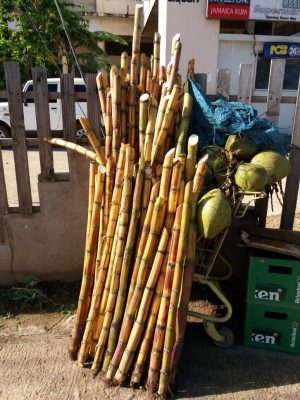
Harvested sugar cane
Slaves were captured from a variety of African tribes that spoke their own languages. In order for slaves to be able to communicate with each other and the slave owners, a mixture of these languages formed, generically termed creole. There were many creole languages that developed as a result of the slave trade. Jamaican Patois, sometimes referred to as Jamaican Creole, is one of them. It is a combination of British English and African languages. Although there are a couple of words that are attributed to other cultures such as the Arawarks.
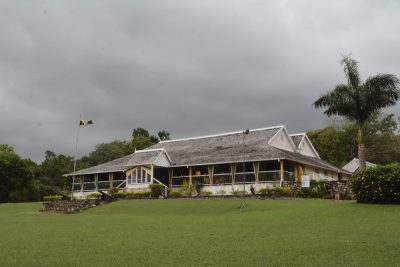
Seville Great House, sugar plantation
Although there has been much debate, Jamaican Patois is not considered an official language; rather it is considered a dialect. Jamaican Standard English is the official language of Jamaica. We hear students in the school hallways speaking Patois, but we never see them writing it. Throughout different regions of Jamaica, words vary in meaning and are spelled differently, making it difficult to create a standard method for writing it.

Students at William Knibb High School socializing in the hallways.
Even though Patois is mostly what I hear while in Jamaica, it is not taught in the schools. Jamaican Standard English is exclusively taught from the time students enter school, yet many students’ first “language” is Patois. Students learn early on that there are certain formal situations when English is used. For instance, while teaching in Jamaica, students respond or ask questions in English.

St. Hilda’s student taking notes in English, not Patois.
While Patois is not the official language of Jamaica, I feel it best represents the people of this island nation. Though I may not always be able to understand what is being said in Patois, I hear in it the passion and energy that seems to truly reflect the spirit of the Jamaican people. Patois is not only a part of everyday life, but it symbolizes the cultural legacy and struggles of the Jamaican people.
Language often lives on through music. Like reggae, Celtic, and other forms of ethnic music, Patois is a powerful form of expression and has the ability to resonate with people across cultures. It is no surprise that Jamaican musicians like Bob Marley incorporate Patois into their music. In our next blog, J.A.M.I.N. to My Mangrove Song, you will hear a song written about mangroves that was composed in Patois by one of our students in the J.A.M.I.N. program.
There are efforts to create a standard Jamaican Patois writing system. Our partners at the University of the West Indies Jamaica are currently developing one. For more information, go to https://www.mona.uwi.edu/dllp/jlu/about/index.htm.