
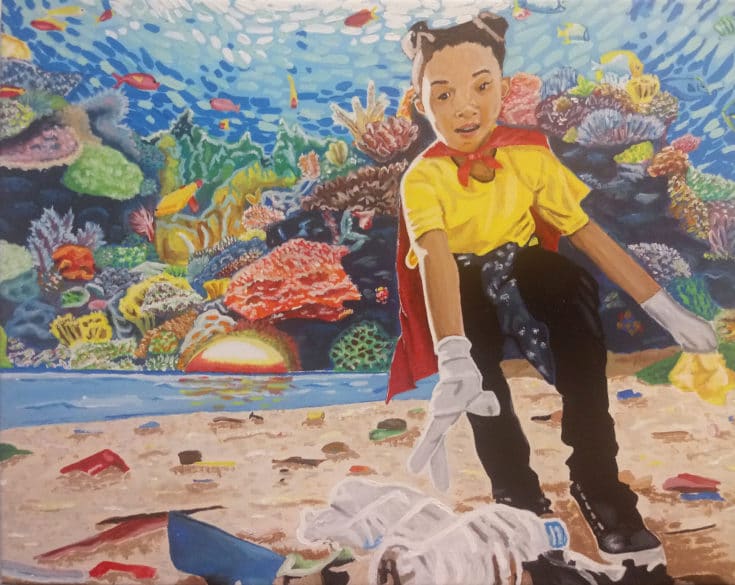
Each year I have the pleasure of getting to know the incredibly talented winners of our Science Without Borders® Challenge. With Zoom becoming a popular method of communication during COVID-19, I thought that I would talk to our winners face-to-face this year using this platform. Anish was the first participant that I spoke with. I couldn’t wait to tell him that he won first-place winner in the Middle School category for his painting titled “Coral Reef Superhero.”
Anish, age 14, attends Harrisburg High School in Virginia. One thing that I immediately learned about Anish, was his passion for conserving the ocean. He explained that he hoped his artwork would inspire other to want to conserve coral reefs stating, “I want people to feel empowered to take personal actions to conserve coral reefs. I want them to understand the beauty of coral reefs, why they are worth saving, and that there are many ways that they can help solve the crisis currently facing coral reefs.”
Learn more from my interview with Anish about why he entered the contest, what he learned from this experience, and so much more. Our conversation has been lightly edited for length and clarity.

Q: Why did you enter the Science Without Borders® Challenge?
A: I entered the contest because I wanted to create meaningful art. I love creating art for fun, but using my art to drive positive change for a cause such as coral reef conservation makes it so much more meaningful. I am constantly looking for ways to use my art to inspire others, and this challenge was one opportunity I stumbled upon and immediately connected with.
Q: What did you learn by participating in the Science Without Borders® Challenge?
A: I learned that everyone has the power to conserve coral reefs. From collecting trash to creating art, there are so many ways that we can take action toward this important issue even while in the midst of a pandemic. A lot of people have felt powerless and overwhelmed in the face of the COVID-19 crisis; I learned that we still have the power to drive positive change within our communities and around the world.
Q: Why is the ocean important to you?
A: The ocean provides a livelihood for many people. This past school year, I was able to travel to Smith Island, a small island in the Chesapeake Bay in Maryland. There, I met people who truly loved and relied on the ocean; this opened my eyes to the strong connection between the ocean and all people.
Q: What are your plans for the future? Do you plan to pursue a career in art or science?
A: Science and art are two big parts of my life, so I hope to find a career in the future to pursue a bit of both. For now, I look forward to more opportunities such as the Science Without Borders Challenge, where I get to combine these passions and share them with others.
Q: What advice would you give to someone who is considering entering the Science Without Borders® Challenge?
A: My advice to anyone considering entering the challenge is to try it out! You might have a lot of fun and create something beautiful in the process. When you find a theme or challenge with a mission that resonates with your ideas, putting your heart into your artwork becomes so much easier and more meaningful, and you might just discover a passion in the process.
ARTIST’S STATEMENT
My artwork illustrates one example of an action that can help conserve coral reefs: cleaning up beaches. I portrayed a young girl picking up beach trash to show the importance of youth regarding coral reef conservation. The girl wears a cape, representing how those who take care of our coral reefs are real-life superheroes. The girl is alone, representing how action can start with just one person. The sunset in the background represents hope for the future, which is further visualized by the vibrant coral reef behind the girl.
To summarize, the littered beach in my painting shows a current challenge for coral reefs, the girl demonstrates a small yet heroic action to solve this issue, and the colorful reef background represents a positive goal that we all must work toward. All in all, my painting aims to thank coral reef “superheroes” and inspire a new generation of young, active leaders.