Coral reefs are majestic undersea wonders that contain some of the most unique and mysterious creatures I have ever observed. Ever since my first encounter with one while snorkeling, the natural awe and intrigue I feel in the presence of these incredible ecosystems has never left me. Throughout my education I have learned about the biology, the functions, and the benefits of coral reefs, and the natural and anthropogenic activities that threaten them. But it wasn’t until I started teaching about coral reefs on the Global Reef Expedition (GRE) that I truly understood the interconnectedness between people and the reefs. It was an insight gained not through a textbook, but, rather, from listening to, speaking with, and directly engaging those whose lives—and livelihoods—are impacted by coral reefs.
During the GRE Fiji mission, we launched our first large-scale education and outreach program that coincided with the scientific research taking place. Before we could proceed, however, we first needed to meet with the chiefs of the local villages to discuss our scientific and educational objectives, as well as seek their approval to continue in our mission. With the helpful guidance of our local liaisons and education partners, Roko Josefa Cinavilakeba and Laitia Raloa, we were able to have fruitful discussions with the chiefs of each village, after which the science team was granted permission to continue in their research. The education team, after continued discussions with the chief and other community members, were able to establish a schedule for coral reef education seminars for the schools and local communities.
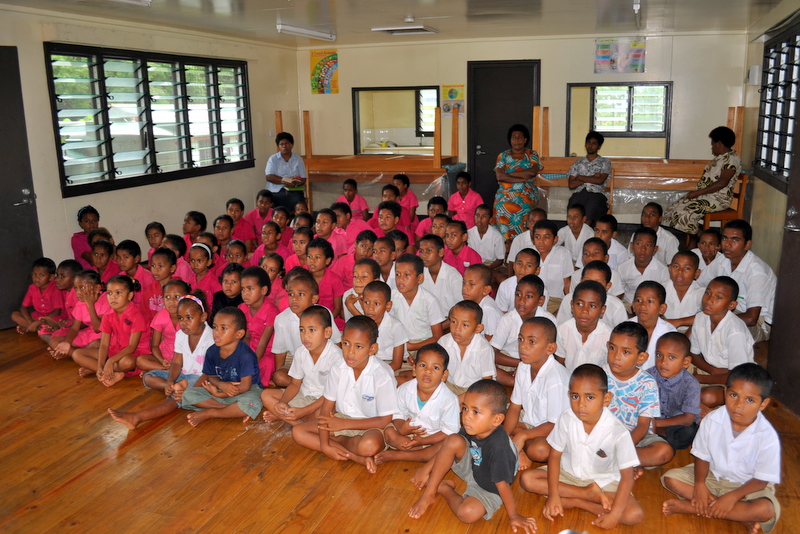
Vanua Balavu Island, Adi Maopa Village primary school 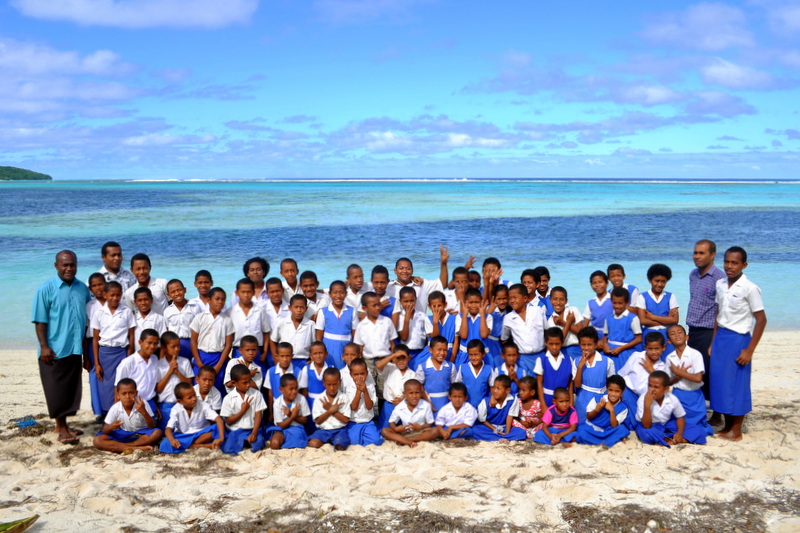
Fulaga Island Muanaicake Village primary school 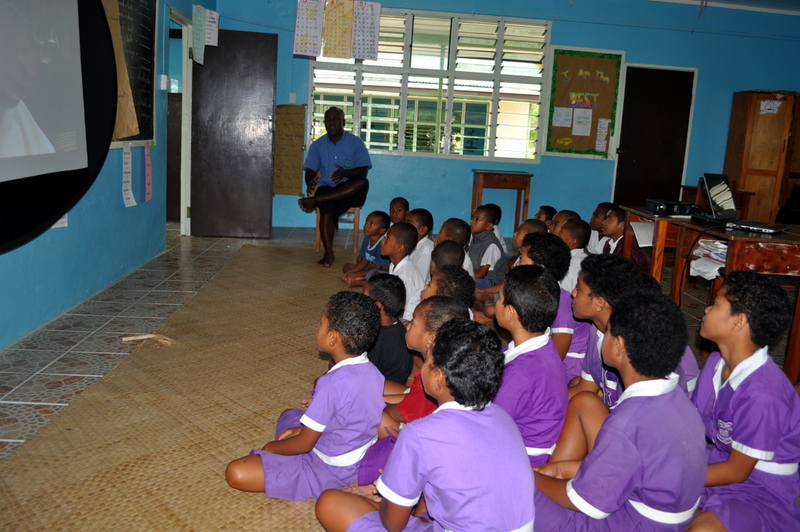
Roko Laitia Raloa presenting Fiji coral reef awareness to a primary school in Kabara Island.
Province to primary and secondary schools as well as village communities.
These seminars were well-received. Both children and adults were enthralled by the subject of coral reefs, and many sat in wide-eyed fascination while the seminar videos revealed an underwater world that many had never seen. Or at least not seen in such detail. However, it quickly became apparent that there was very little education on reefs in these communities. Laitia Raloa confirmed: “In these remote islands, students are not taught about the environment around them.” We saw this as an opportunity, as the enthusiasm and interest to learn was obvious from the positive reaction to the images and videos.
I witnessed from one village to the next how much people rely on both the land and sea for their way of life. This was a defining moment for me, as it made clear that education is crucial to maintaining the delicate balance between nature and humans. “How can they protect their reefs,” I thought, “a system that they rely on for their very survival, if they don’t understand how it functions?” These questions renewed my passion. The Fijians, many of whom became my friends, depended upon this vital resource for their livelihoods. And I experienced firsthand how a coral’s community isn’t just the coral itself and all the living things that inhabit its ecosystem. It also includes the humans that rely on the coral reef. They too are part of the coral’s community.
What We Learned
At the conclusion of our education seminars, we held in-depth conversations during which many people voiced concerns about the current conditions of their coral reefs. It was often the community elders that seemed most concerned. In thoughtful but solemn tones, they spoke of the environmental problems facing future generations. Some brought up climate change and rising sea levels. Others mentioned destructive fishing methods. There was, however, a frequent topic of concern in all the villages, and they shared a common way of expressing it in the simplest and most candid way possible. Eventually, someone, usually an elder, would rise and declare with accompanying hand gestures: “We used to see fish this large (arms open wide), but now the fish we see are very small (hands close together).”
Some may find this way of communication charming, or even quaint. But this observation was based on their direct experience with the world around them and the changes occurring over time. And the observation was accurate. These communities knew exactly what was happening on their reefs, and our scientists were able to confirm this once we analyzed the data collected on the expedition. The fish and invertebrates were overfished, just as the locals suspected, and this was having a detrimental impact on the entire coral reef ecosystem.
After great success with our education programs in Fiji, we carried out additional ones while on the GRE missions in Tonga and the Solomon Islands. In total, over 7,000 people attended our education programs during the GRE. We found similar results to the Fiji mission – a lack of knowledge and resources to teach people about the ocean, especially coral reefs.
Clearly, education is key to protecting these vital ecosystems. Our education efforts during the GRE proved to be successful and will leave a lasting impact. But there is much more to do. As we expand our programs, and create new ones, we will continue to focus on building relationships with these island nations to ensure that the “coral community” remains healthy for generations to come.
Global Reef Expedition Final Report
For more information about our education and outreach programs, scientific findings, and recommendations to protect and conserve coral reefs and coastal marine resources, see our latest publication, the Global Reef Expedition Final Report.