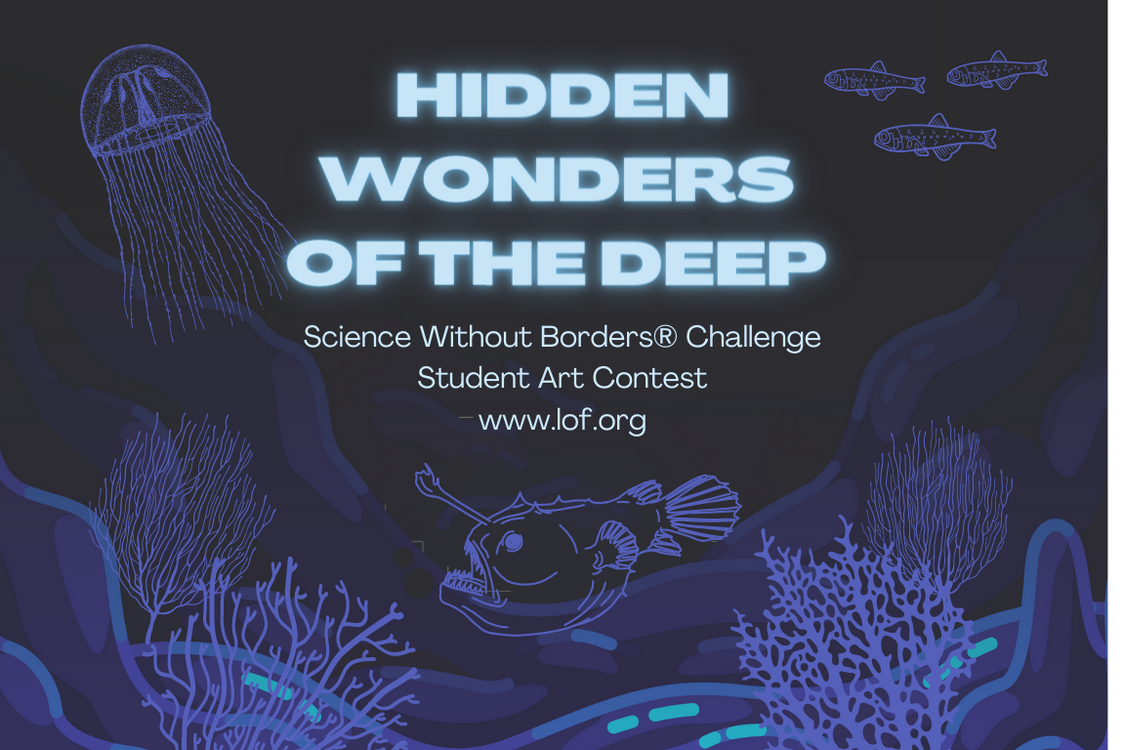
We are thrilled to introduce the 2024 Science Without Borders® Challenge theme: “Hidden Wonders of the Deep.” Our international art contest invites students worldwide to showcase their creativity by depicting the mysterious and unique creatures or ecosystems found in the deep sea. Through their artwork, students will have the opportunity to highlight the beauty and diversity that often goes unnoticed in these fascinating underwater worlds.
When we think of the ocean, we often imagine familiar marine life like dolphins, sea turtles, and colorful coral reefs, but did you know that there is a whole other world beneath the waves? It’s called the deep sea, and it’s a place where humans have yet to fully explore. Imagine living in a world where there is no light, where the pressure is so intense that only special submarines can go there, and there’s hardly any food to eat. Despite these extreme conditions, incredible ecosystems like hydrothermal vents, cold seeps, whale falls, and deep-sea coral reefs thrive. These ecosystems support remarkable creatures adapted to survive in these challenging environments.
Let’s meet some of these incredible creatures and learn about their amazing adaptations. Imagine coming face-to-face with a crab with legs that stretch 12 feet wide. That’s the Japanese spider crab, an arthropod with the largest leg span in the world. Some of the most giant creatures live in the deep sea. And have you ever heard of an anglerfish? It has a glowing rod-like appendage near its mouth that attracts prey. This glow comes from bioluminescent bacteria living on the end of the structure. The anglerfish is clever because it conserves energy by making its food come to it. Now, picture a fish that is mostly made of jelly-like tissue and doesn’t need to move its fins much. That’s the blobfish, a strange and mysterious creature that has adapted to the deep sea’s immense pressure. It uses its jelly-like body to float and conserve energy. These are examples of just a couple of deep-sea creatures that have some truly incredible features, but there are countless more awaiting exploration.
By participating in the Science Without Borders® Challenge, students can deepen their understanding of the deep sea’s hidden wonders while showcasing their artistic talents. We encourage you and your students to explore this hidden world by learning about the theme.
To enter the 2024 Science Without Borders® Challenge, follow the Contest Rules, review the Tips for Success, and upload your artwork to our online Submission Form. The Challenge is open to all students who are 11-19 years old and enrolled in primary or secondary school (or the home-school equivalent). The contest is free to enter and students can win up to $500 for artwork that best reflects this year’s theme. Entries must be received by Monday, March 4, 2024, to be eligible to win.
Help us get the word out about this competition by telling any young artists and teachers you know and encouraging them to apply. Sign up for our newsletter below and follow us on Facebook, Twitter, and Instagram for contest announcements.
Get ready to dive into the hidden wonders of the deep sea with the Science Without Borders® Challenge!