
search-icon
Scientists Create Giant Atlas of World’s Most Remote Reefs

Gizmodo Australia

April 24, 2019

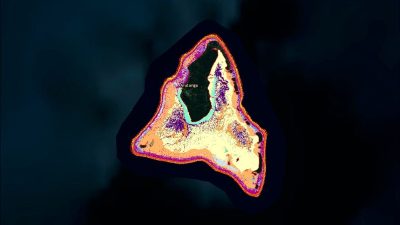
Aitutaki reef map
The island of Aitutaki in the Cook Islands.

Coral reefs line shores around the world, but they’re sometimes tough to spot because well, they’re underwater. Now, a group of researchers has found that satellite imagery is capable of mapping reefs on a global scale. They’ve used the technology, along with field studies, to create the world’s most thorough coral reef atlas to date—including some of the most remote reefs on Earth.

A study describing the atlas, published in the Coral Reefs journal last week, confirm that a mapping method typically reserved for individual reefs that stretch hundreds or thousands of square miles can map reefs on a much larger scale. Maps like this are key to reef conservation: Before we can figure out how to save reefs, we need to know where they are or how large they are. 

Using satellites and field observations, the authors mapped more than 25,000 square miles of corals. They’ve published these maps in an online database called the World Reef Map where viewers can pop into the reefs from Fiji to Seychelles. In some locations, the map offers some actual underwater footage of what the reefs look like.

Gathering all these pieces wasn’t easy. The team—whose researchers hail from the University of Miami Rosenstiel School of Marine and Atmospheric Science and Khaled bin Sultan Living Oceans Foundation, which funded exhibitions and provided the vessel to reach all the reefs—spent 10 years traveling across 11 countries to compile field information about more than a thousand coral reefs. The authors didn’t map popular locations like the Great Barrier Reef in Australia; they sought the most understudied reefs, said author Sam Purkis, the chair of the University of Miami’s Department of Marine Geosciences.

“We went to the most remote reefs, so mapping up the ones which we haven’t mapped should be much easier because they’re more accessible,” he told Earther. “We did the hard bit first.”
Related Posts

After the Storm: Standing with Our J.A.M.I.N. Family in Jamaica

There are moments in this work that feel heartbreakingly familiar.

Two weeks after we completed our Jamaica Awareness of Mangroves in Nature (J.A.M.I.N.) programming, Hurricane Melissa made landfall. A powerful Category 5 hurricane, Melissa is now tied with Hurricane Allen in 1980 for the strongest winds ever recorded in an Atlantic storm. Like Hurricane Dorian, which devastated The Bahamas in 2019, Melissa will be remembered as one of the strongest hurricanes on record in the region.

For 11 years, the University of the West Indies Discovery Bay Marine Laboratory and William Knibb Memorial High School have been more than program partners. They have welcomed us into their classrooms and labs, shared meals and laughter, and committed themselves to educating their students about mangroves and coastal resilience. These colleagues and students are not distant collaborators. They are family.

And they were hit hard…

Read More

B.A.M. Turns 10: A Year of Milestones, Resilience, and Growth

The 2025–2026 academic year was one of those defining years for our Bahamas Awareness of Mangroves (B.A.M.) and Jamaica Awareness of Mangroves in Nature (J.A.M.I.N.) programs. It was a year marked by celebration, challenge, growth, and powerful full-circle moments, and a reminder of why mangrove education matters.

In The Bahamas, B.A.M. reached a major milestone: ten years of partnership and environmental education in Abaco. Since 2015, in collaboration with Friends of the Environment, we have worked alongside Patrick J. Bethel High School and Forest Heights Academy to bring hands-on mangrove science into classrooms and into the field. This year, we were proud to expand the program to S.C. Bootle High School, increasing access for students who live…

Read More
Privacy Overview

This website uses cookies so that we can provide you with the best user experience possible. Cookie information is stored in your browser and performs functions such as recognising you when you return to our website and helping our team to understand which sections of the website you find most interesting and useful.  You can view our complete Privacy Policy here.

Strictly Necessary Cookies

Most of our cookies are used to improve website security and reduce spam. These cookies should be enabled at all times. They also enable us to save your preferences for cookie settings.

3rd Party Cookies

This website uses Google Analytics to collect anonymous information such as the number of visitors to the site, and the most popular pages. Keeping this cookie enabled helps us to improve our website.