
search-icon
Exploring Andros and Abaco By Air

In preparation for the next leg of the Global Reef Expedition, Dr. Sam Purkis, Jeremy Kerr, Captain Steve Breen and Dr. Andy Bruckner  flew over Andros and Abaco Islands, Bahamas  on the Golden Eye seaplane. Their goal was to identify specific research sites and to find anchorages for the Golden Shadow; what they saw was two islands with stark differences.
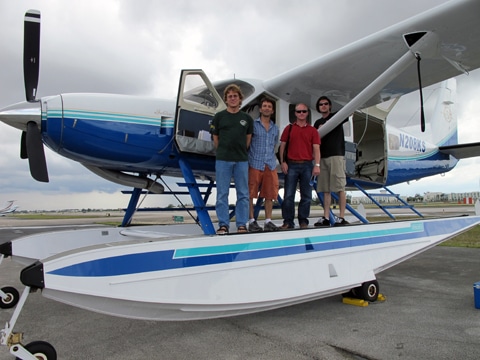
 

Left to right: Dr. Andy Bruckner, Dr. Sam Purkis, CAPT Steve Breen, and Jeremy Kerr

The flight took them from the western (leeward) end of Andros to the southern tip, crossing over sand flats and seagrass beds, many of which were circular and contained a central halo much like that seen in Cay Sal Bank.
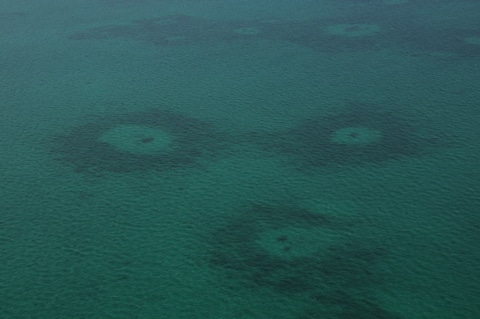
Seagrass halos off Andros Island


Extensive shallow estuarine lakes were carved into the low-lying karst topography on the western Andros Island, the largest island in the Bahamian archipelago.  There were also many deep blue-colored, round sinkholes and in-filled depressions with dense vegetation.
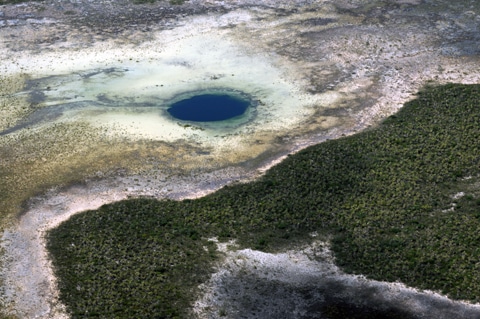
Blue hole on Andros Island


The reef formed a narrow fringe dropping quickly into the Tongue of the Ocean, which reaches depths of 6000 feet or more.  A dense elkhorn coral framework with occasional live corals was visible close to the reef crest. Immediately seaward of this, reef habitats were packed full of small pillar-like star coral bommies.  Moving sand waves and stabilized underwater dunes covered an extensive area at the northern end of Andros on the landward side of the reef.
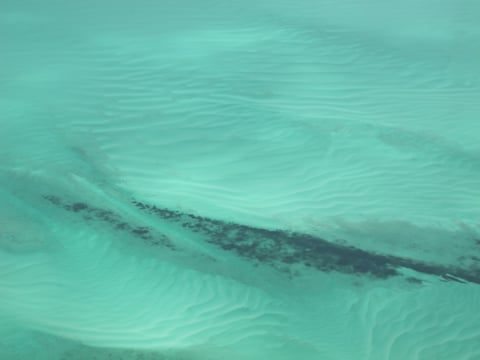
Underwater ooid sand dunes
Underwater sand dunes


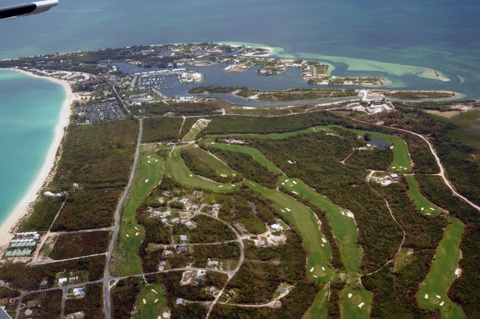
Abaco, the second largest island in the Bahamas was stark contrast to Andros, with a higher density of buildings, golf courses, and other signs of human development.
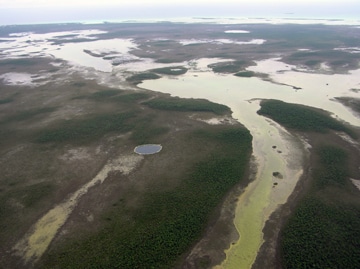
Low development on Andros Island
Developments on Abaco Island


A well-developed barrier reef fringes the eastern end of Abaco island. It is separated from Abaco by a narrow waterway and lies seaward of a line of small islands.
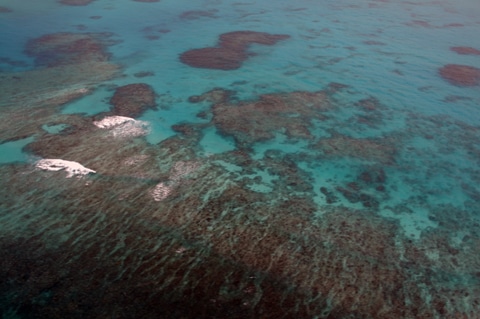
Abaco barrier reef
Abaco barrier reef


The team took extensive aerial photographs and are now ready for the next leg of the Global Reef Expedition.

(Photo/Images by: 1, 4 Dr. Sam Purkis, 2, 3, 6-7 Dr. Andy Bruckner, 5 Jeremy Kerr)

To follow along and see more photos, please visit us on Facebook! You can also follow the expedition on our Global Reef Expedition page, where there is more information about our research and our team members.
Related Posts

2025-2026 B.A.M. Student Voices

Throughout the Bahamas Awareness of Mangroves (B.A.M.) and Jamaica Awareness of Mangroves in Nature (J.A.M.I.N.) programs, we evaluate each phase of the mangrove education and restoration process to better understand how students are learning, growing, and connecting with their coastal environments.

Before the programs begin, students share what they already know about mangroves and how they feel about them. As the program progresses, we continue to gather feedback to see how their knowledge evolves from identifying mangrove species and understanding food webs to recognizing the role mangroves play in coastal protection and climate change mitigation.

But the surveys go beyond science content.

We also ask students…

Read More

Ten Years of B.A.M.: Rooted in Partnership, Growing in Purpose

Ten years ago, the Bahamas Awareness of Mangroves (B.A.M.) program began with a simple but meaningful commitment: to connect Bahamian students with the mangrove ecosystems that shape and protect their island home.

Since 2015, B.A.M. has been implemented in partnership with Friends of the Environment, whose dedication to environmental stewardship in Abaco has made this program possible year after year. Together, we have worked alongside Patrick J. Bethel High School and Forest Heights Academy to bring hands-on mangrove science into classrooms and out into the field.

What makes ten years remarkable is not just longevity — it is consistency…

Read More